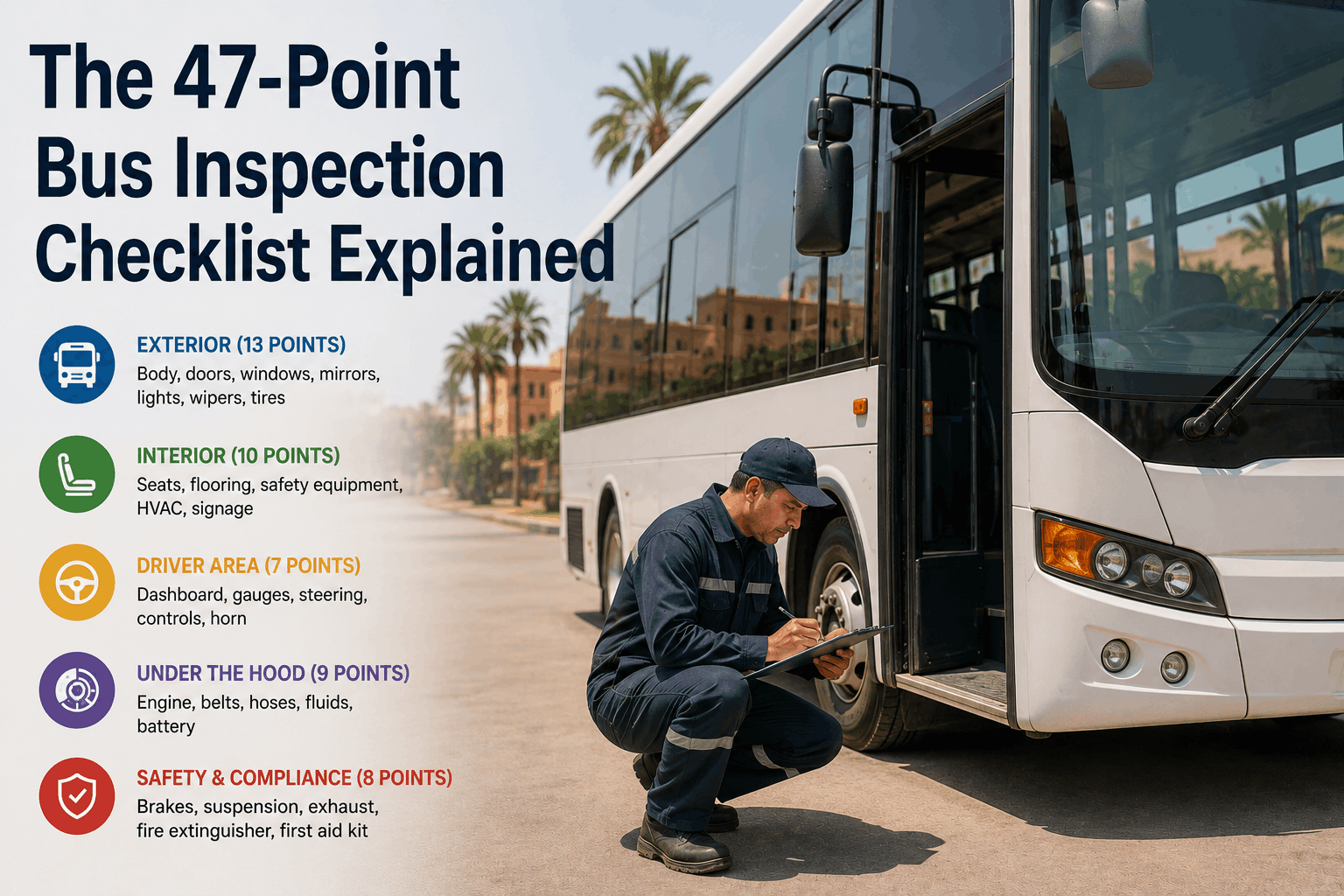
A 45-bus fleet's inspection program caught 340 defects in a year. Most fleets would celebrate. This fleet's maintenance director was concerned. The question: were inspectors finding real defects, or were they being too aggressive? After analysis, the answer was clear: inspectors were inconsistent. One inspector flagged a brake pad at 30% wear. Another passed the same wear on an identical bus. One marked "windshield creeping" as critical. Another ignored it. The inspection checklist existed but wasn't standardized. Inspectors didn't know what "worn" meant. What's the difference between a defect and normal wear? When does a problem become critical enough to pull the bus from service? Without clear definitions, you get random findings, inconsistent enforcement, and maintenance teams questioning inspector credibility. The 47-point bus inspection standard gives you the framework: what to inspect, what to look for, when it's defective, and when it's critical. Most fleets know the 47 points exist. Few can explain what each one means or what failure looks like. This guide walks through all 47 points with real-world definitions of defect and critical failure.
Know every point. Know what defects look like. Know when a bus stays in service vs comes out of service.
Brake failures are catastrophic. A bus with brake defects cannot operate. The 7 brake points cover service brakes (primary stopping), parking brake (holding bus stationary), and brake balance. Service brakes require at least 50% pad thickness remaining and zero air leaks. A brake pad at 49% thickness is a defect. At 25% thickness, it's critical and the bus comes out of service immediately. Air brake systems must maintain pressure (120–135 PSI typical). If pressure drops more than 10 PSI in 2 minutes, there's a leak — defect. If pressure drops 20+ PSI, critical. Parking brakes must hold the bus on a 10% grade without slipping. If the parking brake can be released by pulling too lightly on the handle or if the bus creeps when parked, it's defective. Brake imbalance (one side pulls harder than the other) is less obvious. Measure stopping distance from 30 mph — should be straight within 2 feet. Deviation indicates imbalance — defect. The 7 brake points are straightforward but require knowledge of what-proper" looks like. Fleets that don't teach inspectors these definitions end up with inconsistent findings.
Exterior items are visible but often misunderstood. What counts as a "cracked windshield" defect? A 1-inch crack in the corner? A 6-inch crack in the driver's line of sight? The 47-point standard defines it: cracks larger than 1 inch in the driver's clear vision area are defects. Cracks outside that area are allowed. A windshield with a small crack off to the side passes. A windshield with a 3-inch crack in the center of the driver's view is defective and the bus cannot operate until replaced. Door condition: doors must open and close smoothly with secure latches. A door that sticks or has a loose hinge is a defect. A door that won't latch is critical — passenger safety hazard. Exterior lights must all function: headlights, tail lights, brake lights, turn signals, emergency flashers. Burned-out bulbs are defects. A headlight that's dimmed but still lights is a defect (voltage drop issue). Side mirrors must be present, intact, and positioned correctly. Missing or cracked mirrors are defects. Tires must have minimum 2/32" tread (legal minimum). Visual check: penny test (insert penny into tread — if you see Lincoln's head, tread is too shallow). Bulges or sidewall cuts are critical defects — tire failure imminent.
Interior points cover passenger safety: seats must be secure and undamaged. A loose seat is a defect (hazard to seated passengers). A torn seat cover is cosmetic unless the foam is exposed (then it's a defect due to hygiene). Handrails and grab handles must be present and firmly attached. A loose grab handle is a safety hazard — defect. Flooring must be intact with no trip hazards. A loose floor panel is a defect. Destination signs must be functional and readable. Non-functional sign is a defect (passenger confusion). Heater and air conditioning don't have to work perfectly, but the bus cannot be unbearably hot or cold. A non-functional AC on a 95°F day in a city with high ridership may be critical (passenger health and retention). Emergency exits must be functional and marked. Any emergency exit that doesn't open is critical — fire/evacuation hazard. Fire extinguisher must be present and functional. Missing or expired extinguisher is a defect. The 10 interior points are often overlooked because they don't affect the vehicle's mechanical operation, but they directly affect passenger safety and comfort. A bus with interior defects gets complaints and revenue loss, not just safety risk.
Engine mechanical points are the most technical. Oil level: check with dipstick, should be between min and max marks. Low oil is a defect. Oil color: should be amber/clear. Dark or black oil is a defect (time for oil change overdue). Coolant level: should reach the "cold fill" line when engine is cool. Low coolant is a defect. Coolant appearance: should be colored (usually green or orange depending on type). Cloudy or milky coolant is a defect (water contamination, head gasket issue). Transmission fluid (diesel buses): should be clear to light pink. Dark or burned-smelling fluid is a defect (transmission degradation). Hose condition: all hoses should be inspected for cracks, bulges, or leaks. Soft or cracked hose is a defect (failure risk). Battery must be secure and in good condition. Corroded battery terminals are a defect (starting problems). Exhaust system must have no visible leaks or damage. Rust holes in muffler are defects if they result in excessive noise or emissions. Air filter should be clean. Visually dirty filter is a defect (intake restriction). These 11 points require basic mechanical knowledge. Inspectors must be trained to understand what they're looking at and why it matters.
Steering must be responsive and smooth. Excessive play in the steering wheel (more than 2 inches of movement before wheels respond) is a defect. Hard steering (requiring excessive force to turn) is a defect. Suspension must provide a smooth ride without clunks or creaks. A rattling or banging suspension indicates loose components — defect. Shock absorbers should dampen bounce. A bus that bounces after hitting a bump (more than 2 bounces) indicates worn shocks — defect. Leaf springs or air springs must be intact and not sagging. A bus that sits noticeably lower on one side indicates spring failure — critical defect. Steering hose condition: hydraulic hoses should show no leaks or cracks. Weeping hoses are defects. Tie rod ends must be tight with no play. Grab the wheel at 3 and 9 o'clock and try to wiggle — should not move. Movement indicates loose tie rods — defect. Wheel alignment affects steering feel. A bus that pulls to one side or requires constant correction is misaligned — defect. The 7 steering/suspension points require test drive evaluation. Visual inspection alone won't catch 50% of issues.
The 47-point bus inspection standard is comprehensive, but only if you define what each point means. A "defect" is not subjective — it must have clear criteria. Brake pad wear is 50% thickness threshold. Windshield cracks are 1" in driver's view area. Door latches must securely hold without extra force. These definitions eliminate inspector variation. Some fleets avoid the 47-point standard because they believe it creates too many findings. In reality, lack of standards creates inconsistency, not fewer findings. Inspectors either miss defects (safety risk) or find them sporadically (credibility loss). A standardized, well-trained inspection program finds consistent defects, fleets know what to fix, and safety improves. The 47-point standard is not a burden — it's a framework for excellence.
The 47-point bus inspection is comprehensive. It covers brakes (7 points), exterior safety (12 points), interior passenger safety (10 points), engine/mechanical (11 points), and steering/suspension (7 points). Each point must have clear pass/defect/critical criteria. Brake pads must be >50% thickness. Windshield cracks >1" in driver view are defects. Emergency exits must open smoothly. Oil must be the correct level and color. Most fleets know the 47-point standard exists, but few standardize the definitions. This creates inconsistent inspections and missed defects. When you standardize the criteria and train inspectors properly, defect counts may increase initially — but those are real problems that would have caused accidents or service failures. A properly implemented 47-point inspection catches 95% of critical defects before they cause safety issues or major repairs. That's the return on investment.