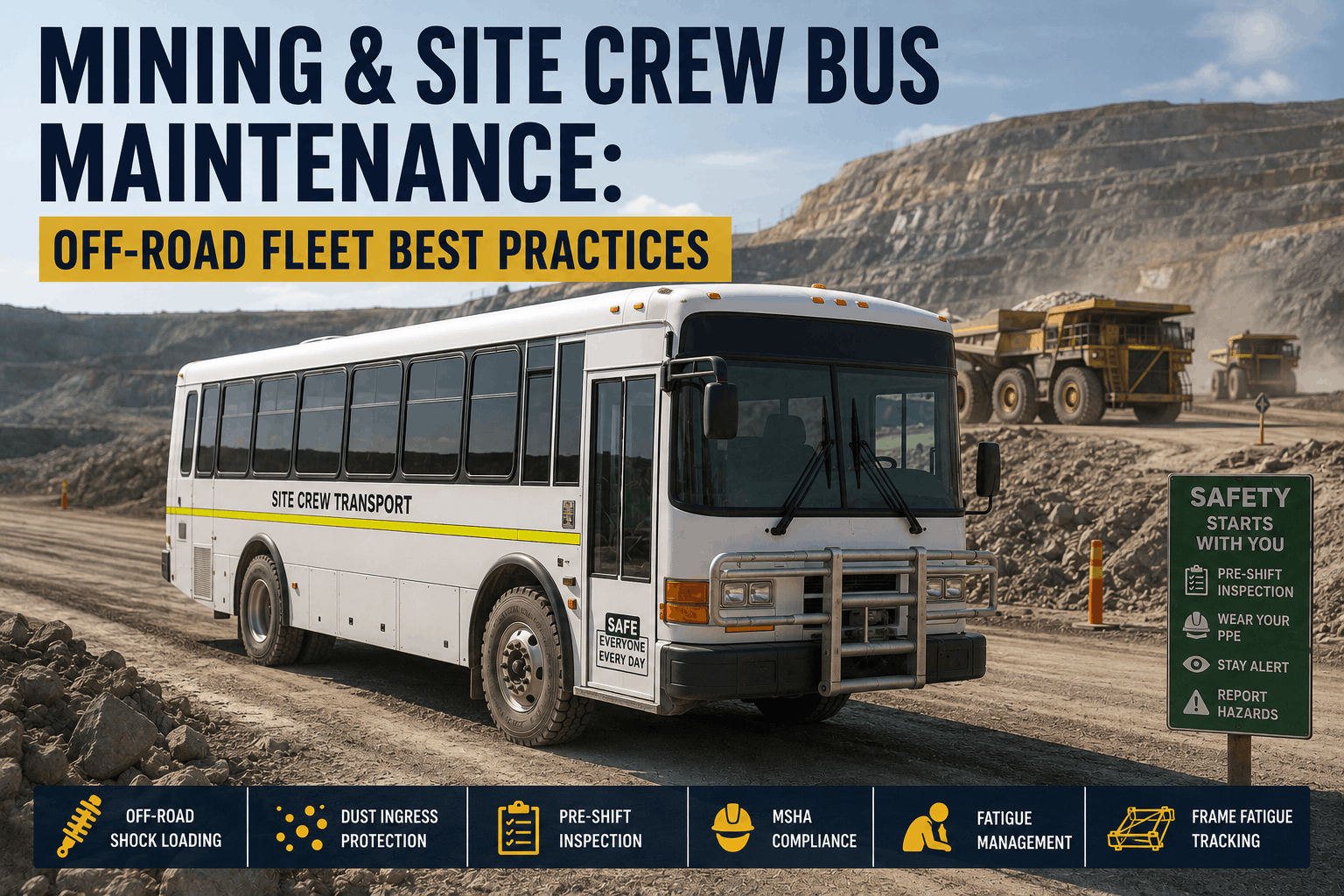
A crew bus running off-road routes into a mine site or frac field takes damage a highway shuttle never sees, from shock loading on unimproved roads to dust ingress that clogs filters in a single shift. When a frame crack or a fatigue-related incident happens on a crew change run, the cost is measured in more than downtime. Start Trial to see how BusCMMS gives mining and energy fleet teams the pre-shift inspection records, frame fatigue tracking, and MSHA documentation an off-road crew bus program requires.
Track What Off-Road Duty Actually Does to Your Fleet
BusCMMS connects pre-shift inspections, frame fatigue records, and filter replacement history into one dashboard so mine and site fleet managers can catch structural wear before it becomes a safety incident.
Why Off-Road Crew Bus Maintenance Needs Its Own Playbook
A crew bus running unimproved site roads absorbs shock loading and dust ingress that a highway PM schedule was never designed around, which means a standard interval-based program will miss the wear that actually causes failures. Fleet teams that Book Demo with BusCMMS see how pre-shift inspection data, frame condition records, and filter replacement history combine into a wear-based maintenance picture instead of a generic calendar. Tracking these records consistently is what keeps a crew transport program ahead of MSHA findings and structural failures instead of reacting to them.
Pre-Shift Inspection Digitization
Driver pre-shift checklists are logged digitally per vehicle and shift, replacing paper forms with a searchable inspection record.
Frame Fatigue and Stress Tracking
Frame and chassis inspection findings are logged per vehicle over time, tracking stress indicators before they progress to a crack.
Dust Ingress Filter Monitoring
Air filter condition and replacement intervals are tracked against actual site dust exposure rather than a fixed highway schedule.
MSHA Compliance Recordkeeping
Inspection and citation history is logged per vehicle, building the documented record MSHA reviewers request during a site audit.
Crew Fatigue Schedule Logging
Driver hours and crew change schedules are tracked alongside vehicle dispatch, supporting fatigue management policy compliance.
Off-Road Suspension Wear Tracking
Suspension and undercarriage component wear is logged per vehicle, extending PM intervals based on actual road condition exposure.
Key Metrics for Mining and Site Crew Bus Fleets
01
Pre-Shift Inspection Completion Rate
Primary Safety Metric
Pre-shift inspection completion is the front line of defense against a mechanical failure on an unimproved site road, and it is the record MSHA and site safety teams check first after any incident. BusCMMS logs pre-shift checklist completion per vehicle and shift, giving fleet managers a live compliance number instead of a stack of paper forms.
Baseline 76%
Current 98%
02
Frame Fatigue Crack Detection Rate
Structural Integrity Signal
Crack detection rate tracks how many frame stress findings are caught during scheduled inspection versus discovered after a failure, a figure that directly reflects inspection program effectiveness. BusCMMS logs frame condition findings per vehicle over time, tracking whether stress indicators are being caught earlier in the wear cycle.
Baseline 51%
Current 87%
03
Filter and Dust Ingress Compliance
Component Protection Signal
Filter replacement compliance tracks whether air filter service is keeping pace with actual site dust exposure rather than a fixed calendar interval, since ingress-related engine wear is one of the most common off-road failure modes. BusCMMS tracks replacement history per vehicle, flagging when exposure is outpacing the service schedule.
Baseline 62%
Current 91%
04
MSHA Citation-Free Rate
Regulatory Compliance
Citation-free rate tracks the share of MSHA inspections that closed without a finding against the crew transport fleet, a number site operators track closely since repeated citations affect the broader site safety record. BusCMMS keeps inspection and citation history per vehicle, making the documentation trail available before the next MSHA visit.
Baseline 73%
Current 95%
05
Suspension and Chassis MTBF
Durability Indicator
Suspension and chassis mean time between failures tracks how long undercarriage components last under actual off-road shock loading, giving fleet planners a realistic replacement forecast rather than relying on the highway-rated manufacturer interval. BusCMMS calculates this from work order history per vehicle, updating as real wear data accumulates.
Baseline 48%
Current 80%
06
PM Compliance Rate
Execution Consistency
Sustained PM compliance keeps a site crew bus from a mid-shift breakdown on a route where a stranded crew can mean lost production time, not just a maintenance inconvenience. BusCMMS tracks scheduled versus completed PM by vehicle, keeping compliance visible in the same dashboard used for MSHA and safety reporting.
Baseline 64%
Current 92%
Mining and Site Crew Bus Metrics: Quick Reference
Scroll for more
| Reliability Metric | Measurement Period | Target Signal | BusCMMS Data Source | Review Frequency |
|---|---|---|---|---|
| Pre-Shift Inspection Rate | Daily | Above 98% | Digital pre-shift checklist log | Weekly review |
| Frame Crack Detection Rate | Quarterly | Increasing QoQ | Frame inspection findings by vehicle | Monthly |
| Filter Replacement Compliance | Monthly | Above 90% | Filter service history by vehicle | Monthly |
| MSHA Citation-Free Rate | Rolling 12 months | Above 95% | Inspection and citation log | Quarterly |
| PM Compliance Rate | Quarterly | Sustained above 90% | PM schedule vs completion | Monthly |
How BusCMMS Supports Off-Road Crew Bus Maintenance
An off-road crew bus fleet wears differently than a highway fleet, and BusCMMS connects pre-shift inspections, frame condition findings, filter history, and MSHA records into one timeline per vehicle so fleet managers can catch structural wear before it becomes an incident. When pre-shift completion is holding above 98 percent, frame findings are being caught earlier in the wear cycle, and MSHA citation-free rate is above 95 percent, that is the evidence base that keeps a crew transport program running safely. Sites can Start Trial and begin building this record from the first pre-shift inspection logged in BusCMMS.
Digital Pre-Shift Checklists
BusCMMS logs pre-shift inspection completion per vehicle and shift, replacing paper forms with a searchable digital record.
Frame Condition Tracking
Chassis and frame findings are logged over time per vehicle, tracking stress indicators before they progress to a structural failure.
Filter Service History
Filter replacement is tracked against actual dust exposure, flagging vehicles where service is falling behind site conditions.
MSHA-Ready Reporting
Inspection and citation history exports per vehicle, keeping the fleet audit-ready ahead of the next MSHA site visit.
Building an Off-Road Crew Bus Maintenance Program: Implementation Steps
01
Audit Current Fleet Condition and Records
Pull existing PM history, frame inspection notes, and MSHA citation records into BusCMMS to establish a wear baseline per vehicle.
02
Digitize Pre-Shift Inspection Checklists
Move paper pre-shift forms into BusCMMS so completion is logged automatically and searchable by vehicle, driver, and shift.
03
Set Frame and Chassis Inspection Intervals
Define a recurring frame condition inspection schedule based on route severity rather than a fixed highway-rated interval.
04
Track Filter Replacement Against Exposure
Log filter service per vehicle in BusCMMS and compare against actual site dust conditions to catch ingress-related wear early.
05
Build MSHA-Ready Documentation
Configure inspection and citation logging in BusCMMS so the full compliance record is exportable ahead of any MSHA site visit.
06
Review Wear Trends Monthly per Vehicle
Schedule monthly reviews of frame findings, filter compliance, and PM completion to catch wear trends before they become failures.
Frequently Asked Questions
What makes off-road crew bus maintenance different from standard fleet maintenance?
Off-road routes create shock loading, dust ingress, and frame stress that a standard highway PM schedule is not built to catch, requiring wear-based tracking instead of fixed calendar intervals.
How does BusCMMS support MSHA compliance for crew bus fleets?
BusCMMS logs inspection findings and citation history per vehicle, building the documented compliance record MSHA reviewers request during site audits.
Why is pre-shift inspection tracked as a core maintenance metric?
Pre-shift inspection is the first line of defense against a breakdown on an unimproved site road, and completion history is often the first record reviewed after any incident.
How often should frame and chassis inspections happen on an off-road crew bus?
Frequency should be based on route severity and dispatch volume rather than a fixed interval, which is why tracking findings per vehicle over time matters more than a generic schedule.
Can BusCMMS support multiple mine or field sites under one fleet operator?
Yes. BusCMMS reporting compares wear metrics and MSHA compliance across sites, letting a multi-site operator benchmark crew bus condition by location.
Catch Structural Wear Before It Becomes an Incident
BusCMMS gives mining and energy fleet teams the pre-shift records, frame condition history, and MSHA documentation to run a crew bus program that stays ahead of off-road wear.


