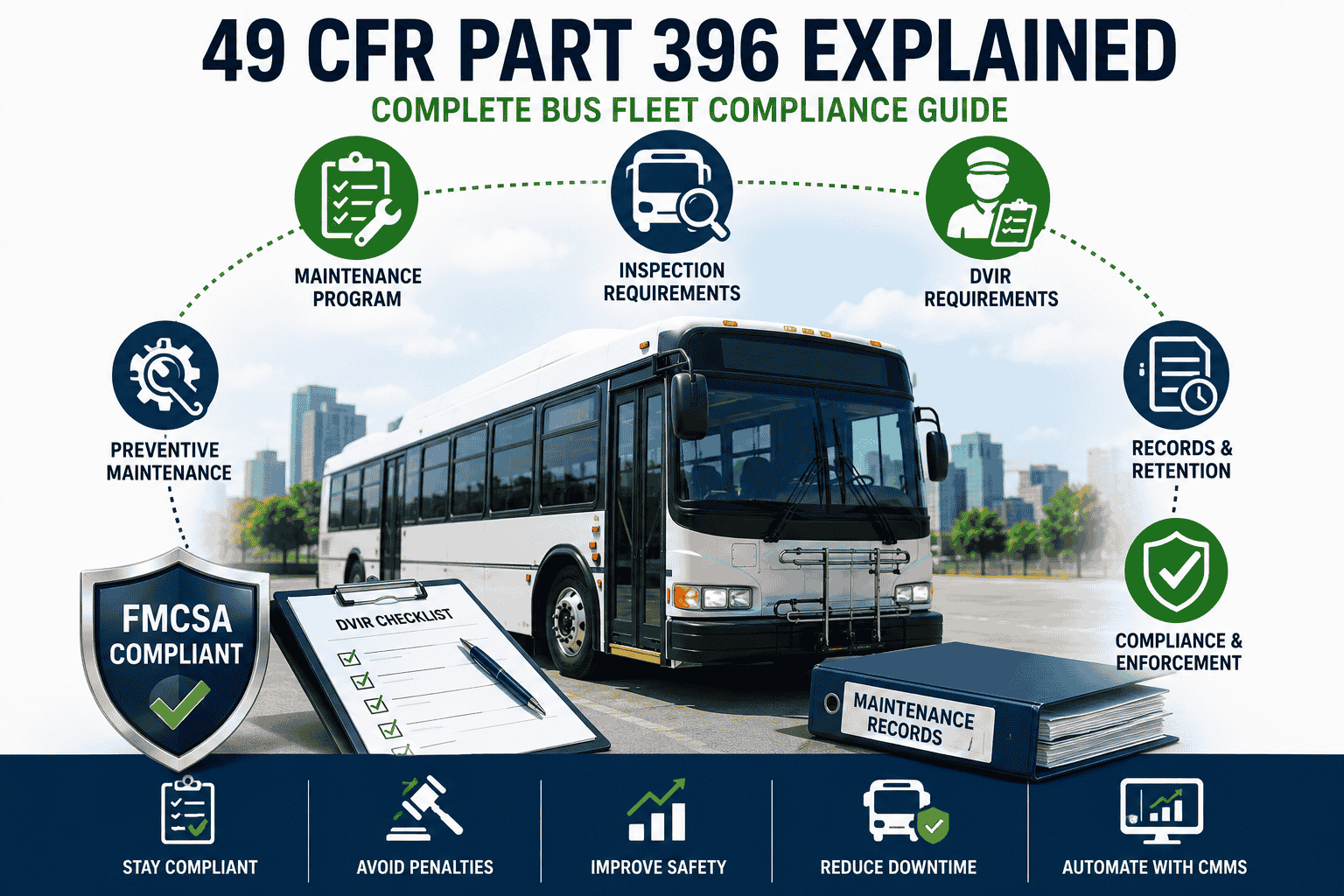
49 CFR Part 396 Explained: Complete Bus Fleet Compliance Guide (2026)
An FMCSA auditor just pulled three random buses from your fleet and asked for their DVIRs from last Thursday, the most recent 90-day emergency exit inspection, and proof your annual DOT inspection was completed within the last 12 months. You have 48 hours to produce everything. If those records live in a filing cabinet across three binders and a spreadsheet — and one of them is missing — you're looking at $1,584 per day per missing record, an out-of-service order, and CSA damage that follows your fleet for 24 months. 93% of carriers fail DOT audits with at least one violation. The regulations that cause those failures all live in one place: 49 CFR Part 396. This is the complete guide to every section that applies to your bus fleet — what it requires, what happens when you miss it, and how to automate compliance so audits become exports, not emergencies.
2026 Compliance Reference
93%
of Carriers Fail DOT Audits
Most violations are recordkeeping and scheduling failures under Part 396 — not mechanical defects
$23,048
Max penalty per OOS violation
48 hrs
To produce records when FMCSA asks
24 mo
CSA violations stay on your record
What Is 49 CFR Part 396?
Part 396 is the federal regulation governing the inspection, repair, and maintenance of all commercial motor vehicles — including every school bus, transit bus, shuttle, and coach operating under DOT authority. It covers four core areas: your written maintenance program, daily driver vehicle inspection reports (DVIRs), periodic annual inspections, and record retention. For bus fleets specifically, Part 396 adds a unique requirement that doesn't apply to trucking: emergency exit inspections every 90 days. Here's every section that matters to your fleet, in plain English.
The 8 Sections of Part 396 That Matter to Bus Fleets
Part 396 contains multiple sections, but these 8 drive 95% of bus fleet compliance. Miss any one and you're exposed:
§396.3
Inspection, Repair, and Maintenance — Written Program
Every motor carrier must have a systematic inspection, repair, and maintenance program. For buses specifically, this section requires emergency exits, push-out windows, and emergency door marking lights to be inspected every 90 days. You must also maintain records including: vehicle identification, inspection/maintenance schedule, repair history, and 90-day exit test records.
BusCMMS auto-schedules 90-day exit inspections with 30/60/90-day advance alerts
§396.5
Lubrication
Every motor carrier must ensure each CMV is properly lubricated and free of oil/grease leaks. Specifically, all vehicles with chassis lubrication fittings must follow manufacturer specifications for lubrication points and intervals.
PM schedules in BusCMMS include lubrication checkpoints at every interval
§396.7
Unsafe Operations Forbidden
No motor carrier shall require or permit a person to operate a vehicle that is likely to cause an accident or breakdown due to its mechanical condition or loading. This is the catch-all that makes every maintenance failure a potential violation — not just the specific items listed in Appendix A.
Penalty: $15,420 per occurrence for dispatching a vehicle with known defects
§396.11
Driver Vehicle Inspection Reports (DVIRs)
Drivers must complete a DVIR at the end of each day's operation covering 11 safety components: service brakes, parking brake, steering, lights/reflectors, tires, horn, wipers, mirrors, coupling devices, wheels/rims, and emergency equipment. Bus-specific rule: passenger-carrying vehicles must file DVIRs even when no defects are found. As of March 23, 2026, electronic DVIRs are explicitly authorized (FMCSA-2025-0115). Retention: 3 months minimum.
BusCMMS provides mobile eDVIRs with all 11 FMCSA components + bus-specific items pre-loaded
§396.13
Driver Inspection — Review Before Operating
Before operating a vehicle, the driver must be satisfied it's in safe condition. If the previous DVIR listed defects, the current driver must review and sign acknowledging repairs were made. This creates the 3-signature chain: Driver A (reports defect) → Mechanic (certifies repair) → Driver B (acknowledges repair). The most commonly missed signature is Driver B's acknowledgment.
BusCMMS enforces the 3-signature chain digitally — bus can't dispatch without all three
§396.17
Periodic (Annual) Inspection
Every commercial vehicle must undergo comprehensive inspection at least once every 12 months, covering all items in Appendix A. The inspection report must be retained for 14 months. A sticker, report, or decal documenting the most recent inspection must be kept on the vehicle at all times. Schedule 60 days before expiration to avoid gaps.
BusCMMS auto-schedules annual inspections 60 days before expiration per bus
§396.19
Inspector Qualifications
Annual inspections must be performed by qualified inspectors who understand Appendix A standards, can identify defects, and have knowledge of inspection methods and tools. Qualification can come from a federal/state training program, qualifying certificate, or a combination of training/experience totaling at least one year. Qualification documentation must be retained through employment plus one year after.
BusCMMS tracks inspector certifications with expiration alerts
§396.21
Periodic Inspection Recordkeeping
The original or copy of every periodic inspection report must be retained for 14 months. The report must identify the inspector, carrier, vehicle, date, components inspected, and results. This is the document FMCSA will request first during an audit — and the one most commonly missing or expired.
BusCMMS stores all inspection records indefinitely — one-click audit export
Every one of these sections generates documentation. On paper, that's hundreds of forms per bus per year. With BusCMMS, every DVIR, every 90-day exit inspection, every annual report, and every repair certification is digital, timestamped, per-bus, and exportable in 30 seconds. Book a demo to see Part 396 compliance on one dashboard.
Record Retention Requirements at a Glance
When FMCSA issues a records request, you have 48 business hours. Here's how long each document must be retained:
DVIRs (Daily Reports)
Minimum
3 months
§396.11 — Best practice: 12+ months for CSA defense
Roadside Inspection Reports
Minimum
12 months
§396.9 — Corrections must be certified within 15 days
Annual Inspection Reports
Minimum
14 months
§396.21 — Plus sticker/decal must be on vehicle at all times
Maintenance Records
Minimum
Vehicle life + 6 mo
§396.3 — Keep for as long as you control the vehicle, then 6 months after
2026 isn't just another compliance year — it's a regulatory reset. Three major changes directly impact how Part 396 applies to your bus fleet:
eDVIR Explicitly Authorized
Before: eDVIRs allowed under 390.32 but language was ambiguous
Now: FMCSA-2025-0115 (effective March 23, 2026) adds explicit eDVIR language to §396.11 and §396.13
Paper DVIRs remain legal, but digital creates better audit trails and litigation defense
CSA Scoring Overhaul
Before: Vehicle Maintenance was a single BASIC category
Now: Split into two categories. New "Driver Observed" scoring means DVIR quality directly impacts safety rating
Violations now count for 12 months instead of 24 under new methodology
Clearinghouse Enforcement
Before: Annual queries mandatory but enforcement was inconsistent
Now: FMCSA actively revoking CDLs for unresolved "prohibited" status. Positive results must be reported within 24 hours
Over 3,400 violations issued in 2025 for missing Clearinghouse queries alone
Expert Review: Making Part 396 Automatic
Part 396 isn't complicated — it's relentless. Daily DVIRs. 90-day exit inspections. Annual comprehensives. Record retention for years. Inspector certifications. Each section is simple individually. Managing them all simultaneously across 50+ buses on paper is where carriers fail. The 7% who pass audits clean haven't memorized the regulations — they've built systems that make compliance the default. BusCMMS is that system for bus fleets. Digital DVIRs with the 3-signature chain. Auto-scheduled 90-day exits and annual inspections. Inspector certification tracking. Indefinite record storage. One-click audit exports. Every section of Part 396, automated, for every bus, every day.
What Districts Using BusCMMS Report
"We got audited in February. The inspector asked for 90-day emergency exit records on 3 random buses. With BusCMMS, I pulled up all 3 in under 2 minutes. Timestamped, photo-verified, signed. Zero violations. Zero fines. Zero follow-up." — Transportation Director, 62-bus school district, Ohio
Every day without automated compliance is another day you're exposed to $1,270–$23,048 in penalties for documentation failures that a CMMS eliminates automatically. Stop managing compliance by memory — book a demo today.
Join the 7% That Pass Audits Clean.
Every section of 49 CFR Part 396, automated. Digital DVIRs. 90-day exits. Annual inspections. Record retention. Inspector certifications. One dashboard. Every bus. Free 14-day trial.
49 CFR Part 396 is the federal regulation governing the inspection, repair, and maintenance of commercial motor vehicles, including buses. It covers your written maintenance program (§396.3), daily driver vehicle inspection reports (§396.11), pre-operation driver review (§396.13), annual periodic inspections (§396.17), inspector qualifications (§396.19), and record retention (§396.21). Bus fleets have additional 90-day emergency exit inspection requirements under §396.3.
Does Part 396 apply to school buses?
Yes — with conditions. Home-to-school transportation is exempt from FMCSRs under §390.3T(f). However, Part 396 applies fully when school buses are used for interstate field trips, sporting events, or extracurricular activities. Contracted school bus services operating interstate are always subject. Most states adopt Part 396 standards for all school bus operations regardless of federal applicability. Best practice: comply with Part 396 for all operations.
How long must bus maintenance records be kept under Part 396?
DVIRs: 3 months minimum (§396.11). Roadside inspection reports: 12 months (§396.9). Annual inspection reports: 14 months (§396.21). Maintenance records: while vehicle is controlled + 6 months (§396.3). Inspector qualifications: through employment + 1 year (§396.19). FMCSA can request any record with 48-hour turnaround during audits.
Are electronic DVIRs legal under Part 396?
Yes — explicitly since March 23, 2026. FMCSA final rule FMCSA-2025-0115 added clear eDVIR language to §396.11 and §396.13. Electronic DVIRs were already permitted under §390.32 since 2018, but the 2026 rule removes all legal ambiguity. Digital signatures, cloud storage, and mobile submission are fully compliant. FMCSA actively encourages digital adoption.
What are the penalties for Part 396 violations?
Missing DVIR: $1,270/day. Missing records: $1,584/day (up to $15,846 max). Falsified report: $12,700. Dispatching with unrepaired defect: $15,420. Missing annual inspection: up to $23,048. Operating under OOS order: $23,048. All violations impact CSA scores for 24 months. A 50-bus fleet with systematic DVIR failures could face $63,500+ from a single audit.