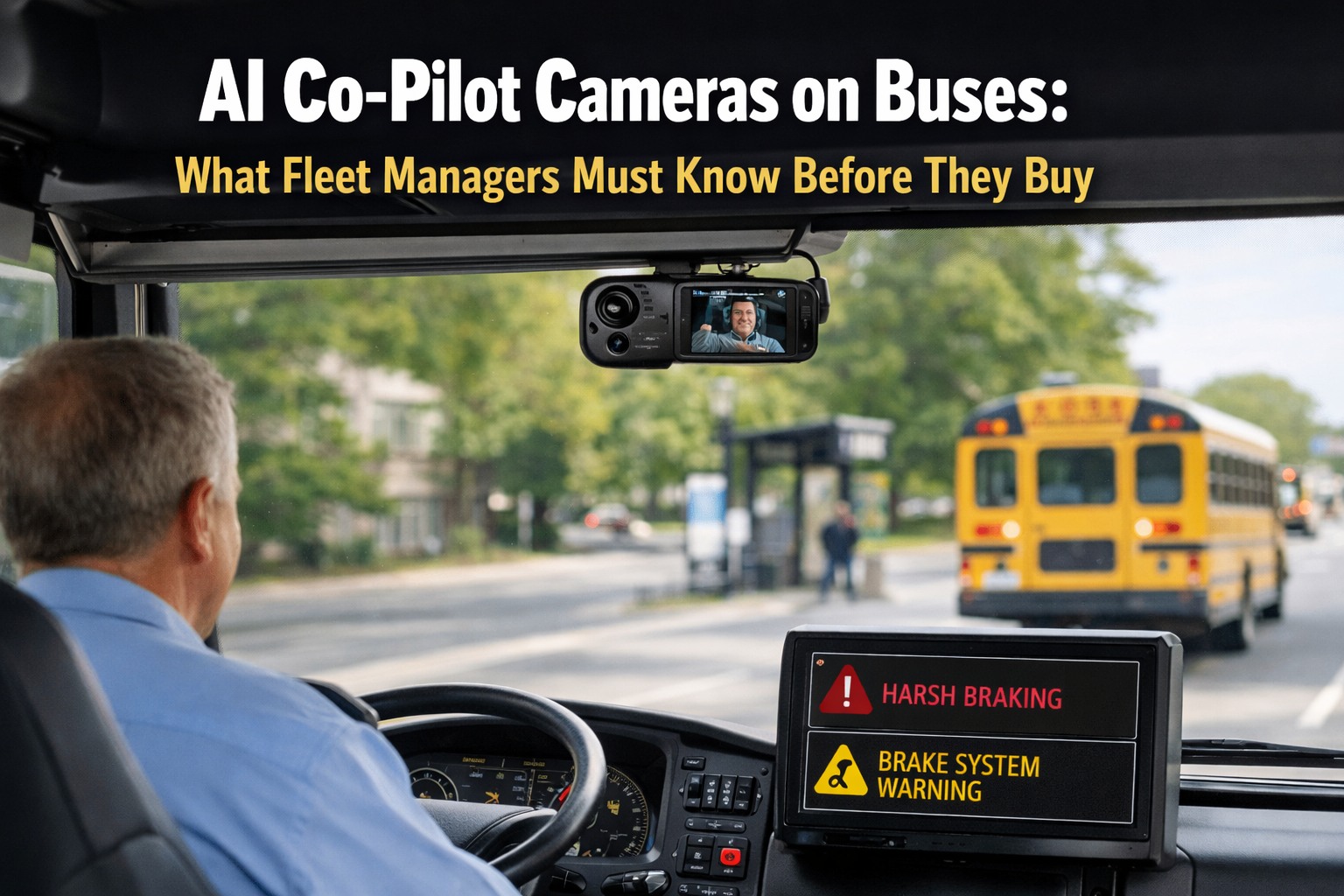
Your driver just got flagged for harsh braking—again. Fourteen times this week. The safety manager schedules coaching. But here's what nobody asked: is the driver the problem, or is the bus's brake system failing? AI cameras see one thing. Maintenance records show another. And the two systems never talk. This is the $40,000 mistake most bus operators make when buying AI cameras—and this guide shows you how to avoid it.
What AI Co-Pilot Cameras Actually Do
Modern AI dashcams go far beyond passive recording. They run 30+ neural network models simultaneously, detecting risks before accidents happen—not just documenting them after.
Within 6 months of deployment, fleets see 49% fewer harsh driving events and up to 96% reduction in mobile phone use. But here's the catch: cameras only show behavior. They don't show why that behavior is happening. Sign up for BusCMMS to connect safety events to vehicle health data.
The Hidden Problem: Safety Data Without Maintenance Context
When a driver gets flagged for harsh braking 14 times in a week, most fleets schedule coaching. But what if the real problem is:
This is why the smartest bus operators don't just buy AI cameras—they connect camera safety data directly to maintenance systems. Book a demo to see how BusCMMS auto-generates inspection work orders from safety events.
AI Camera Vendor Comparison: What Bus Fleets Need to Know
Not all AI cameras are created equal. Detection rates, false positive handling, and integration capabilities vary dramatically. Here's what the data shows.
Key finding: Dual-facing cameras achieve crash reductions more than 2x greater than front-facing only. If you're evaluating cameras, dual-facing should be your baseline—not an upgrade. Sign up for BusCMMS to integrate with any AI camera vendor.
Expert Review: The Real ROI Numbers
Forget vendor marketing. Here's what actual fleet deployments show across multiple independent studies.
But here's what vendors don't tell you: this ROI assumes your safety data actually drives action. Camera footage sitting in cloud storage doesn't prevent the next accident. Book a demo to see how BusCMMS turns safety events into actionable workflows.
What to Ask Before You Buy
Most vendors will happily sell you cameras. Few will tell you what happens after installation. Here are the questions that separate successful deployments from expensive shelf-ware.
The best camera system is the one that connects to your entire operation—not just your safety department. Sign up for BusCMMS to unify safety, maintenance, and compliance data.
Frequently Asked Questions
How much do AI dash cameras cost for bus fleets?
AI dash camera systems typically cost $25–$60 per vehicle per month, depending on the vendor and feature tier. Entry-level systems like SmartWitness start around $15–$25/month, while enterprise platforms like Samsara, Lytx, and Motive range from $30–$55/month. Most subscriptions include hardware, installation, cloud storage, and basic support. The ROI typically exceeds the cost within 30–60 days through insurance savings and avoided accidents—a single exonerated not-at-fault claim can save $5,000–$25,000, often covering months of subscription costs.
Do AI cameras actually reduce bus accidents?
Yes, significantly. Samsara's 2025 Fleet Safety Report, based on 2,600 fleets over 30 months, found that AI cameras with driver coaching achieved a 73% crash rate reduction. Coach USA, a major bus operator, reported 92% fewer preventable accidents after implementation. The key factor is combining cameras with coaching—fleets using cameras without regular coaching see only about 37% improvement versus 73% with full implementation. Dual-facing cameras outperform front-facing by more than 2x in crash reduction.
Will drivers resist AI camera installation?
Initial resistance is common but manageable. Fleets that frame cameras as driver protection tools—not surveillance—see 80%+ acceptance within 60 days. The most effective strategy is sharing real exoneration stories where footage cleared drivers from false claims. One fleet operator noted that more dual-facing cameras are now selling than front-facing only because drivers increasingly understand the protective value. Programs that reward safe driving (like Netradyne's GreenZone) accelerate buy-in further.
How do AI cameras integrate with fleet maintenance systems?
Most AI camera vendors offer API integrations that allow safety data to flow into maintenance management platforms. However, integration depth varies significantly. Basic integration simply logs events. Advanced integration—like what BusCMMS offers—correlates driver behavior patterns with vehicle health data, auto-generates inspection work orders when behavior patterns suggest mechanical issues, and tracks whether coaching or maintenance resolved the underlying problem. This connection is critical because harsh braking events, for example, could indicate driver behavior OR failing brake components.
What should I prioritize: front-facing or dual-facing cameras?
Dual-facing cameras should be your baseline, not an upgrade. Data from Samsara's Fleet Safety Report shows dual-facing cameras achieve crash rate reductions more than twice as high as front-facing alone. The driver-facing camera captures critical context—distraction, fatigue, phone use—that forward-facing cameras miss entirely. For school buses and transit operations where passenger safety is paramount, dual-facing cameras also provide documentation of in-cab incidents. The additional cost (typically $5–$15/month more) pays for itself through better safety outcomes and stronger liability protection.