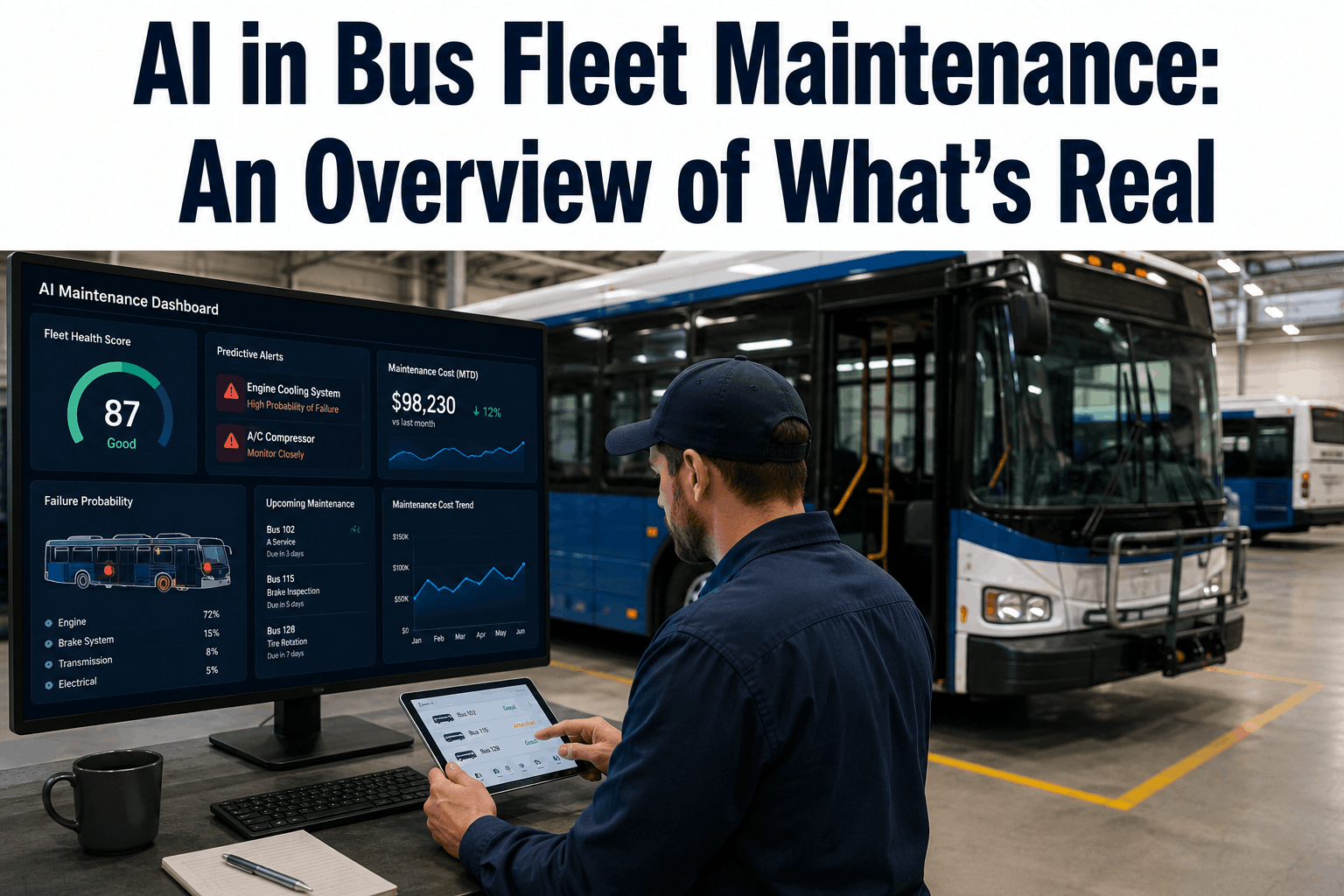
AI in Bus Fleet Maintenance: A Overview of What's Real
A 200-bus transit authority in Texas ran the same routes with two identical maintenance workflows. Fleet A had a dispatcher manually reviewing spreadsheets every morning, catching breakdowns after they happened. Fleet B deployed an AI-assisted maintenance platform in 2023. By 2025, Fleet B had reduced roadside failures by 61%, cut unscheduled downtime by 44%, and trimmed its annual maintenance labor cost by $180,000. The difference wasn't more mechanics. It was smarter scheduling, earlier warnings, and a system that learned from every repair. AI in bus fleet maintenance is real — but it's also heavily hyped. This overview separates what genuinely works from what vendors oversell.
AI Fleet Maintenance 2026
AI in Bus Fleet Maintenance: A Overview of What's Real
Predictive alerts. Smart PM scheduling. Fault code analysis. Here's where AI genuinely moves the needle — and where it doesn't.
Fault code false positives (manual)60–70% of alerts
Fault code false positives (AI)Under 20%
AI doesn't replace mechanics. It tells them what to fix before it breaks.
01Predictive Maintenance Alerts: Where AI Earns Its Keep
Predictive maintenance is the most proven AI application in bus fleets. The model is straightforward: telematics data (engine hours, idle time, fault codes, fluid temps) feeds a machine learning model trained on historical failure data. When sensor patterns match pre-failure signatures, the system issues an alert days or weeks before catastrophic failure. Real-world outcomes from fleets using predictive AI: brake system failures caught 2–3 weeks early based on pressure decay patterns; transmission failures predicted 1,000+ miles before breakdown using temperature and slip data; DPF failures flagged based on regen frequency anomalies before the bus goes into limp mode. The key distinction: this is pattern recognition, not magic. It requires quality telematics data, consistent repair records, and enough fleet history for the model to learn from. New fleets with sparse data get less value early — and more value every month they operate.
What AI Predicts Well
Brake wearPressure decay + application frequency = 2–4 week early warning
Transmission failureTemp anomalies + slip events flag failure 500–1,500 miles ahead
DPF / emissionsRegen pattern analysis catches blockage before limp mode
Battery health (electric)SOH degradation curves predict range loss 30–60 days out
Requires minimum 6–12 months of clean telematics data before predictions become reliable.
Where AI Struggles
Sudden mechanical failureBolt shear, road damage — no pattern. AI cannot predict random events.
Sparse data fleetsUnder 20 buses or under 1 year of data = poor model accuracy
Mixed fleet signalsDiesel + CNG + electric need separate models. One-size AI underperforms.
Vendor hype claims"100% failure prevention" is impossible. Any vendor claiming it is lying.
AI is a decision-support tool, not an oracle. Expect 60–80% early-detection rates, not 100%.
02AI-Powered PM Scheduling: Smarter Than the Calendar
Traditional preventive maintenance runs on fixed intervals — change oil every 5,000 miles, inspect brakes every 10,000. Simple. But a bus running severe urban duty (constant stops, high idle, summer heat) degrades 40–60% faster than a highway coach doing the same mileage. Fixed intervals either over-maintain highway buses or under-maintain urban ones. AI scheduling adjusts PM intervals dynamically based on actual operating conditions. Urban bus with 35% idle time? Shorten oil change interval by 25%. Highway coach with minimal idle? Extend safely. The result: right maintenance at the right time, not arbitrary calendar dates. Fleets implementing AI-dynamic scheduling report 18–30% reduction in total PM labor hours alongside better component life — because they're not changing parts that still have life left.
Fixed Interval vs AI-Dynamic PM — Efficiency Gap
AI-dynamic (urban)
95% — catches issues before failure
AI-dynamic (highway)
90% — avoids over-maintenance
Fixed interval (urban)
55% — under-maintains high-stress buses
Fixed interval (highway)
60% — over-maintains low-stress buses
Dynamic scheduling uses actual operating data — idle %, temp exposure, load cycles — not just odometer miles.
A modern diesel bus generates 50–200 fault codes per month. A hybrid or electric generates more. Without AI triage, mechanics chase codes that are transient, environmental, or already resolved — wasting 3–5 hours per bus per month on false positives. AI fault code analysis does two things: it classifies codes by urgency using historical repair correlation (which codes actually preceded failures?), and it groups related codes to identify root cause rather than symptoms. Example: Bus showing P0401 (EGR flow) + P0087 (fuel pressure low) + P2463 (DPF soot) isn't three separate problems — it's a single clogged EGR causing a cascade. AI sees the pattern. Manual review sees three work orders. Fleets using AI fault triage report 55–70% reduction in time spent on non-actionable alerts.
Manual Fault Code Review
3–5 hrs/bus/month chasing false positives
Treats each code as a separate issue
No historical pattern matching
Mechanics decide urgency from experience alone
Result: 60–70% of shop time on non-critical codes
AI Fault Code Triage
Classifies codes: critical / monitor / ignore
Groups related codes to identify root cause
Matches patterns to historical failure data
Auto-generates prioritized work orders
Result: mechanics focus only on codes that matter
"Before AI triage, my lead mechanic spent 2 hours every morning reviewing fault alerts. Half were noise. Now the system pre-sorts everything. He spends 20 minutes. We haven't had a missed critical fault in 14 months. The ROI was obvious in the first 60 days."
— Director of Fleet Maintenance, 95-bus suburban transit agency, Ohio
AI vendors routinely overpromise. Fleets that go in with unrealistic expectations get disappointed — and sometimes abandon tools that were actually working. Here's what AI genuinely cannot do in fleet maintenance. It cannot prevent all breakdowns — random mechanical failures, driver-induced damage, and road hazards have no predictive pattern. It cannot work without clean data — garbage sensor inputs produce garbage predictions. It cannot replace experienced mechanics — AI identifies what to look at; the mechanic decides what to do. And it cannot deliver instant results — most predictive models require 6–12 months of operational data before accuracy becomes reliable. The fleets that get the most from AI are the ones who understand it as a decision-support layer on top of disciplined human maintenance processes.
Any vendor promising "zero breakdowns" or "100% failure prevention" with AI is overselling. Demand pilot data and reference fleets before committing.
AI Can Do These
Pattern detectionRecognize pre-failure signatures across thousands of data points
Priority sortingRank which buses and which faults need attention first
Schedule optimizationAdjust PM intervals based on real duty cycle data
Root cause groupingLink related fault codes to a single underlying problem
AI Cannot Do These
Random event preventionBolt shear, road debris, driver abuse — no pattern to learn
Fix bad dataFaulty sensors or missing records corrupt model accuracy
Replace judgmentFinal repair decisions require mechanic expertise and physical inspection
Instant results6–12 months of data needed before predictions become reliable
05Evaluating AI Fleet Maintenance Software: What to Ask
Not all AI fleet tools are equal. Some are genuine machine learning platforms trained on fleet data. Others are rule-based alert systems with "AI" bolted onto the marketing. Here's how to tell the difference and what to demand before signing.
AI Fleet Software Evaluation Checklist
Data source
Does it ingest real telematics, or only manual entry? Real-time = far more valuable.
Model training
Is it trained on your fleet data, industry data, or just rules? Ask specifically.
False positive rate
Request actual metrics. Over 30% false positives = mechanics stop trusting the system.
Reference fleets
Ask for 3 fleets similar to yours with measurable outcomes. Non-negotiable.
Implementation time
Full AI value takes 6–12 months. Beware promises of instant ROI.
Integration
Does it connect to your existing telematics, parts inventory, and work order system?
Avoid if...
No pilot program, no reference data, promises of 100% failure prevention.
Fleet Expert Review
AI in bus fleet maintenance is real, proven, and increasingly accessible to fleets of all sizes. Predictive alerts, dynamic PM scheduling, and fault code triage each deliver measurable ROI — but only when implemented on clean data, with realistic timelines, and realistic expectations. The fleets getting 40–60% downtime reductions didn't replace their mechanics with AI. They gave their mechanics better information. BusCMMS combines AI-assisted scheduling, predictive alerts, fault code triage, and full maintenance tracking in one platform built specifically for bus fleets.
The Bottom Line
AI in bus fleet maintenance isn't hype — it's a genuine operational advantage for fleets that implement it correctly. Predictive alerts catch failures weeks before they happen. Dynamic scheduling cuts unnecessary PM labor by 20–30%. Fault code triage eliminates 60–70% of wasted diagnostic time. But AI requires clean data, realistic timelines, and mechanics who trust and act on its outputs. BusCMMS delivers all three: telematics-connected predictive alerts, AI-optimized PM scheduling, and intelligent fault code prioritization — with a 14-day free trial and no implementation fees.
BusCMMS uses real machine learning — not rule-based alerts — to predict failures, optimize PM schedules, and triage fault codes automatically. Built for bus fleets. Free 14-day trial.
What does AI actually do in bus fleet maintenance?
AI analyzes telematics, fault codes, and maintenance history to predict failures before they happen, optimize PM scheduling based on real duty cycles, and triage fault code alerts so mechanics focus on what matters. It doesn't replace mechanics — it tells them what to inspect and when.
How much downtime reduction can AI maintenance deliver?
Fleets with mature AI implementations report 30–60% reductions in unscheduled downtime. Results depend on data quality, fleet size, and how consistently mechanics act on AI-generated alerts. Expect meaningful improvement within 6–12 months.
How long does it take for AI fleet maintenance to become accurate?
Most predictive models require 6–12 months of consistent telematics and repair data before predictions become reliable. Rule-based alerts can work immediately, but true machine learning needs operational history to learn from.
What data does AI fleet maintenance need to work?
Quality telematics (engine hours, idle time, fault codes, fluid temperatures), consistent work order records, and mileage tracking per bus. The more complete and consistent the data, the more accurate the predictions.
Does AI maintenance work for small bus fleets?
AI scheduling and fault triage work for fleets of any size. Predictive failure models are more accurate with larger fleets (20+ buses), but even small fleets benefit significantly from AI-optimized PM scheduling and intelligent fault code prioritization.
Does BusCMMS use real AI or just rules-based alerts?
BusCMMS uses machine learning trained on bus fleet operational data combined with telematics integration — not just static rule-based triggers. Predictions improve over time as your fleet data grows. Book a demo to see exactly how it works for your operation.
Diesel + Electric + CNG. AI Maintenance for Every Fuel Type.
Predictive alerts for diesel engines. Battery SOH tracking for electric. Fault triage for CNG. All on one AI-powered dashboard. Free 14-day trial.