The fleet that maintains the same way in January and July has breakdowns in both. A bus needs different care in summer heat than winter cold. In summer, cooling systems fail, tires overheat, and air conditioning strains electrical systems. In winter, batteries lose capacity, fuel gels, air lines freeze, and starting systems struggle. Spring brings pothole damage from thaw cycles. Fall demands heating system checks before cold arrives. The fleets with the lowest annual breakdowns don't use one maintenance calendar — they use four. This guide maps exactly what to inspect, test, and service in each season. Follow this calendar and your buses will survive summer heat waves and winter polar vortices without roadside failures.
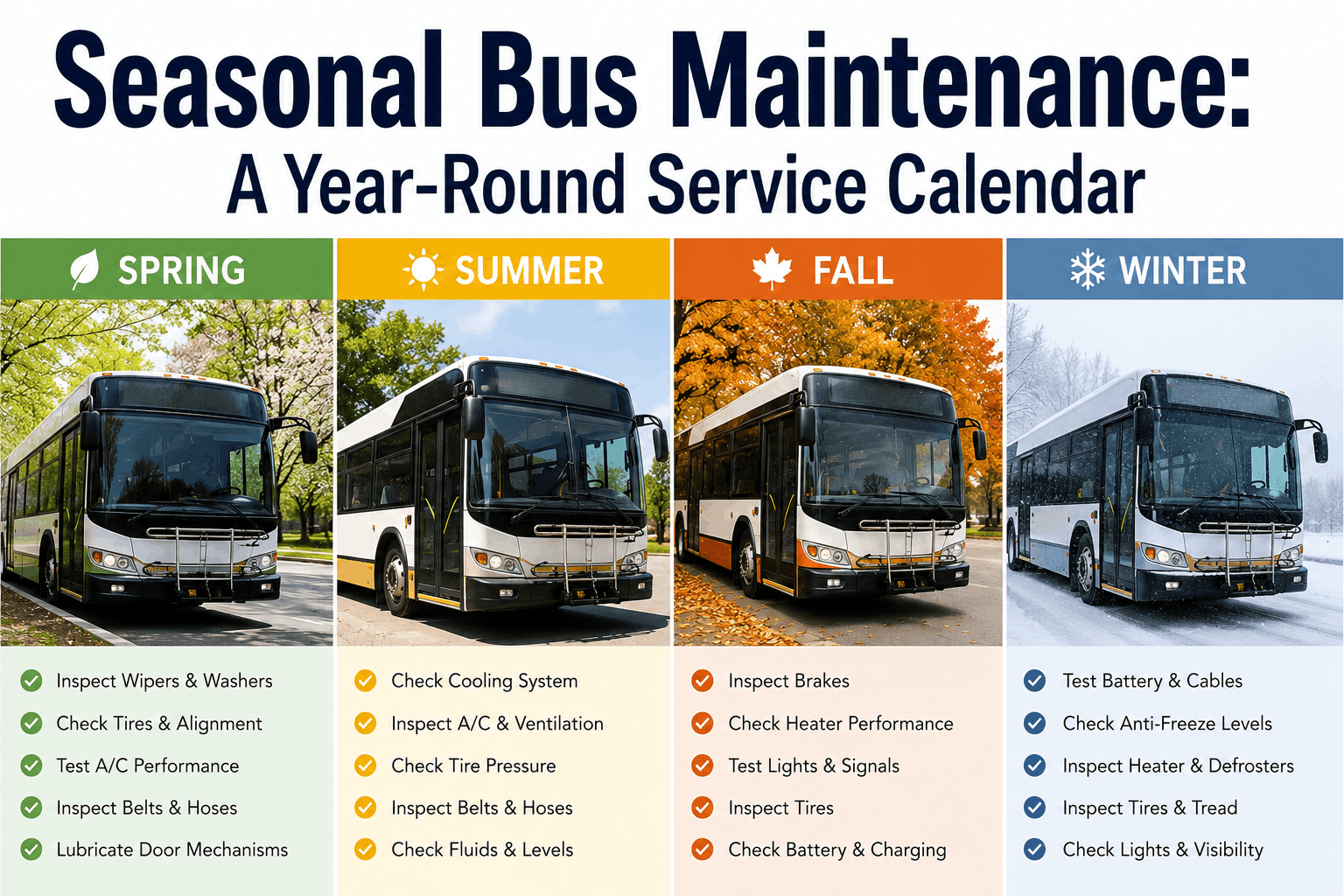
Seasonal Bus Maintenance: A Year-Round Service Calendar
Cooling systems in summer. Batteries in winter. Heating before fall. A/c before spring. Match maintenance to the season and prevent breakdowns year-round.
Breakdowns by Season — Fleet Data
Proper seasonal preparation reduces winter breakdowns by 60% and summer failures by 45%. The cost of seasonal PM is 10% of emergency repair costs.
Winter Preparation (September–November): Before Cold Arrives
Winter is the highest-breakdown season — 43% of annual roadside events occur December through February. Most winter failures are preventable with preparation in fall. The window is September through November, before the first hard freeze. Batteries are the #1 winter failure — load test every battery in the fleet. Replace any battery below 75% of rated CCA. Cold cranking amps drop 30-40% at 0°F compared to 80°F. A battery that starts easily in October may fail completely in January.
Also test coolant freeze point — should protect to -30°F minimum. Drain air tanks daily to prevent frozen air lines. Check block heaters — plug them in 2-4 hours before cold starts. Use winter-grade diesel fuel or treat with anti-gel additives. Inspect heater systems before drivers need them.
Battery CCA by Temperature (600 CCA Rated Battery)
A battery at 75% health (450 CCA) at 80°F provides only 270 CCA at 0°F — below starting requirements. Replace before winter.
"We lost 14 buses to no-start conditions in our first winter with a new fleet. Batteries that were fine in October failed in January. Now we load test every battery in September and replace anything below 80% health. Three winters since, zero cold-start failures. The $8,000 in proactive battery replacement saved $45,000 in tow trucks and missed routes."
Winter Preparation Checklist (Sep–Nov)
Load test every battery — replace below 75% rated CCA
Test coolant freeze point — must protect to -30°F minimum
Inspect block heaters — test function, replace worn cords
Drain air tanks daily — install automatic tank drains if possible
Switch to winter-grade diesel or add anti-gel additive
Check heater systems, defroster fans, and ducting
Inspect winter wiper blades (heavy-duty rubber)
Complete by November 15. Cost: $200–$500 per bus. Savings: prevents $2,000–$5,000 per breakdown.
Winter Operations (December–February): Daily Checks
Once winter arrives, daily vigilance prevents roadside failures. Drivers must drain air tanks every morning — moisture freezes and blocks air lines. Check battery voltage before first start — below 12.2V requires charging before cranking. Use block heaters for 2-4 hours before cold starts (below 20°F). After start, allow engines to warm at idle for 5-10 minutes before driving — cold oil doesn't flow well.
Monitor DEF tank levels — DEF freezes at 12°F but thaws without damage; however, frozen DEF won't inject, causing derate. Park buses indoors or use engine block heaters overnight. Never let fuel level drop below 1/4 tank — condensation forms and freezes in fuel lines.
Below 0°F, a bus that isn't plugged in for 4+ hours may not start regardless of battery health. Block heaters are not optional in cold climates — they are mandatory winter equipment.
Winter Daily Driver Checklist
Spring Transition (March–April): Post-Winter Recovery
Spring is the season of hidden damage. Winter potholes damage suspensions, steering linkages, and tires. Road salt corrodes brake lines, electrical connectors, and chassis components. Thaw cycles cause potholes that can bend wheels and break suspension components. Spring maintenance focuses on inspecting for winter-caused damage and preparing for summer heat.
Check all suspension components — shocks, leaf springs, air bags, bushings. Inspect brake lines for rust and corrosion — pitted lines can fail under pressure. Wash undercarriage thoroughly to remove salt residue. Check tire sidewalls for cuts or bulges from pothole impacts. Test air conditioning systems before summer demand arrives. Inspect battery terminals for corrosion — clean and coat with anti-corrosion spray.
Spring Inspection — Post-Winter Damage Check
Summer Preparation (May–June): Before Heat Arrives
Summer heat kills cooling systems. The same engine that runs at 195°F in spring may overheat at 220°F+ in July. Preparation starts in May, before the first 90°F day. Test coolant concentration and additive levels — diesel engines require nitrite levels above 600 ppm to prevent cavitation. Pressure test cooling system to identify leaks before they cause overheating. Inspect radiator fins for debris — clean with compressed air.
Check fan clutch operation — should engage around 200-210°F. Test thermostats — replace if opening temperature is inaccurate. Inspect and service air conditioning systems — low refrigerant causes compressor failure. Check tire pressures — running underinflated in heat increases blowout risk 400%.
Summer Preparation Checklist (May–Jun)
Test coolant concentration and nitrite levels (SCA)
Pressure test cooling system — identify leaks
Clean radiator and charge air cooler fins
Test fan clutch operation — engage at 200-210°F
Inspect belts for cracking, glazing, or fraying
Service air conditioning — check pressures, add refrigerant
Set tire pressures to manufacturer spec (higher pressures for summer heat)
Complete by June 1. Cooling system failure in summer costs $15,000–$30,000 in engine damage.
"July 2022 was our worst month ever — three buses overheated on the same 98-degree day. Two had coolant leaks that we had ignored. One had a failed fan clutch. Total repair bill: $47,000. Now we do summer prep in May: pressure test every cooling system, test every fan clutch, inspect every belt. Two summers since, zero heat-related breakdowns. The prep costs $5,000 for the whole fleet. The savings: $47,000 in one year."
Summer Operations (July–August): Heat Wave Management
During extreme heat events (95°F+), modify daily operations to prevent overheating. Monitor engine temperature gauges constantly — if temp exceeds 220°F, pull over and idle to cool down. Never shut off a hot engine immediately — heat soak can cause coolant boiling and cylinder head damage. Allow 2-3 minutes idle cool-down after heavy loads.
Check coolant levels daily — heat accelerates evaporation. Monitor DEF consumption — SCR systems work harder in heat, consuming more DEF. Keep DEF tanks above 25% to prevent pump cavitation. Check tire pressures weekly — heat increases pressure by 10-15 PSI; adjust to manufacturer spec (do not bleed hot tires). Park buses in shade when possible. Clean radiator fins weekly in dusty environments.
Coolant Temperature Danger Zones (Diesel Bus)
Shutting off an overheated engine without idle cool-down causes heat soak — coolant stops circulating while internal temperatures spike, cracking cylinder heads.
Fall Transition (September–October): Before Winter Returns
Fall is the mirror of spring — prepare for the coming cold while finishing summer operations. Test battery health while temperatures are still mild — weak batteries show symptoms in fall before failing in winter. Check heater systems, defroster fans, and ducting before drivers need them. Inspect winter wiper blades — replace worn rubber. Check tire tread depth — winter roads require deeper tread for snow traction.
Test coolant freeze point — top up with concentrate if protection is below -20°F. Inspect block heater cords and plugs — replace frayed cords before first freeze. Drain and flush cooling systems if due. This is also the time to schedule annual inspections before winter weather makes outdoor work difficult.
Fall Preparation Timeline (Sep–Oct)
Complete all fall preparation by October 31. The first hard freeze often arrives unexpectedly in November.
Fleet Expert Review
Seasonal maintenance is not optional — it is the difference between a bus that starts at -20°F and one that needs a tow. The fleets with the lowest winter breakdown rates don't wait for the first freeze. They test batteries in September. They check coolant in October. They inspect block heaters before November. The fleets with the lowest summer failure rates test cooling systems in May. They clean radiators before June. They service A/C before July.
Season by season, the pattern is the same: prepare before the extreme weather arrives. Reactive maintenance after failure costs 5-10x more than proactive seasonal preparation. Use this calendar. Train your team. And use maintenance software to track completion of every seasonal task — because missing one battery test in September becomes a no-start in January.
The Bottom Line
Four seasons. Four different maintenance focuses. Winter demands batteries, block heaters, and frozen air lines. Spring uncovers pothole damage and salt corrosion. Summer tests cooling systems, tires, and air conditioning. Fall prepares for the next winter cycle. The fleets that succeed don't use one calendar. They use four.
BusCMMS tracks seasonal PM tasks by date range — battery testing in September, coolant checks in October, cooling system pressure tests in May, A/C service in June. Automatic work orders trigger when each season approaches. Drivers get daily checklists for winter and summer extremes. Mechanics get inspection forms for spring and fall transitions. One dashboard. Four seasons. Zero seasonal breakdowns.
Four Seasons. One Dashboard. Zero Seasonal Breakdowns.
BusCMMS tracks seasonal PM — battery tests before winter, cooling system checks before summer, spring damage inspection, fall heater service. Automatic seasonal work orders. Free 14-day trial.
Frequently Asked Questions
When should I test bus batteries before winter?
How do I prevent coolant from freezing in winter?
What is the most common summer bus breakdown?
How often should I drain air tanks in winter?
When should I service bus air conditioning?
Can BusCMMS automate seasonal maintenance schedules?
Diesel + Electric + CNG. All Seasons. One System.
Seasonal maintenance for every fuel type. Winter battery prep for diesel and electric. Summer cooling for diesel. Fall heater checks. Spring damage inspection. Free 14-day trial.