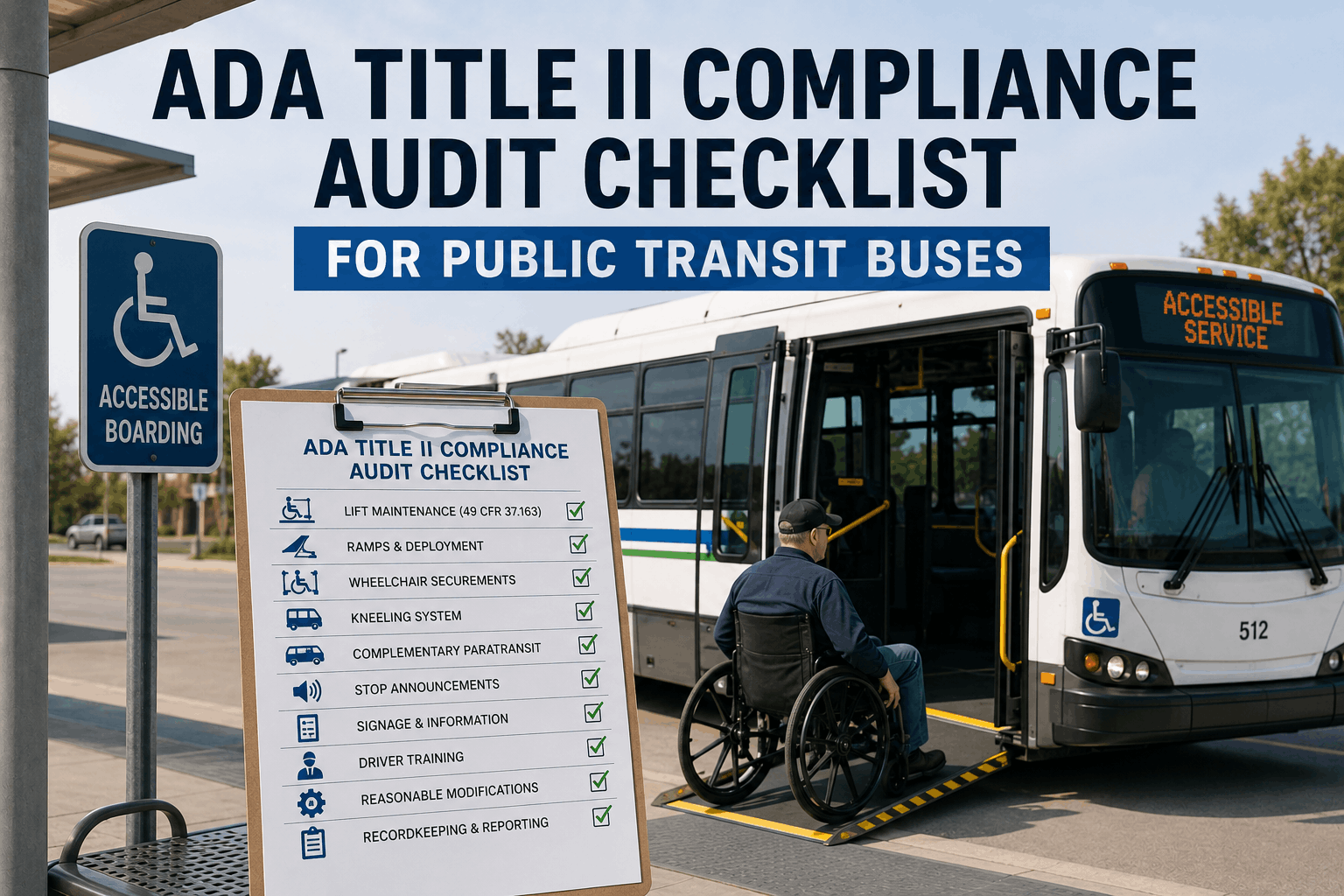
ADA Title II compliance is not optional — FTA auditors scrutinize lift maintenance records, ramp inspections, securement device checks, and complementary paratransit documentation at every triennial review. This audit checklist covers all 49 CFR 37.163 requirements so your transit agency can pass the review with zero findings.
ADA Compliance Audit Checklist 2026
ADA Title II Compliance Audit Checklist for Public Transit Buses
ADA Title II compliance audit checklist for public transit. Lift maintenance per 49 CFR 37.163, ramps, securements, kneeling, complementary paratransit, signage.
The Risk of Incomplete ADA Documentation
Transit agencies average 3–5 ADA-related findings per triennial review. Each finding triggers a mandatory corrective action plan with a 60–90 day resolution deadline. This checklist covers every 49 CFR 37.163 requirement to close all compliance gaps before the auditors arrive.
3–5
Average ADA findings per audit
60–90 days
Corrective action deadline
100+ items
On this compliance checklist
0
Findings achievable with full prep
Why a Dedicated ADA Compliance Checklist Is Essential
Lift Maintenance & Cycling
49 CFR 37.163 requires daily lift cycling and quarterly preventive maintenance. Missing logs or incomplete records are the top ADA audit finding.
Ramp & Securement Devices
Wheelchair ramps must deploy fully and securements must be present and functional on every trip. Defects must be reported and resolved before the bus returns to service.
Kneeling Systems
Buses equipped with kneeling systems must have them operational. Non-functioning kneelers must be repaired within a reasonable time and documented.
Complementary Paratransit
Service must mirror fixed-route coverage, response times, and fare limits. Eligibility records and trip denials must be documented and auditable.
Stop Announcements & Signage
Automated stop announcements and visual displays are required. Non-functioning equipment must be repaired within 48 hours or a documented plan must exist.
Reasonable Modifications
Requests for modifications to policies must be logged, reviewed, and resolved. Denials require a written explanation and must be tracked.
ADA Compliance Readiness by Category
The donut chart reveals your current ADA compliance posture. The two largest segments — lift maintenance and ramp securement — represent over half of audit findings. Complete these first for maximum impact.
The Complete ADA Audit Checklist
Lift & Ramp Maintenance (25 items)
Daily cycling logs with date and bus number. Quarterly PM records signed by technician. Hydraulic fluid and cable inspection reports. Platform sensor calibration logs. Door interlock verification records.
Securement Devices (18 items)
Wheelchair securement belt inspection logs. Floor anchor condition reports. Tie-down strap replacement records. Occupied wheelchair securement testing documentation.
Kneeling Systems (12 items)
Kneeler operation check per pre-trip. Repair work orders for non-functioning systems. Time-to-repair tracking. Passenger notification procedures when kneeler is unavailable.
Paratransit Compliance (30 items)
ADA eligibility determination records. Trip denial logs with written explanations. Service area maps matching fixed-route coverage. Fare comparison documentation. Response time performance data.
Stop Announcements & Displays (15 items)
Functional test records for audio announcements. Visual display operational checks. Repair logs for non-functioning equipment. Alternative announcement procedures documented.
Reasonable Modifications (10 items)
Modification request log with dates and outcomes. Written denial letters. Policy documentation and staff training records. Annual review of modification trends.
Common ADA Findings and How to Avoid Them
Missing Lift Cycling Logs
Solution: Digitize daily lift cycling as part of the DVIR. Automatically log every cycle with GPS and timestamp verification.
Incomplete Securement Inspections
Solution: Add securement device checks to daily pre-trip and quarterly PM checklists. Photograph each inspection for audit evidence.
Unresolved Kneeler Repairs
Solution: Track kneeler defect resolution time. Set a 48-hour repair target and escalate any open work order that exceeds the limit.
Paratransit Trip Denial Gaps
Solution: Record every trip denial with reason code and timestamp. Generate a monthly report showing denial patterns to identify systemic issues.
Non-Functioning Stop Announcements
Solution: Perform daily functional checks of audio and visual systems. Flag failures immediately and provide alternative announcement methods until repaired.
Modification Request Backlog
Solution: Create a digital workflow for modification requests. Set a 7-day review deadline and track outcomes through resolution.
ADA Audit Preparation Progress
Lift Cycling Logs Reviewed
All daily lift cycling logs verified for the past 12 months. Any missing dates flagged and corrected.
Ramp & Securement Inspected
Every bus ramp and securement device inspected and photographed. Replacement parts ordered for non-compliant equipment.
Kneeler Repair Backlog Cleared
All outstanding kneeler repairs completed. Work order closure documentation filed digitally.
Paratransit Records Audited
Eligibility files, trip denials, and fare comparison data reviewed for the last 2 fiscal years.
Stop Announcements Tested
Audio and visual systems tested on all buses. Non-functioning units scheduled for immediate repair.
Modification Request Log Audited
All requests reviewed for timely response and proper documentation. Denial letters verified for completeness.
ADA Compliance KPIs
Lift Cycling Completion Rate
Target: 100% of buses cycled daily with digital log. Any gap is an immediate audit exposure.
Kneeler Repair Speed
Target: 90% of kneeler defects repaired within 48 hours of first report.
Securement Inspection Pass Rate
Target: 100% first-pass on quarterly securement inspections. Failures must be corrected before bus re-enters service.
Paratransit Denial Documentation
Target: 100% of trip denials recorded with written reason within 24 hours of the denial decision.
Modification Request Resolution
Target: 95% of requests resolved within 7 calendar days. Open requests older than 14 days trigger management review.
Our last FTA review produced four ADA findings. After implementing this digital checklist and linking lift cycling directly to our DVIRs, we passed the next triennial with zero ADA findings and the auditor commended our documentation.
Pass Your Next ADA Audit With Zero Findings
BusCMMS digitizes lift cycling logs, securement inspections, and all ADA compliance documentation into a single audit-ready platform. Book a demo to see how your agency can close every ADA compliance gap before the next review.
ADA Title II Compliance FAQs
What does 49 CFR 37.163 require for bus lifts?
Lifts must be cycled and inspected daily before the bus enters service. Quarterly preventive maintenance with hydraulic, electrical, and mechanical checks is required. All records must be retained for a minimum of one year.
How often must securement devices be inspected?
Securement devices must be inspected as part of the daily pre-trip inspection. A thorough quarterly inspection with documented results is also required. Any damaged belts or anchors must be replaced immediately.
What documentation is required for complementary paratransit?
Agencies must maintain eligibility determinations, trip denial logs with written explanations, fare records proving no higher than fixed-route fares, and on-time performance data.
How quickly must a broken kneeler be repaired?
There is no specific regulatory timeline, but FTA expects repairs within a reasonable period — typically 48 hours. Agencies must document the defect, notify passengers of alternatives, and track repair progress.
Can fleet management software help with ADA compliance?
Yes. A CMMS digitizes lift cycling logs, securement inspections, kneeler repairs, and all ADA documentation. It provides instant audit retrieval and generates compliance reports on demand.
What are the penalties for ADA non-compliance?
Penalties include mandatory corrective action plans, potential loss of FTA funding, and civil rights complaints. Repeat or serious violations can result in Department of Justice enforcement action.
Zero ADA Findings Is the Result of Systematic Preparation
ADA Title II compliance is not a one-time submission — it's a daily operational standard. By digitizing lift cycling logs, securement inspections, kneeler repairs, and paratransit documentation, transit agencies can close every gap before the auditors arrive. The result is zero findings, no corrective action plans, and complete confidence that your service meets every accessibility obligation under 49 CFR Part 37.