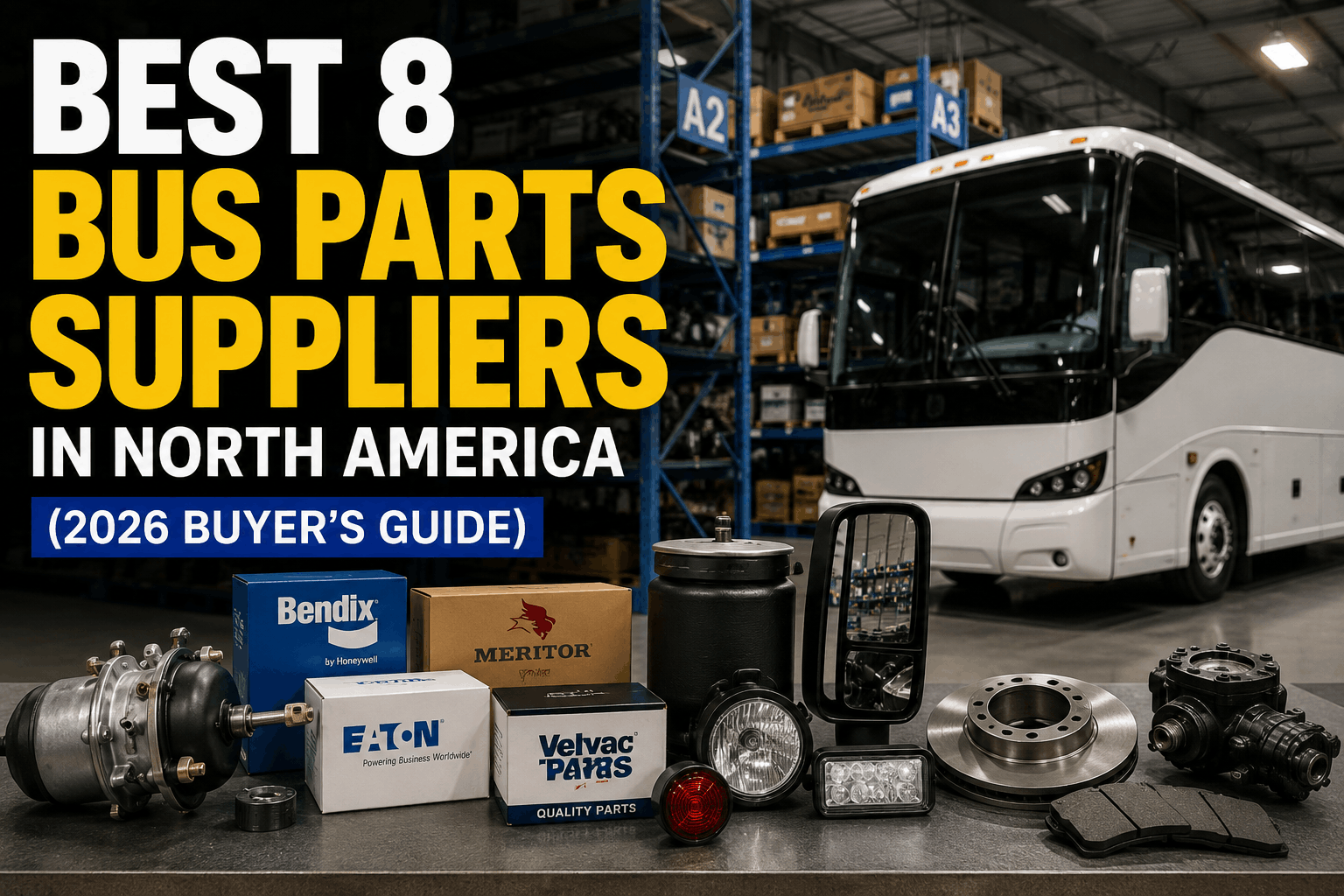
Bus maintenance operations depend on reliable parts suppliers to keep fleets running. With over 480,000 buses operating across North America, choosing the right parts supplier directly impacts uptime, repair costs, and fleet reliability. This buyer's guide ranks the 8 best bus parts suppliers for 2026 based on pricing, inventory depth, OEM vs aftermarket coverage, and service quality for school, transit, and motorcoach fleets.
2026 Bus Parts Buyer's Guide
Best 8 Bus Parts Suppliers in North America — 2026 Buyer's Guide
Buyer's guide: 8 best bus parts suppliers in North America for 2026. Pricing, inventory depth, OEM vs aftermarket, school + transit + motorcoach coverage.
Bus Parts Supply Industry Statistics
The North American bus parts market exceeds $2 billion annually. Fleets using multiple suppliers report 28% lower parts costs and 35% faster repair times. Parts availability is the single biggest factor in maintenance turnaround time.
$2B+
Annual bus parts market
28%
Lower cost with multiple suppliers
35%
Faster repairs with parts availability
95%
Target parts in-stock rate
Top 8 Bus Parts Suppliers — Ranked
Each supplier is evaluated on pricing, inventory depth, OEM vs aftermarket coverage, delivery speed, and fleet feedback. Rankings reflect real-world performance across school districts, transit agencies, and motorcoach operators.
1
Dayton Parts
Full OEM and aftermarket coverage. 95%+ inventory depth. 24-48 hour delivery. Strong in transit and school bus. Pricing: competitive.
2
Velvac
Specializes in mirrors, lighting, and HVAC. Excellent quality. 92% inventory depth. Strong motorcoach and transit coverage. Pricing: mid-range.
3
Bendix
Leading brake and safety systems supplier. OEM and aftermarket. 90% inventory depth. Strong across all bus types. Pricing: premium quality.
4
Meritor
Drivetrain, axle, and brake components. OEM quality. 88% inventory depth. Strong transit and school bus. Pricing: mid to premium.
5
Eaton
Transmission and drivetrain components. OEM quality. 85% inventory depth. Strong transit and motorcoach. Pricing: premium.
6
Newport Bus Parts
Aftermarket parts specialist. Good coverage for older buses. 80% inventory depth. Strong school bus focus. Pricing: budget-friendly.
7
FleetPride
Heavy-duty parts distributor. Good for general bus maintenance. 78% inventory depth. Strong transit coverage. Pricing: competitive.
8
NAPA Bus Parts
Broad availability across North America. Good for common parts. 75% inventory depth. Coverage across all bus types. Pricing: value-oriented.
Supplier Comparison — Price, Inventory, Delivery
Dayton Parts achieves 95% inventory depth with competitive pricing. Velvac and Bendix offer premium quality with good availability. Newport and NAPA provide budget-friendly options with moderate inventory depth. Selecting a primary and secondary supplier optimizes cost and availability.
Bus Parts Supplier Market Share
Dayton Parts leads with 32% market share among bus fleets using a primary supplier. Velvac follows at 28%, Bendix at 22%, and other suppliers collectively account for 18% of the market. Fleet consolidation favors suppliers with broad inventory and consistent delivery performance.
Supplier Selection — Pass / Fail Thresholds
Inventory Depth
Pass: 90%+ in-stock on critical parts. 24-48 hour availability. Multiple distribution centers.
Fail: Under 75% in-stock. Frequent backorders. Single distribution center.
Pricing Competitiveness
Pass: Volume discounts. Price matching. Transparent pricing. No hidden fees.
Fail: Premium pricing. No volume discounts. Hidden surcharges.
Delivery Speed
Pass: 24-48 hour delivery for in-stock parts. Emergency orders within 12 hours.
Fail: 3-5 day standard delivery. No emergency options.
OEM vs Aftermarket
Pass: Both OEM and quality aftermarket options. Clear quality labeling.
Fail: Limited to one option. Unclear quality sourcing.
Fleet Coverage
Pass: Covers school, transit, and motorcoach. Multiple vehicle models. Full component range.
Fail: Limited vehicle coverage. Specialized only.
Fleet Feedback
Pass: 4.5+ star satisfaction. Fast resolution of issues. Good technical support.
Fail: Mixed reviews. Poor complaint handling. Limited tech support.
Parts Program KPIs
Track these five key performance indicators to optimize your parts supply program:
Parts In-Stock Rate
Target: 95%+. Track monthly. Low rate causes repair delays and increased downtime.
Average Order Fulfillment Time
Target: Under 48 hours. Track weekly. Slow fulfillment delays repairs and increases MTTR.
Cost Per Part Category
Target: Consistent or decreasing. Track quarterly. Rising costs indicate supplier or market changes.
Emergency Order Rate
Target: Under 10% of orders. Track monthly. High emergency orders signal poor planning or inventory gaps.
Supplier Fill Rate
Target: 95%+ first-time fill. Track monthly. Low fill rate increases order frequency and administrative cost.
Our 120-bus fleet consolidated parts supply with Dayton Parts as primary and Velvac as secondary. We improved parts in-stock from 78% to 96%, reduced average repair time by 32%, and cut parts cost by 18% through volume discounts. The digital ordering system integrated with our CMMS has eliminated parts-related downtime.
Optimize Your Parts Inventory with BusCMMS
BusCMMS integrates with leading parts suppliers to auto-order parts when inventory drops below thresholds. Track parts usage by vehicle and component. Generate demand forecasts based on PM schedules. Reduce parts-related downtime by 40% or more.
Bus Parts Supplier FAQs
Which bus parts supplier is best for school bus fleets?
Dayton Parts and Newport Bus Parts are the top choices for school bus fleets. Dayton offers comprehensive coverage of school bus components, while Newport provides cost-effective aftermarket options for older school buses. Velvac is excellent for lighting and mirror systems.
What is the difference between OEM and aftermarket bus parts?
OEM parts are manufactured by the original equipment manufacturer and are identical to original components. Aftermarket parts are produced by third-party manufacturers and may vary in quality and price. Both can be suitable depending on application, budget, and vehicle age.
How do I choose between multiple parts suppliers?
Select a primary supplier for 80% of your parts needs based on inventory depth, pricing, and delivery speed. Choose one or two secondary suppliers for specialized components and emergency needs. Evaluate suppliers quarterly using fill rate, price competitiveness, and delivery performance metrics.
What is the average parts availability rate for bus suppliers?
Top-tier suppliers maintain 90-95% in-stock availability on critical parts. Industry average is 75-85%. Fleets should target 95%+ availability to minimize repair delays and vehicle downtime. Partnering with a primary and secondary supplier improves overall fill rate.
How can I reduce bus parts costs?
Consolidate purchases with fewer suppliers for volume discounts. Use OEM parts for critical safety components and quality aftermarket for non-critical systems. Implement inventory management software to track usage and forecast demand. Standardize parts across similar vehicle models where possible.
Can BusCMMS help manage parts inventory?
Yes. BusCMMS tracks parts inventory in real-time, sets reorder points, and auto-generates purchase orders. The system integrates with major suppliers for automated ordering and tracks parts usage by vehicle, technician, and component type.
The Bottom Line
Choosing the right bus parts supplier is essential for fleet reliability and cost control. This buyer's guide ranking of the 8 best suppliers for 2026 shows Dayton Parts leading in inventory depth, pricing, and fleet satisfaction, followed by Velvac and Bendix. Evaluate suppliers using the pass/fail criteria: inventory depth (90%+), pricing competitiveness, delivery speed (24-48 hours), OEM vs aftermarket options, and fleet coverage. Most fleets benefit from a primary supplier covering 80% of needs and one or two secondary suppliers for specialized components. A well-structured parts program reduces repair times by 35%, improves parts availability to 95%, and lowers costs through volume purchasing. Combine your supplier strategy with BusCMMS for real-time inventory tracking, auto-reordering, and complete parts usage visibility. Start your free trial today to optimize your parts supply program.