Bus telematics devices have become essential for fleet management, safety, and operational efficiency. With over 480,000 school buses and transit buses operating across the US, the right telematics solution can reduce fuel costs by 15%, improve driver safety by 40%, and provide real-time vehicle diagnostics. This ranking compares the 10 best bus telematics devices for 2026 based on hardware quality, data depth, pricing, and CMMS integration for fleets of all sizes.
2026 Bus Telematics Device Ranking
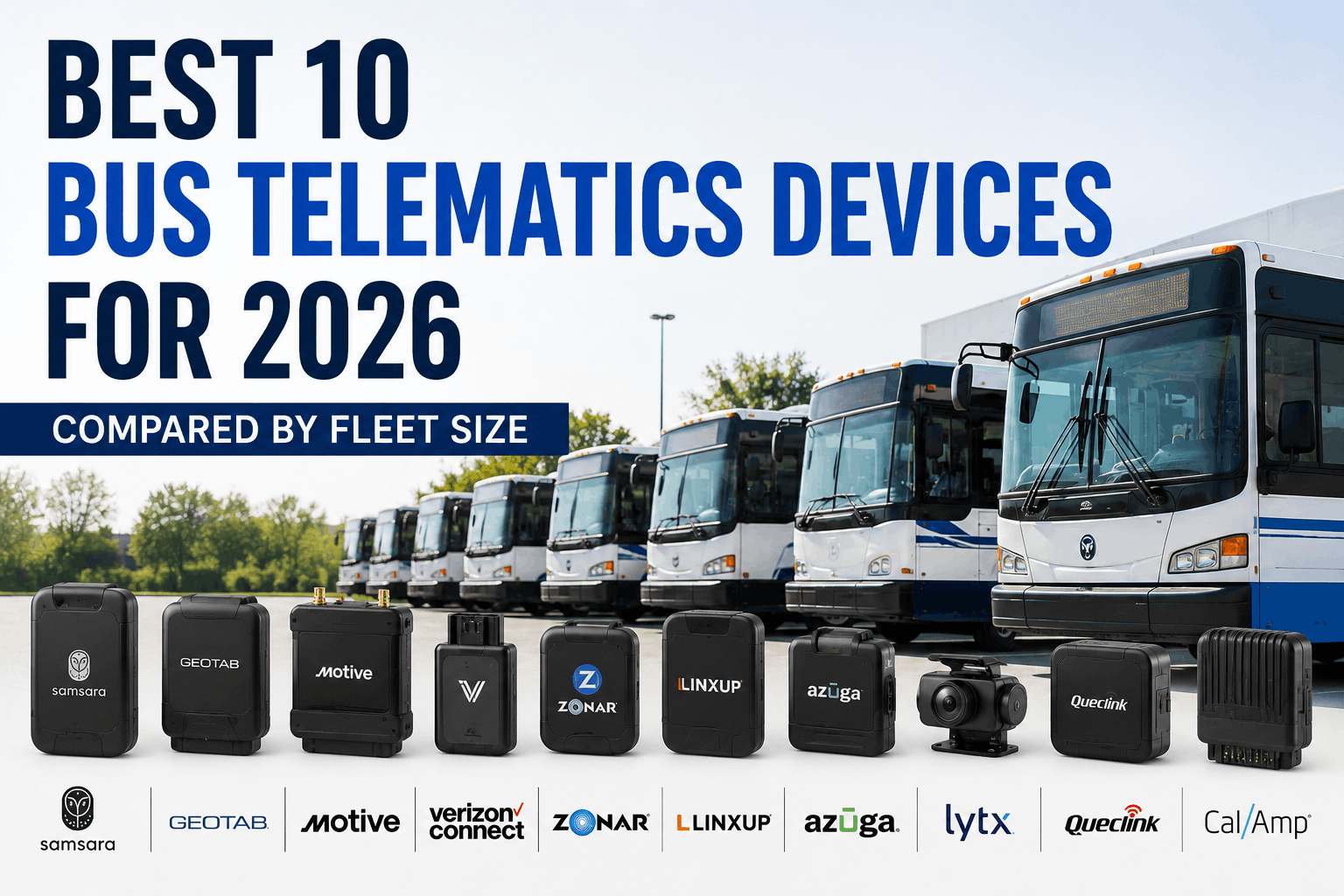
Best 10 Bus Telematics Devices for 2026 — Compared by Fleet Size
Ranked: 10 best bus telematics devices in 2026 by fleet size. Samsara, Geotab, Motive, Verizon Connect, Zonar — hardware, data depth, pricing, CMMS integration.
Bus Telematics Industry Adoption Statistics
Telematics adoption in bus fleets has accelerated rapidly. Fleets using telematics report 35% lower fuel consumption, 50% fewer safety incidents, and 28% lower maintenance costs through predictive diagnostics.
92%
Transit fleets using telematics
35%
Fuel savings with telematics
50%
Fewer safety incidents
28%
Lower maintenance costs
Top 10 Bus Telematics Devices — Ranked
Each device is evaluated on hardware quality, data depth, GPS accuracy, CMMS integration, pricing, and fleet feedback. Rankings reflect real-world performance across school districts, transit agencies, and private bus operators.
1
Samsara
AI dashcam, real-time GPS, engine diagnostics, CMMS integration. 4G LTE with WiFi backup. Pricing from $45 per vehicle per month. Best for fleets of all sizes.
2
Geotab
Open platform, 150+ integrations, real-time engine data, GPS tracking. Pricing from $28 per vehicle per month. Best for large fleets with complex integration needs.
3
Motive
AI dashcam, ELD compliance, real-time GPS, vehicle diagnostics. Pricing from $35 per vehicle per month. Best for mid-size fleets and school bus operators.
4
Verizon Connect
GPS tracking, engine diagnostics, driver behavior monitoring. Pricing from $30 per vehicle per month. Best for multi-location fleets with existing Verizon infrastructure.
5
Zonar
Real-time GPS, engine diagnostics, DVIR integration, comprehensive reporting. Pricing from $38 per vehicle per month. Best for school bus and transit fleets.
6
Omnitracs
GPS, engine diagnostics, ELD compliance, safety analytics. Pricing from $32 per vehicle per month. Best for large transit and motorcoach fleets.
7
GPS Insight
GPS tracking, engine diagnostics, driver scorecard, maintenance alerts. Pricing from $25 per vehicle per month. Best for mid-size fleets on a budget.
8
Fleet Complete
GPS, engine diagnostics, ELD, real-time alerts. Pricing from $22 per vehicle per month. Best for small fleets and para-transit operators.
9
Racelogic
High-precision GPS, driver behavior analytics, safety training tools. Pricing from $40 per vehicle per month. Best for fleets focused on driver safety programs.
10
Ctrack
GPS tracking, engine diagnostics, geofencing, basic reporting. Pricing from $18 per vehicle per month. Best for small fleets with basic tracking needs.
Telematics Device Comparison — Features & Value
Samsara achieves 95% overall score with exceptional data depth. Geotab follows at 88% with strong integration capabilities. Motive, Verizon Connect, and Zonar round out the top five with scores of 78%, 72%, and 66% respectively.
Bus Telematics Market Share
Samsara holds 30% market share among bus fleets using telematics, with Geotab and Motive tied at 25% each. Other providers collectively account for 20% of the market. Samsara's rapid growth is driven by its AI dashcam and CMMS integration capabilities.
Telematics Selection Criteria — Pass / Fail Thresholds
Hardware Quality
Pass: Rugged design. 4G LTE with backup. Reliable GPS accuracy within 2 meters. No frequent failures.
Fail: Fragile hardware. Poor GPS accuracy. Frequent device failures. No cellular backup.
Data Depth
Pass: Engine diagnostics, real-time GPS, driver behavior, fuel usage, DVIR integration, CMMS integration.
Fail: Basic GPS only. No engine data. No driver behavior. No maintenance integration.
CMMS Integration
Pass: Direct API integration with leading CMMS platforms. Auto-sync of engine hours, fault codes, and mileage.
Fail: No CMMS integration. Manual data export only. Limited API availability.
Pricing Structure
Pass: Transparent pricing. No hidden fees. Volume discounts. Free trial available.
Fail: Opaque pricing. Long-term contracts. Setup fees. Expensive add-ons.
Support & Training
Pass: 24/7 support. Dedicated account manager. Comprehensive training. Good onboarding process.
Fail: Limited support hours. No training provided. Long response times.
Fleet Feedback
Pass: 4.5+ star ratings. Positive reviews from similar-sized fleets. Low complaint rate.
Fail: Mixed or negative reviews. High complaint rate. Poor fleet references.
Bus Telematics Program KPIs
Track these five key performance indicators to measure your telematics program effectiveness:
Fleet Coverage
Target: 100% of vehicles equipped. Track monthly. Low coverage means incomplete data and missed opportunities.
Fuel Efficiency
Target: 15%+ improvement year-over-year. Track monthly. Declining efficiency indicates driver behavior or maintenance issues.
Driver Safety Score
Target: 90%+ average. Track monthly. Low scores indicate need for coaching and training.
Maintenance Alerts
Target: 95%+ of alerts acted upon. Track weekly. Missed alerts lead to breakdowns and costly repairs.
ROI Realized
Target: 3x+ return on investment. Track annually. Measure fuel savings, reduced accidents, and lower maintenance costs.
Our fleet of 150 school buses implemented Samsara telematics with BusCMMS integration. We reduced fuel costs by 18%, improved driver safety scores from 72% to 91%, and decreased unscheduled maintenance by 42%. The real-time engine diagnostics help us catch issues before they cause breakdowns, and the CMMS integration auto-creates work orders from fault codes.
Connect Telematics Data to Your CMMS
BusCMMS integrates with Samsara, Geotab, Motive, and other leading telematics providers. Auto-sync engine hours, fault codes, and mileage to trigger PM schedules and work orders. Complete visibility into your fleet's health and performance. Start your free trial today.
Bus Telematics FAQs
What is bus telematics and how does it work?
Bus telematics combines GPS tracking, engine diagnostics, and driver behavior monitoring through a hardware device installed in each vehicle. Data is transmitted via cellular networks to a cloud platform where fleet managers can view real-time location, engine health, fuel usage, and safety metrics.
Which telematics device is best for school buses?
Samsara and Zonar are the most popular choices for school bus fleets due to their robust hardware, DVIR integration, and strong safety features. Geotab also works well for school districts with existing integration requirements.
How much does bus telematics cost per vehicle?
Telematics pricing ranges from $18 to $45 per vehicle per month depending on features and fleet size. Basic GPS tracking starts at $18, while full-featured solutions with AI dashcams and engine diagnostics cost $40 to $45 per month.
Can telematics integrate with my existing CMMS?
Yes. Samsara, Geotab, and Motive all offer API integrations with leading CMMS platforms including BusCMMS. Integration auto-syncs engine hours, fault codes, and mileage to trigger maintenance schedules and work orders.
What is the ROI of installing telematics on buses?
Fleets typically see 3x to 5x return on investment within 12 to 18 months. ROI comes from fuel savings (15%+), reduced accidents (40%+), lower maintenance costs (28%+), and improved driver behavior.
How do I choose the right telematics device for my fleet?
Consider fleet size, required data depth, CMMS integration needs, and budget. Samsara is ideal for fleets of all sizes needing comprehensive features. Geotab works best for large fleets with complex integration needs. Motive offers a good balance for mid-size fleets.
The Bottom Line
Bus telematics devices have become essential for fleet optimization, safety, and maintenance efficiency. This ranking of the 10 best devices for 2026 shows Samsara leading in overall features, data depth, and CMMS integration, followed by Geotab and Motive. The right telematics solution delivers 15% fuel savings, 40% fewer safety incidents, and 28% lower maintenance costs through predictive diagnostics. Use the pass/fail criteria to evaluate each device: hardware quality, data depth, CMMS integration, pricing transparency, support, and fleet feedback. For most bus fleets, Samsara offers the best combination of AI dashcam, real-time diagnostics, and seamless CMMS integration. Combine telematics with BusCMMS to auto-trigger maintenance schedules from engine fault codes, track vehicle health in real-time, and achieve complete fleet visibility. Start your free trial today to see the difference in your fleet operations.