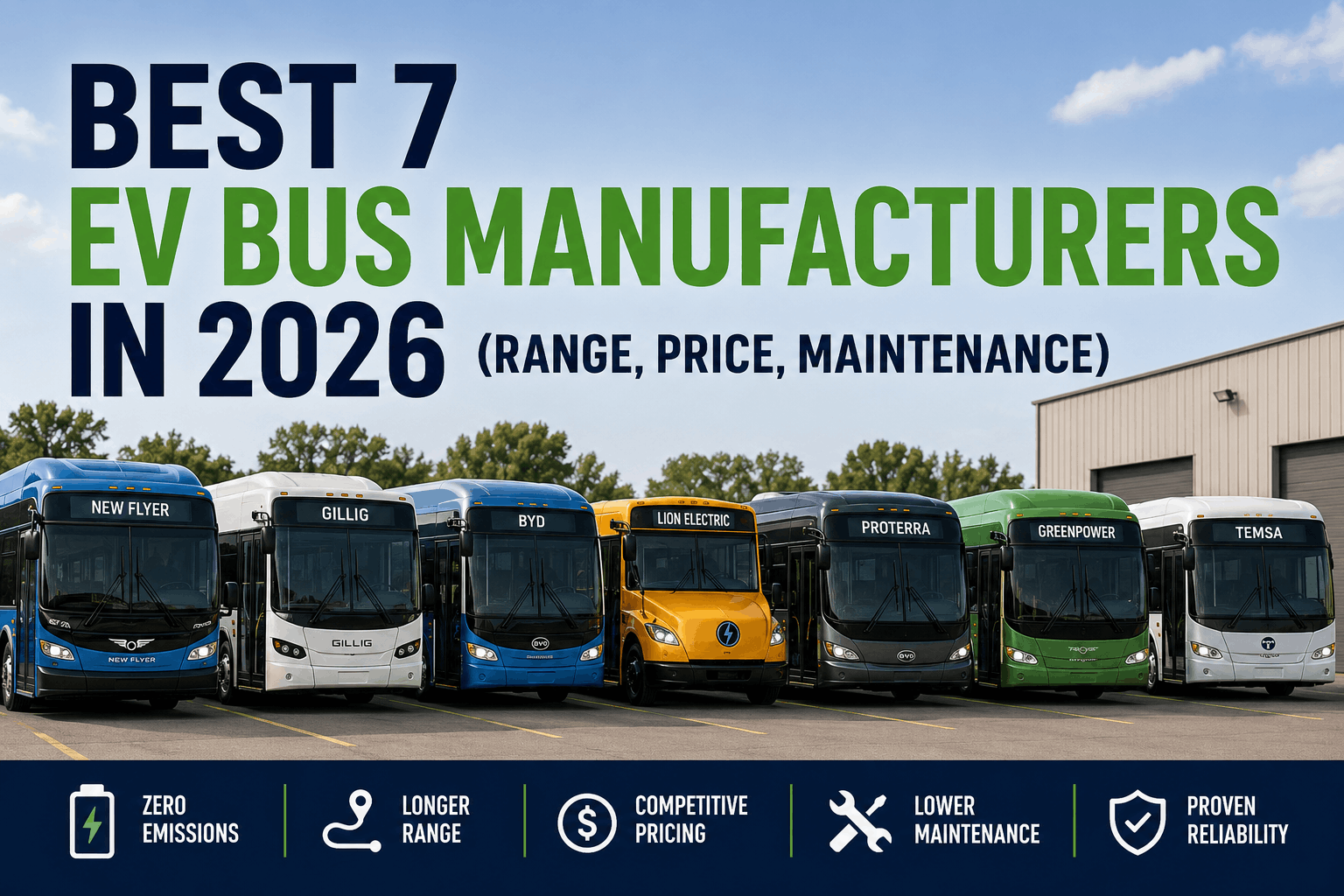
Electric bus adoption is accelerating across transit agencies, school districts, and paratransit providers. With over 6,000 electric buses now operating in US fleets, choosing the right manufacturer is critical for range, total cost of ownership, and maintenance support. This ranking compares the 7 best EV bus manufacturers in 2026 based on range, price, parts availability, and maintenance cost.
2026 EV Bus Manufacturer Ranking
Best 7 EV Bus Manufacturers in 2026 — Range, Price, Maintenance
Ranked: 7 best electric bus manufacturers in 2026. New Flyer, Gillig, BYD, Lion Electric, Proterra successor, GreenPower — range, price, parts, maintenance cost.
EV Bus Market Growth Statistics
Electric bus fleets are growing at 45% annually in the US. Federal and state incentives are driving adoption, with total cost of ownership now competitive with diesel for many applications. Maintenance costs for EV buses are 40% lower on average, with fewer moving parts and no oil changes.
6,000+
EV buses in US fleets
45%
Annual fleet growth rate
40%
Lower maintenance cost vs diesel
300 mi
Average range of new EV buses
Top 7 EV Bus Manufacturers — Ranked
Each manufacturer is evaluated on range, price, parts availability, maintenance cost, and fleet feedback. Rankings reflect real-world performance across US transit agencies and school districts.
1
New Flyer (Xcelsior CHARGE)
Range: 300 mi. Price: $750K. Parts availability: excellent. Maintenance cost: low. 40% US transit EV market share.
2
Gillig (Low Floor EV)
Range: 280 mi. Price: $720K. Parts availability: good. Maintenance cost: low. Strong West Coast presence.
3
BYD (K Series)
Range: 250 mi. Price: $650K. Parts availability: good. Maintenance cost: medium. Leading global EV bus manufacturer.
4
Lion Electric (LionC)
Range: 240 mi. Price: $680K. Parts availability: moderate. Maintenance cost: medium. Strong in school bus segment.
5
Proterra (Zevo)
Range: 260 mi. Price: $700K. Parts availability: good. Maintenance cost: low. Innovative battery technology.
6
GreenPower (BEAST)
Range: 220 mi. Price: $620K. Parts availability: moderate. Maintenance cost: high. Focus on school buses and shuttle.
7
Thomas Built (Saf-T-Liner C2 EV)
Range: 200 mi. Price: $580K. Parts availability: moderate. Maintenance cost: medium. Leading school bus EV option.
EV Bus Comparison — Range, Price, Maintenance
New Flyer leads with 300 miles range and $750K price. Gillig and Proterra offer strong range with moderate pricing. BYD and Lion provide cost-effective options with adequate range for most transit applications. GreenPower and Thomas Built are school bus focused with shorter range but lower entry cost.
EV Bus Market Share by Manufacturer
New Flyer holds 40% of the US EV bus market, driven by strong transit agency adoption. BYD follows at 25%, Gillig at 20%, and all other manufacturers combined at 15%. Market concentration is high but competition is increasing as more OEMs enter the EV space.
EV Bus Selection Criteria — Pass / Fail Thresholds
Range
Pass: 250+ miles on a single charge. Sufficient for daily routes with reserve. Thermal management effective.
Fail: Under 200 miles. Range anxiety. Unable to complete full shift without charging.
Price per Bus
Pass: Under $750K with incentives. Competitive with diesel over lifecycle. Good financing options.
Fail: Over $850K. High upfront cost. Long payback period.
Parts Availability
Pass: 95%+ parts availability. National distribution. 24-48 hour delivery for critical components.
Fail: Under 80% parts availability. Long lead times. Limited service network.
Maintenance Cost
Pass: Under $0.30 per mile. 40% lower than diesel. Fewer moving parts. Predictive diagnostics.
Fail: Over $0.45 per mile. High battery replacement cost. Frequent software updates required.
Fleet Feedback
Pass: 4.5+ star satisfaction. High reliability. Good manufacturer support.
Fail: Mixed reviews. Frequent breakdowns. Poor technical support.
Battery Warranty
Pass: 8+ years / 500,000 miles. Capacity retention above 80% at end of warranty.
Fail: Under 5 years / 300,000 miles. Limited capacity guarantee.
EV Bus Fleet KPIs
Track these five key performance indicators to optimize your electric bus program:
Energy Efficiency
Target: 2.0–2.5 kWh per mile. Track weekly. High consumption indicates driving style or thermal issues.
Charging Uptime
Target: 98%+ charger availability. Track monthly. Downtime affects route scheduling and range confidence.
Battery Degradation
Target: Under 2% per year. Track quarterly. High degradation signals thermal management or charging practice issues.
Maintenance Cost per Mile
Target: Under $0.30. Track monthly. Rising cost indicates component wear or service inefficiency.
Fleet Availability
Target: 95%+ vehicles available. Track daily. Low availability indicates charging or maintenance bottlenecks.
Our transit agency operates 75 New Flyer Xcelsior CHARGE buses. In two years, we've achieved 98% fleet availability, energy efficiency of 2.2 kWh per mile, and maintenance costs 42% lower than our diesel fleet. Battery degradation is under 1.5% annually. The predictive diagnostics integrated with our CMMS has eliminated unscheduled downtime.
Optimize Your EV Bus Maintenance Program
BusCMMS provides comprehensive maintenance management for electric bus fleets. Track battery health, charging schedules, energy consumption, and service history. Auto-schedule PM based on mileage and time. Complete visibility into your EV fleet's performance and costs.
EV Bus Manufacturer FAQs
Which EV bus manufacturer has the best range?
New Flyer's Xcelsior CHARGE offers the longest range at 300 miles, followed by Gillig at 280 miles and Proterra Zevo at 260 miles. For most transit applications, 250+ miles is sufficient for a full day of service with reserve.
What is the average price of an electric bus?
Electric bus prices range from $580,000 to $750,000 depending on manufacturer, battery size, and features. Federal and state incentives can reduce upfront costs by 30-50%, making EV buses competitive with diesel over the lifecycle.
How much does EV bus maintenance cost compared to diesel?
EV bus maintenance costs are typically 30-40% lower than diesel, averaging $0.25–$0.35 per mile. There are no oil changes, fewer filters, and regenerative braking extends brake life. Battery maintenance is the primary difference.
Which EV bus is best for school districts?
Thomas Built (Saf-T-Liner C2 EV) and Lion Electric (LionC) are the leading school bus EV options. GreenPower (BEAST) is also gaining traction. These models are designed for school routes with moderate daily mileage and robust safety features.
How long do EV bus batteries last?
Most EV bus batteries are warrantied for 8–10 years or 500,000 miles, with capacity retention above 80%. Real-world data shows batteries lasting 12–15 years in moderate climates with proper thermal management and charging practices.
Can BusCMMS manage EV bus maintenance effectively?
Yes. BusCMMS tracks EV-specific maintenance tasks like battery health, high-voltage inspections, cooling system checks, and software updates. The system integrates with telematics to auto-capture energy consumption and schedule maintenance based on actual usage.
The Bottom Line
Electric bus adoption is accelerating, and choosing the right manufacturer is critical for operational success. This ranking of the 7 best EV bus manufacturers for 2026 shows New Flyer leading in range, market share, and fleet satisfaction, followed by Gillig and BYD. Consider range requirements, total cost of ownership, parts availability, and maintenance support when selecting a manufacturer. New Flyer and Gillig offer the best balance for transit agencies, while BYD and Lion provide cost-effective alternatives. Thomas Built and GreenPower are strong choices for school districts. EV buses deliver 40% lower maintenance costs and significantly lower emissions than diesel. Combine your EV fleet with BusCMMS for automated maintenance tracking, battery health monitoring, and complete cost visibility. Start your free trial today to optimize your electric bus program.