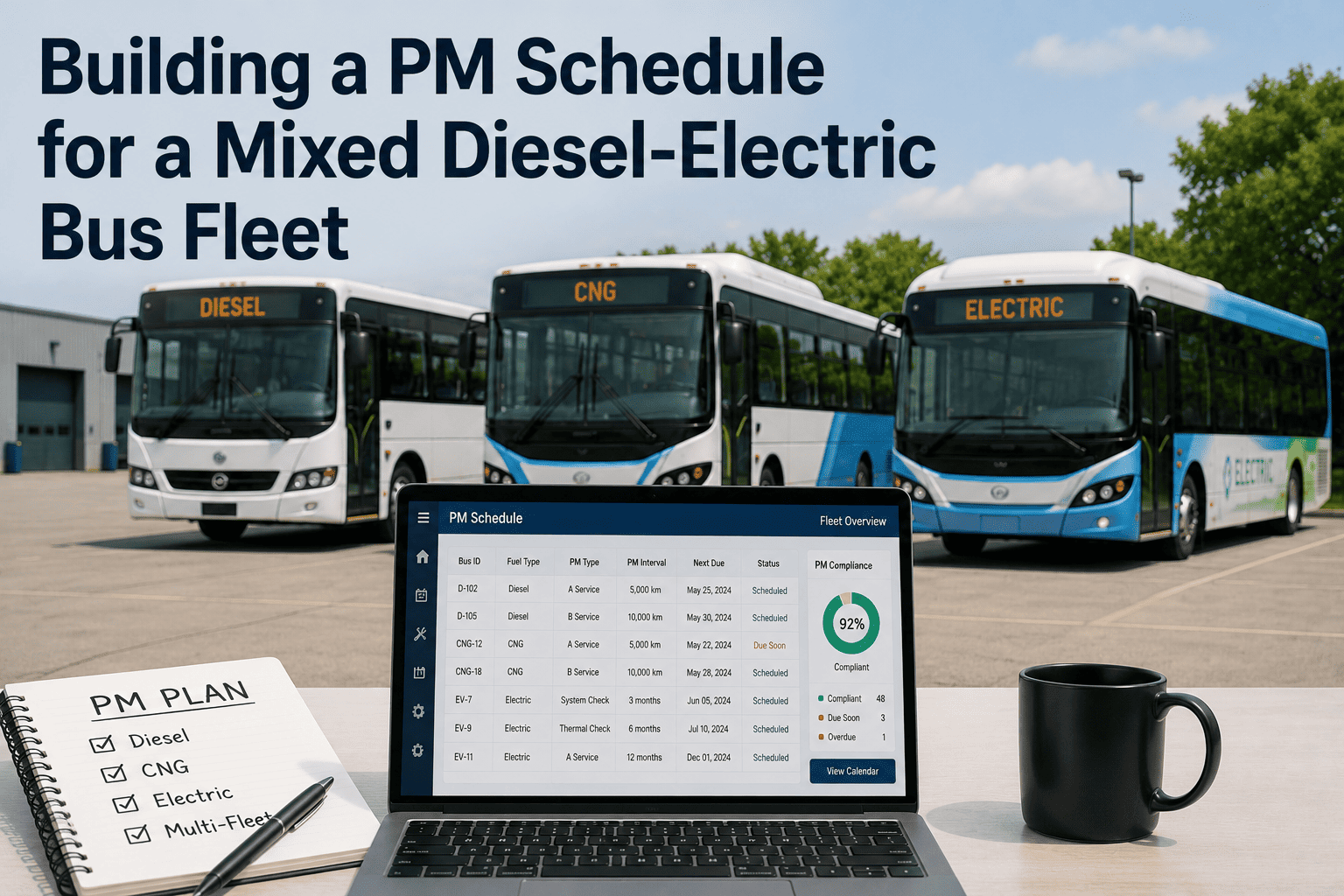
Preventive maintenance is the backbone of efficient bus fleet operations across the United States. Fleet managers at school districts, transit agencies, charter companies, and private transportation services face a critical challenge: managing buses with different fuel types—diesel, compressed natural gas (CNG), and electric—each requiring distinct maintenance schedules, specialized parts, and unique service intervals. A single PM schedule cannot serve a diesel engine operating at 500,000+ miles the same way it serves an electric drivetrain with zero combustion emissions. Building an effective preventive maintenance schedule for mixed fuel-type fleets requires deep understanding of fuel-specific requirements, maintenance triggers, compliance standards, and the operational complexities of modern transportation. This comprehensive guide teaches you how to build PM schedules that handle diesel, CNG, and electric buses in one integrated system, maximize uptime, reduce unexpected breakdowns by 70–80%, and cut total maintenance costs by 30–40% annually.
Multi-fuel fleets demand multi-trigger PM scheduling. Master fuel-type-aware maintenance and achieve 90%+ uptime while saving $150,000+ annually on 45-bus operations.
The first critical mistake fleet managers make is treating all buses identically. Diesel buses, CNG buses, and electric buses have fundamentally different failure modes, wear patterns, and service intervals. A one-size-fits-all PM schedule is not just inefficient—it's dangerous. It leaves some vehicles under-maintained (risking catastrophic failure) while over-maintaining others (wasting money on unnecessary service).
Diesel Bus PM Requirements are well-established and industry-standardized. Cummins, Detroit Diesel, and Allison—the major manufacturers of heavy-duty bus powertrains—publish detailed maintenance schedules. Diesel engines require oil changes every 15,000–25,000 miles depending on operating environment (city driving requires more frequent changes than highway). Engine coolant needs flushing every 150,000 miles or 5 years. Transmission fluid changes every 100,000 miles. Air filters every 30,000–50,000 miles. Fuel filters every 15,000 miles. The key insight: diesel PM is heavily mileage-dependent because mileage accurately reflects engine work on vehicles spending most time at highway speeds. However, city buses with frequent stops and idling accumulate more engine hours than mileage would suggest, requiring calendar-based triggers as safety nets.
CNG Bus PM Requirements overlap with diesel but diverge significantly on fuel system components. CNG buses still need standard transmission, cooling system, and electrical maintenance like diesels. But the natural gas fuel system introduces additional requirements that diesel engines don't have: fuel injector inspections every 12 months or 50,000 miles (CNG injectors are more prone to carbon buildup than diesel injectors), regulator checks every 12 months (regulators control fuel pressure and can degrade), storage cylinder inspections annually (regulatory requirement for safety certification), and pressure relief valve testing. CNG buses typically have lower oil change intervals (10,000–15,000 miles) because the fuel system is more sensitive to contamination. A fleet operating mixed CNG and diesel buses cannot use the same PM template; the CNG-specific fuel system work must be explicitly scheduled.
Electric Bus PM Requirements are dramatically different because they skip engine maintenance entirely. No oil changes, no air filters, no fuel filters, no transmission fluid, no engine coolant. Instead, electric buses require battery health monitoring every 6 months (checking voltage, capacity, thermal management), brake fluid inspection quarterly (regenerative braking is gentler but hydraulics still need maintenance), coolant loop inspection (electric motors generate heat requiring cooling), and thermal management system diagnostics. Tire maintenance is actually more critical on electric buses because they're heavier (6,000–7,000 lbs additional weight from battery pack) than equivalent diesel buses, causing accelerated tire wear. Many electric buses see 20–30% shorter tire life than diesels. Electric bus PM is heavily calendar-dependent and condition-dependent (battery health metrics) rather than mileage-dependent, because annual mileage varies widely (some electric buses run 8,000–12,000 miles/year on short urban routes; others run 45,000+ miles/year on longer routes).
Leading U.S. transit agencies and school districts manage this complexity using fuel-type-aware CMMS systems that maintain separate PM templates for each fuel type. Every maintenance record is tagged with fuel type and vehicle age. When a work order is generated, it specifies fuel-type-specific requirements: "Oil change for CNG bus: use SAE 10W-30 synthetic blend (CNG-spec only); diesel spec will void warranty." This prevents catastrophic mistakes like putting diesel-spec oil in a CNG engine.
A single maintenance trigger—usually mileage—is insufficient for modern mixed fleets. The industry-standard approach is "whichever comes first" logic: every PM interval is defined by three independent thresholds, and service is triggered when ANY threshold is met. This methodology is recommended by all major OEMs (Cummins, Allison, Volvo Buses), industry associations (American Bus Association), and regulatory bodies (FMCSA).
Mileage triggers capture distance-based wear: an engine running at steady highway speed accumulates predictable wear per mile. For diesel buses operating primarily on highways, mileage is often the primary trigger. A diesel bus with 20,000-mile oil change interval might accumulate those miles in 4–5 months, making mileage the natural scheduling baseline.
Engine-hour triggers capture actual engine load and stress independent of miles traveled. Two buses with identical 100,000 miles might have dramatically different engine hours. A city bus averaging 4.5 MPG (indicating heavy traffic, frequent stops, high idle time) has accumulated roughly 22,200 engine hours. A highway bus averaging 6.8 MPG (steady cruise) has only 14,700 engine hours. Engine hours directly correlate to lubrication degradation and bearing stress. City bus 1 needs more aggressive oil change than highway bus 2, even though both show 100,000 miles. Engine-hour triggers ensure high-idle buses get serviced more frequently than highway buses at identical mileage.
Calendar triggers prevent the "dormant fluid" problem—the most dangerous PM failure mode. A school bus used 180 days per year might accumulate only 8,000 miles in 18 months. At a 20,000-mile oil change interval, it would never be serviced. But lubricant oxidizes in storage, losing viscosity and protection. The calendar trigger ensures service happens: "Oil change every 12 months OR 20,000 miles, whichever is sooner." For seasonal buses, the calendar trigger may be the controlling factor, overriding mileage.
Automated CMMS implementation is essential because manual tracking fails. Bus CMMS integrates GPS data (verifying odometer to ±0.1% accuracy), telematics engine-hour data (from OBD ports), and calendar logic. When any threshold is reached, a work order is generated automatically with the triggering reason noted: "Oil change due: 400 engine hours reached [trigger]; 19,850 miles accumulated [not yet triggered]; 11.8 months elapsed [not yet triggered]—service due because engine hours threshold exceeded."
The mathematics of multi-trigger scheduling reveals why it's essential: assume a 45-bus fleet with 15 diesel buses averaging 25,000 miles/year and 500 engine hours/year. Single-trigger (mileage only) scheduling would space oil changes 20,000 miles apart = 1 oil change per 10 months on average. Multi-trigger scheduling with (20,000 miles OR 400 hours OR 12 months) triggers would still generate 1 oil change per ~10 months on average, BUT it prevents the scenario where a bus sits idle for 14 months and is never serviced. The calendar trigger acts as a safety net, ensuring nothing slips through.
Building PM schedules for mixed fleets is a structured process. Leading U.S. fleets follow a phased 90-day implementation to avoid shop overwhelm.
Phase 1: Audit (Days 1–14) — Pull 24 months of maintenance history. Calculate current spending per bus, breakdown frequency, and reactive-vs-planned maintenance ratio. Document your fleet composition: how many diesel, CNG, and electric buses? Average age? Utilization (bus-days/month in service)? Identify your peak maintenance periods (e.g., post-summer for school buses, winter for transit). This data becomes your baseline for measuring improvement.
Phase 2: PM Design (Days 15–35) — For each fuel type, design PM schedules using OEM specifications as starting points. Cummins publishes detailed diesel engine PM intervals. Westport (CNG engines) and Volvo (electric) do likewise. But also gather internal history: which components fail most frequently on YOUR fleet? A school district might discover their buses have 40% higher air filter consumption than OEM spec suggests (due to dusty rural roads). A city transit system might find brakes wear 20% faster than specified (due to frequent stop-and-go driving). Use this real-world data to tailor schedules. For a 45-bus mixed fleet, expect to create 8–12 PM templates covering fuel-type and duty-cycle variations.
Phase 3: CMMS Configuration (Days 36–60) — Input PM schedules into Bus CMMS. Configure GPS integration (automatic mileage capture), telematics integration (automatic engine-hour capture), and alert thresholds (service flagged when due date is 14 days away). Set up work order templates that specify fuel-type requirements and parts needed. Run a dry run on 8–10 buses: load their service history, calculate what PM is now overdue, and verify the system logic is correct.
Phase 4: Pilot Rollout (Days 61–75) — Go live with the 8–10 pilot buses. Run them on CMMS-scheduled PM for two weeks. Monitor whether work orders are generated correctly, whether shop crews understand the new process, and whether any PM intervals need adjustment. Expect 5–10% of work orders to have errors (system logic misunderstandings, data entry mistakes) in the first two weeks. Fix these systematically.
Phase 5: Full Rollout (Days 76–90) — Expand to remaining buses in cohorts of 15 every 2 weeks. By day 90, all 45 buses are on CMMS-scheduled PM. Expected outcome: PM compliance jumps from 65–75% to 88–92%, unplanned breakdowns drop 60–70%, and uptime improves 15–20 percentage points. Maintenance costs drop 25–35% in year one as you eliminate wasted service and prevent breakdowns.
Building perfect PM schedules means nothing if you can't execute them. Two critical factors determine success: (1) ensuring PM services happen on schedule (compliance), and (2) having required parts in stock when services are due (parts availability).
PM compliance rate = (Services Completed On Time) ÷ (Services Due) × 100. Well-managed fleets target 95–98% compliance. If 187 PM services are due in a month and 181 are completed on time, compliance is 96.8%. If only 165 are completed, compliance drops to 88.2%—a gap costing $12,000–20,000 in extra unplanned maintenance that month.
Achieving high compliance requires: (1) early alerts (service flagged 14 days before due date, not 1 day before), (2) predictable shop capacity (dedicating specific days/hours to PM work), (3) parts pre-positioning (ordering long-lead-time items 6 weeks in advance), and (4) crew training (ensuring technicians understand procedures and don't repeat work). Most fleets see compliance improve 10–15 percentage points within 60 days of CMMS implementation, simply because visibility is created.
Parts availability is the second compliance killer. A shop schedules an oil change for Wednesday, but the CNG-spec oil hasn't arrived. The service is deferred to Friday. Friday rolls around and a transmission service takes longer than expected, pushing the oil change to next week. Suddenly a service scheduled for Wednesday hasn't happened by the following Wednesday—it's now overdue. A robust parts management system (integrated with your CMMS) tracks inventory, flags slow-moving items, and auto-orders replenishment when stock hits threshold. Bus CMMS includes parts management; you specify that you always want 4 cases of CNG-spec SAE 10W-30 in stock, and the system alerts you when inventory reaches 3 cases—time to order more.
Before Bus CMMS, our PM scheduling was a nightmare. We had a spreadsheet tracking which buses needed service, but with 42 buses and mixed fuel types, buses kept falling through the cracks. We'd discover overdue maintenance only when a bus broke down. Now the system tells us exactly what's due, when it's due, and what parts we need. Our maintenance manager spends an hour per week reviewing the dashboard instead of 10 hours firefighting breakdowns. Our uptime jumped from 71% to 89% in six months. The ROI was immediate.
How do I know which PM intervals to use for my specific buses?
Start with OEM (manufacturer) specifications as the baseline. Then analyze your fleet's historical maintenance data: which components fail most frequently? Are your air filter intervals longer or shorter than OEM spec? Use this real-world data to fine-tune intervals. Bus CMMS has manufacturer-specific PM templates built-in for most common bus models, so you don't start from scratch.
What's the difference between a diesel and CNG PM schedule?
Diesel buses skip the CNG fuel system work (injector checks, regulator inspections, cylinder certifications). CNG buses skip some diesel-specific checks but add natural gas fuel system diagnostics. Oil change intervals are tighter on CNG (12,000–15,000 miles vs. 20,000 for diesel). Always use fuel-type-specific PM templates; mixing them causes expensive mistakes.
Do electric buses really need less maintenance than diesel?
Yes, roughly 20–30% less. No engine oil, no air filters, no fuel system. But battery diagnostics and thermal management are more frequent (every 6 months vs. 12 for diesel). Tire wear is faster due to weight. So total maintenance is lighter, but different—not lower indefinitely.
How often should I revisit and adjust my PM schedules?
Quarterly during the first year, then annually. As you accumulate real-world data on component failures and service history, you'll find some intervals can be extended (data shows components have more life) while others need tightening. Let actual fleet experience drive refinement.
What happens if a bus misses a scheduled PM service?
The service is marked overdue and flagged in your compliance dashboard. Contact the shop immediately to understand the blocker (parts delay, capacity issue, data entry error). Schedule it within one week. Systematically investigate why compliance slipped; usually it's a parts availability or shop capacity issue you can fix.
How much does it cost to implement CMMS-based PM scheduling?
Bus CMMS is $8–18 per bus per month depending on fleet size and features. A 45-bus fleet pays $4,320–9,720 annually. Most fleets see 3–6 month payback through reduced breakdowns and eliminated wasted service. First-year savings typically exceed $150,000 on mid-sized fleets.
Can I manage mixed fleet PM with a spreadsheet instead of CMMS software?
Technically yes, but it fails at 30+ buses. With 45 mixed-fuel buses, tracking 3 triggers per service type per bus means 1,000+ data points to monitor manually. One missed update and compliance slips. CMMS automation scales to any fleet size without human error.
What's the most common PM scheduling mistake fleet managers make?
Using mileage-only triggers and ignoring calendar/engine-hour triggers. Seasonal buses, idle equipment, and high-idling vehicles fall through the cracks. Multi-trigger logic (whichever comes first) prevents this entirely. Don't rely on single triggers; always use three.
Building PM schedules for mixed diesel-electric fleets is no longer optional for competitive U.S. bus operators. The American Bus Association, FMCSA guidance, and leading transit agencies all mandate preventive, fuel-type-aware PM. Fleets operating reactive maintenance spend 2–3x more on unplanned repairs than prevention-focused fleets. The technology (CMMS with multi-trigger scheduling, telematics integration, automated parts management) is mature and affordable. The ROI is undeniable: 30–40% maintenance cost reduction, 18–25% uptime improvement, and 70–80% reduction in emergency breakdowns. This is foundational operational excellence, not cutting-edge innovation.