A 112-bus transit fleet in Florida replaced brakes on a schedule: every 60,000 miles regardless of wear. Some buses came in with 50% pad life remaining — $18,000 in wasted material and labor annually. Other buses with longer routes wore pads to the backing plates at 55,000 miles, scoring rotors and adding $12,000 in extra rotor replacements. The fleet was both wasting money and creating safety risks. Brakes don't wear by mileage alone — they wear by duty cycle, driver behavior, route terrain, and bus weight. The fleets that optimize brake replacement cost save 30-40% annually while improving safety. This guide covers how to diagnose brake wear accurately, when to replace, and how to time replacements for maximum life and minimum cost.
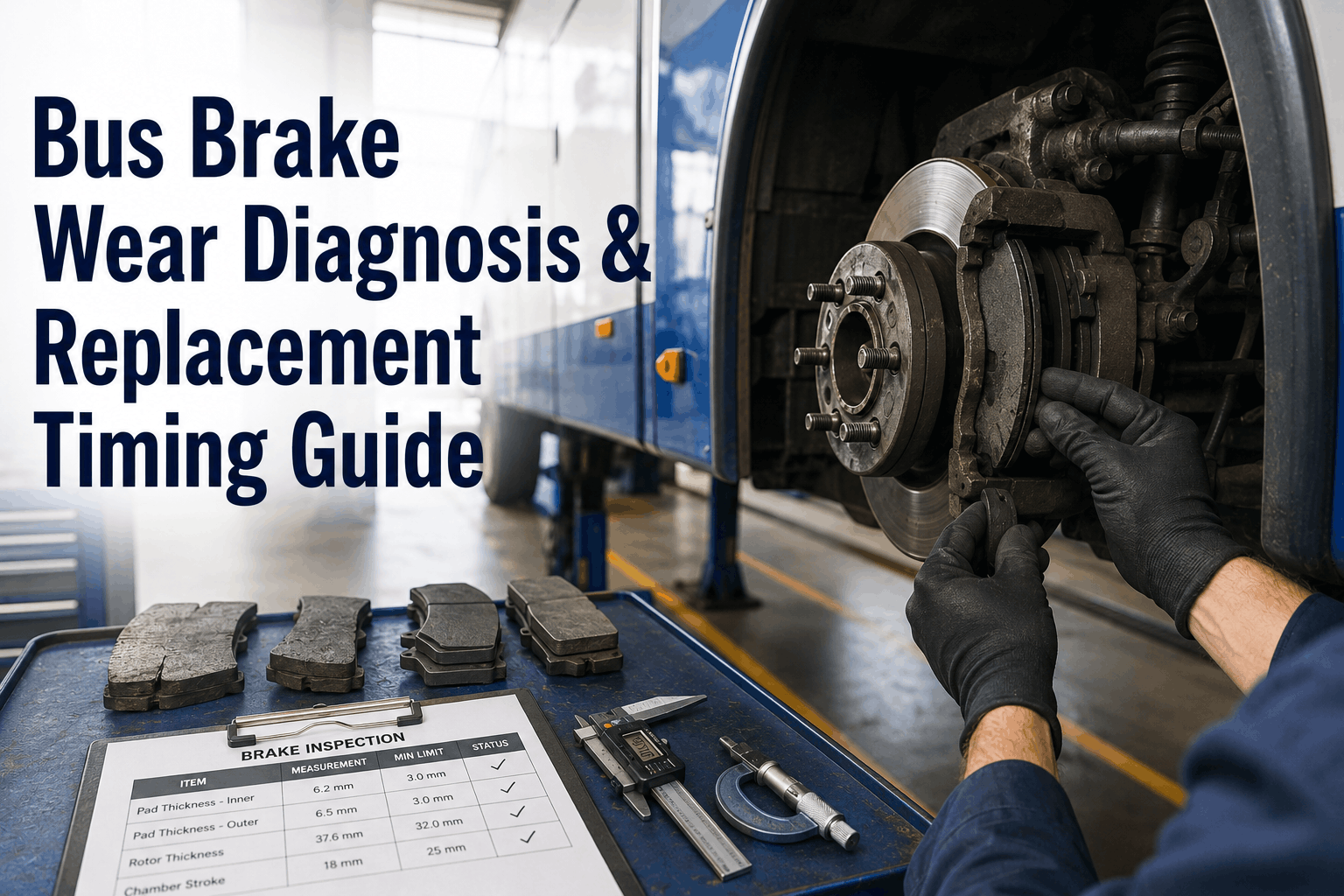
Bus Brake Wear Diagnosis & Replacement Timing Guide
Measure wear accurately. Replace at the right time. Extend brake life by 30-40%. Save thousands per bus annually.
Bus Brake Replacement — Cost Impact
Replacing brakes too early wastes 30-40% of usable life. Replacing too late destroys rotors/drums. Accurate wear diagnosis saves both.
Brake Wear Limits: Legal & Safety Minimums
FMCSA 49 CFR 393.47 establishes minimum brake lining thickness for commercial vehicles. Steer axle brakes require 4/32 inch (3.2mm) minimum lining thickness. Drive and tag axles require 2/32 inch (1.6mm) minimum. Below these limits, the bus is out of service — immediate violation with fines and potential towing. However, these are absolute minimums, not replacement targets. Replacing at the legal minimum means you've already been running brakes near failure. Best practice: replace steer axle brakes at 6/32 inch (4.8mm) and drive axle brakes at 4/32 inch (3.2mm). This provides safety margin and prevents rotor damage from backing plates contacting metal. Never allow any brake to wear below the FMCSA minimum — the safety and liability risk is unacceptable.
Brake Lining Thickness — Action Guide
Replace in axle sets — never replace only one side. Uneven braking causes pull during stops.
"An FMCSA auditor caught three of our buses with steer axle pads at 3/32 inch — below the 4/32 legal minimum. Each bus was immediately placed out of service. Total fines: $14,000. Plus towing. Plus missed routes. Now we measure every 10,000 miles and replace at 6/32. The extra pad life we 'lost' by replacing early is nothing compared to the fines and downtime we avoid."
How to Measure Brake Wear Accurately
Visual inspection is not accurate enough for replacement decisions. Mechanics' estimates of "50% remaining" vary wildly — one mechanic's 50% is another's 30%. Use a brake lining thickness gauge (inexpensive tool, $20–$50). Measure through inspection ports on air brake chambers or through wheel openings on hydraulic brakes. Measure both inner and outer pads — inner pads often wear faster due to caliper drag. Measure at multiple points across the lining — uneven wear indicates caliper or slack adjuster problems. Record measurements in millimeters or 32nds of an inch. Track wear rate over time — a bus that wore 2/32 in 10,000 miles will wear another 2/32 in the next 10,000. Use this data to predict replacement timing.
Brake Measurement Tools & Methods
Where to Measure (Critical Points)
Never measure only the outer pad. Inner pads wear 20-40% faster due to caliper drag. A bus with 6/32 outer pads may have 3/32 inner pads — below legal minimum.
Wear Patterns: Diagnosing Underlying Problems
Uneven brake wear is not normal — it indicates a mechanical problem that must be addressed during replacement. Tapered wear (one end of pad thicker than other) indicates caliper slide pin or air brake slack adjuster issues. Inner pad wearing faster than outer indicates caliper drag — the caliper piston is not retracting fully. Scored or grooved rotors indicate embedded debris or worn pads contacting metal. Glazed pads (shiny, smooth surface) indicate overheating — driver riding brakes or stuck caliper. Cracked pads indicate thermal shock from hard stops followed by water. Diagnose and fix these issues during replacement. If you replace pads without addressing the root cause, the new pads will wear just as unevenly and fail prematurely.
Abnormal Wear Patterns — Root Causes
Tapered wear (one end thicker) — stuck slide pins or slack adjuster
Inner pad wear faster — caliper drag, piston not retracting
Outer pad wear faster — caliper mounting bracket corrosion
Glazed/smooth surface — overheating, driver riding brakes
Cracked pads — thermal shock, water on hot brakes
Crusty/delaminated pads — contaminated with oil or grease
Fix root cause at replacement. Otherwise, new pads fail in half the expected life.
Expected Brake Life by Duty Cycle (Air Disc Brakes)
These are ranges, not guarantees. Measure wear every 10,000–15,000 miles to establish fleet-specific replacement intervals.
Air Brake vs Hydraulic Brake Wear Differences
School and transit buses use air brakes. Medium-duty and some shuttle buses use hydraulic brakes. Wear diagnosis differs between systems. Air brakes use brake chambers and slack adjusters — check slack adjuster stroke when measuring lining. Stroke exceeding 1 inch (manual adjust) requires adjustment. Automatic slack adjusters that don't maintain stroke need replacement. Hydraulic brakes use master cylinder and calipers — check brake fluid level and condition. Dark fluid indicates contamination — flush system. Hydraulic brake pads wear faster than air disc pads because hydraulic systems apply more clamping force. Regardless of system, the lining thickness minimums (4/32 steer, 2/32 drive) apply equally to air and hydraulic brakes.
Air Brake — Additional Checks
Hydraulic Brake — Additional Checks
Rotor & Drum Wear: When to Replace
Rotors (disc brakes) and drums (drum brakes) don't need replacement at every pad change unless they are worn below specification, warped, or scored. Minimum rotor thickness is stamped on the rotor edge — typically 1.25-1.5 inches for heavy-duty bus rotors. Measure thickness at multiple points with a micrometer. Warped rotors cause pedal pulsation — replace or resurface (resurfacing is rarely cost-effective on heavy-duty rotors). Drum maximum diameter is stamped inside drum — typically 14.75-15.0 inches for bus drums. Replace drums when diameter exceeds maximum by 0.080-0.120 inches. Scored rotors or drums (grooves deeper than 0.060 inches) require replacement — new pads will not bed properly on damaged surfaces. Rotor replacement adds $1,500-3,000 per axle to brake job.
Rotor/Drum Replacement Indicators
Always replace rotors/drums in axle pairs. Never replace only one side — braking balance will be uneven.
Building a Brake Replacement Prediction Model
The most cost-effective fleets don't replace brakes on fixed mileage intervals. They predict replacement based on wear rate. Measure brake thickness at every PM (10,000-15,000 miles). Calculate wear rate per 1,000 miles. Example: New pads at 14/32. At 50,000 miles, measure 8/32. Wear = 6/32 over 50,000 miles = 1.2/32 per 10,000 miles. Replacement target for steer: 6/32. Miles remaining = (current thickness - target) / wear rate × interval. At 8/32, need to lose 2/32 at 1.2/32 per 10k miles = 16,600 miles to replacement. This prediction allows you to schedule brake jobs at convenient times, combine with other PM, and order parts in advance. Over time, you'll develop fleet-specific replacement intervals that maximize brake life without risking legal minimums.
"We used to replace brakes at 60,000 miles on every bus. Some buses needed them at 50,000. Some had 40% pad left at 70,000. Now we measure every 10,000 miles and calculate wear rate per bus. Our brake parts spend dropped 32% in the first year. We replace only when needed, not on a calendar. And we've had zero brake-related out-of-service violations since switching to measurement-based replacement."
The cost of measuring brake thickness every 10,000 miles: 5 minutes per bus. The cost of replacing brakes 10,000 miles too early: $500–$1,000 per bus. The cost of replacing brakes 10,000 miles too late: $1,500–$3,000 in rotor damage plus safety risk.
Fleet Expert Review
Brake replacement timing is one of the largest variable costs in bus maintenance. Replace too early and you waste 30-40% of usable pad life across your fleet — tens of thousands of dollars annually. Replace too late and you destroy rotors and drums, adding $1,500-3,000 per axle to the repair. The solution is measurement-based replacement. Measure lining thickness every 10,000-15,000 miles. Track wear rate per bus. Predict replacement timing within 2,000 miles. Fix uneven wear patterns when you find them. Replace rotors only when below spec. The fleets that do this spend 30-40% less on brakes annually while maintaining better safety margins. BusCMMS tracks brake measurements per axle, calculates wear rates, predicts replacement dates, and alerts you when pads approach your replacement target. One dashboard gives you complete visibility into every brake in your fleet.
The Bottom Line
Accurate brake wear diagnosis and timely replacement saves money and improves safety. The legal minimums (4/32 steer, 2/32 drive) are absolute floors — not replacement targets. Replace earlier with safety margin: 6/32 for steer, 4/32 for drive. Measure every 10,000-15,000 miles with a thickness gauge — not by visual estimate. Calculate wear rate per bus to predict replacement timing. Diagnose and fix uneven wear patterns at replacement — otherwise new pads will fail early. Replace rotors and drums only when below specification, warped, or deeply scored. The fleets that follow this approach reduce brake spend by 30-40% while eliminating out-of-service brake violations. BusCMMS tracks every measurement, calculates wear predictions, and schedules replacements at the optimal time — not too early, not too late.
Stop Replacing Brakes Too Early (or Too Late)
BusCMMS tracks brake measurements per axle, calculates wear rates, and predicts replacement timing. Save 30-40% on brake spend annually. Free 14-day trial.
Frequently Asked Questions
What is the legal minimum brake lining thickness for school buses?
How often should I measure brake lining thickness?
Why does one brake pad wear faster than the other on the same axle?
Do I need to replace rotors every time I replace pads?
How many miles do bus brake pads typically last?
Can BusCMMS track brake wear and predict replacement timing?
Every Brake. Every Axle. One Dashboard.
Air disc, air drum, hydraulic disc. Steer, drive, tag. Brake measurement tracking, wear prediction, replacement scheduling. All in one system. Free 14-day trial.