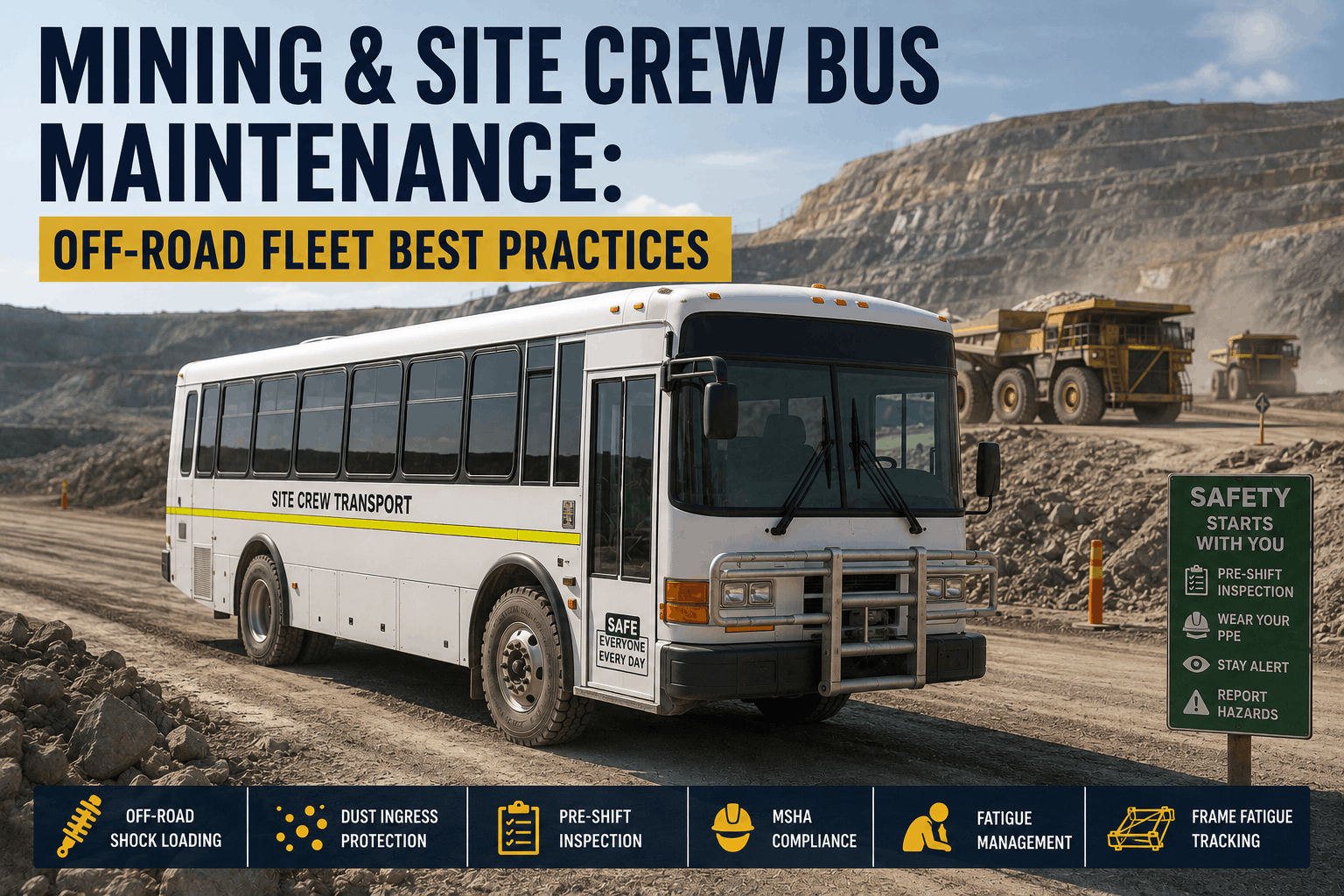
Bus maintenance by mileage intervals is the most reliable way to prevent breakdowns and extend vehicle life. Unlike calendar-based schedules that ignore actual usage, mileage-based intervals align maintenance with the actual wear and tear on engine, transmission, brakes, and chassis components. A school bus that drives 12,000 miles per year has very different maintenance needs than a charter bus covering 60,000 miles annually. This guide maps every service interval from 5,000 to 100,000+ miles based on diesel bus manufacturer recommendations and real fleet data. Follow these intervals, and your buses will consistently exceed their expected 15-20 year service life. Schedule a demo of Bus CMMS preventive maintenance scheduling.
Why Mileage-Based Maintenance Beats Calendar Schedules
Calendar-based maintenance (every 3 months, every 6 months) assumes all buses experience equal wear. They do not. A bus used for daily school routes accumulates 10,000-15,000 miles per year. A transit bus may run 30,000-40,000 miles annually. A charter bus covering long distances can exceed 60,000 miles per year. Using the same calendar schedule for all three means some buses get over-serviced (wasting money) while others get under-serviced (increasing failure risk). Mileage-based intervals solve this problem. Each service is triggered when the odometer reaches a specific threshold. The bus that drives more miles gets serviced more frequently. The bus that drives fewer miles does not waste money on unnecessary oil changes. Modern bus maintenance software like Bus CMMS automatically tracks odometer readings from GPS integration or manual entry, then generates work orders when each bus reaches its next mileage interval. No more missed services. No more premature services.
Complete Mileage-Based Maintenance Schedule
The chart below shows standard intervals for diesel-powered Type C and Type D buses. Actual intervals may vary by engine manufacturer (Cummins, Detroit, Navistar) and transmission type (Allison, Voith). Always verify with your specific bus OEM manuals.
Engine oil and filter change, chassis lubrication (grease fittings), tire pressure check and adjustment, fluid top-offs (coolant, power steering, wiper), brake inspection (linings and air system), belt and hose visual inspection, battery terminal cleaning, DVIR review for recurring issues.
Fuel filter replacement, air filter inspection (replace if restriction gauge shows >25 inches H₂O), suspension torque check, wheel bearing inspection (grease seals for leaks), alternator belt tension check, exhaust system inspection for leaks or hanger damage.
Intermediate “A” service. No additional major components unless OEM specifies otherwise.
Crankcase breather replacement (closed crankcase ventilation), coolant sample test (nitrite and pH levels), drive belt replacement (if cracked or glazed), transmission spin-on filter change, differential oil level check, steer axle kingpin inspection for play.
Wheel end service (repack or replace grease, inspect bearings), brake chamber diaphragm inspection (air brakes), slack adjuster stroke measurement and adjustment, air dryer cartridge replacement, cabin air filter replacement, engine valve lash adjustment (check clearance, adjust as needed).
All 20,000-mile tasks plus: transmission fluid change and filter replacement (Allison recommends every 25,000-50,000 miles depending on duty cycle), fuel tank water drain and sediment check, EGR valve cleaning (if equipped), turbocharger inspection for shaft play, engine mount inspection, radiator fan clutch operation test, coolant flush and replacement (per OEM interval, typically 50,000 miles but check condition).
Differential fluid change, power steering fluid flush, serpentine belt replacement (preventative), coolant filter replacement (if equipped), EGR cooler inspection for leaks, DPF ash cleaning (if equipped — consult engine manufacturer).
Water pump inspection (weep hole check, bearing noise), alternator output test, starter amperage draw test, HVAC system performance check, door mechanism lubrication and adjustment, wheelchair lift annual service (if equipped).
Engine valve lash adjustment (re-check), injector balance test, compression test (baseline or if performance issues), torque converter inspection (Allison transmission), rear suspension air bag inspection (replace if cracked or leaking).
Complete engine overhead (valve adjustment, injector calibration), transmission rebuild or exchange (per OEM recommendation, typically 150,000-200,000 miles but inspect at 100k), differential rebuild inspection, turbocharger replacement (preventative if high soot loading), complete cooling system overhaul (water pump, thermostat, hoses, radiator inspection), wiring harness inspection for chafing and corrosion.
Daily, Weekly, and Monthly Inspections
Mileage-based services catch major wear, but daily and weekly inspections catch developing issues before they become failures. These low-cost, high-frequency checks prevent 60% of roadside breakdowns.
Engine Oil and Filter Change Intervals
Oil change intervals generate more debate than any other maintenance task. For diesel bus engines, the safe range is 5,000 to 15,000 miles depending on oil type, engine age, and duty cycle. Conventional 15W-40 diesel oil requires changes at 5,000-7,000 miles. Synthetic blend extends to 10,000 miles. Full synthetic (5W-40 or 15W-40) can reach 15,000-20,000 miles with oil analysis verification. Severe duty (frequent idling, extreme temperatures, stop-and-go traffic) shortens intervals by 30-40%. Oil analysis is the only accurate way to extend intervals beyond manufacturer recommendations. Test every second or third oil change. If wear metals are low and additive package remains active, extend the interval by 25%. If analysis shows high soot or oxidation, shorten by 25%. Never exceed 20,000 miles without oil analysis regardless of synthetic claims.
Transmission Service Intervals
Allison transmissions dominate the bus industry. Standard intervals for 1000, 2000, and 3000 series with TranSynd synthetic fluid: 25,000 miles for filter change only, 50,000 miles for complete fluid and filter change. For severe duty transit applications (constant stop-and-go), reduce to 15,000 miles for filters and 30,000 miles for fluid change. Voith transmissions (common in European-built buses) typically require service every 37,000-50,000 miles. Always use transmission-specific fluid. Using incorrect fluid causes clutch slippage and valve body damage within 10,000 miles. Bus CMMS can track transmission service intervals separately from engine intervals, generating work orders based on the stricter of mileage or time.
Cooling System Maintenance
Coolant is often neglected until overheating occurs. By then, damage to cylinder heads, head gaskets, and EGR coolers is already done. Test coolant every 20,000 miles for nitrite levels (diesel-specific additive), pH (should be 8.5-10.5), and freeze point. Replace coolant at 50,000 miles or 24 months, whichever comes first. For extended-life coolant (OAT formulations), replacement interval extends to 100,000 miles or 48 months but still requires additive testing. Diesel bus cooling systems also require periodic filter changes if equipped with spin-on coolant filters (typically every 20,000-30,000 miles). Neglected coolant leads to cavitation erosion, liner pitting, and eventual cylinder wall failure — all requiring engine overhaul or replacement.
Tracking Maintenance by Mileage with Bus CMMS
Manual tracking of mileage intervals across a fleet of 50+ buses is error-prone. A single missed service on one bus leads to premature component failure, and that failure often happens on the road costing thousands in tow and repair. Bus CMMS automates the entire process. The system integrates with GPS telematics to pull live odometer readings, or mechanics can enter readings during pre-trip inspections. When a bus reaches a service threshold (e.g., 20,000 miles since last transmission filter), the system automatically generates a preventive maintenance work order. The work order includes the required task list, estimated time, and parts needed. Completed services are logged against the bus record, and the system resets the interval counter. Managers see a dashboard of upcoming services by mileage, so no bus falls through the cracks. See how Bus CMMS automates mileage-based PM scheduling.
Frequently Asked Questions — Mileage-Based Bus Maintenance
What is the standard oil change interval for a diesel school bus?
Conventional oil: 5,000-7,000 miles. Synthetic blend: 10,000 miles. Full synthetic: 15,000 miles with oil analysis verification. Severe duty reduces all intervals by 30%.
How often should transmission fluid be changed in a transit bus?
Allison transmissions with synthetic fluid: filter change every 25,000 miles, complete fluid and filter change every 50,000 miles. Severe duty reduces to 15,000 and 30,000 miles.
What mileage requires wheel bearing repacking on buses?
Standard interval is every 30,000 miles for wheel end service including bearing inspection, cleaning, and repacking with fresh grease. Consult OEM for sealed hub units.
How often should I test diesel bus coolant?
Test every 20,000 miles for nitrite levels and pH. Replace coolant at 50,000 miles or 24 months. Extended-life coolant lasts 100,000 miles but still requires additive testing.
Can I extend service intervals beyond manufacturer recommendations?
Yes, but only with oil analysis, coolant analysis, and filter restriction monitoring. Never exceed 20,000 miles on oil without analysis regardless of claims.
What maintenance is required at 100,000 miles on a diesel bus?
Major service: complete engine overhead (valve adjustment, injector calibration), transmission inspection, differential service, cooling system overhaul, and turbocharger inspection.
How does Bus CMMS track mileage-based maintenance?
Bus CMMS integrates with GPS or manual odometer entry, automatically generates PM work orders when buses reach set mileage thresholds, and tracks completion history per bus.
What is the cost difference between calendar and mileage-based PM?
Mileage-based PM reduces unnecessary services by 20-35% compared to calendar schedules, saving fleets $15,000-$50,000 annually depending on fleet size and bus utilization variance.
A structured mileage-based maintenance schedule is the foundation of any reliable bus fleet. The intervals above represent industry best practices, but always verify with your specific bus OEM manuals. Engine and transmission manufacturers have the final say on warranty requirements. The key is consistency—every bus serviced at every interval, every time. Miss one service, and the domino effect begins. A 5,000-mile overrun on oil change accelerates wear. A 10,000-mile overrun on transmission filter risks valve body damage. A 20,000-mile overrun on coolant testing risks cylinder liner pitting. Bus CMMS eliminates missed services through automated tracking and alerts. The software pays for itself in prevented breakdowns and extended component life. Whether you manage 10 buses or 500, mileage-based tracking is non-negotiable for modern fleet maintenance. Schedule a demo to see automated mileage tracking in action.