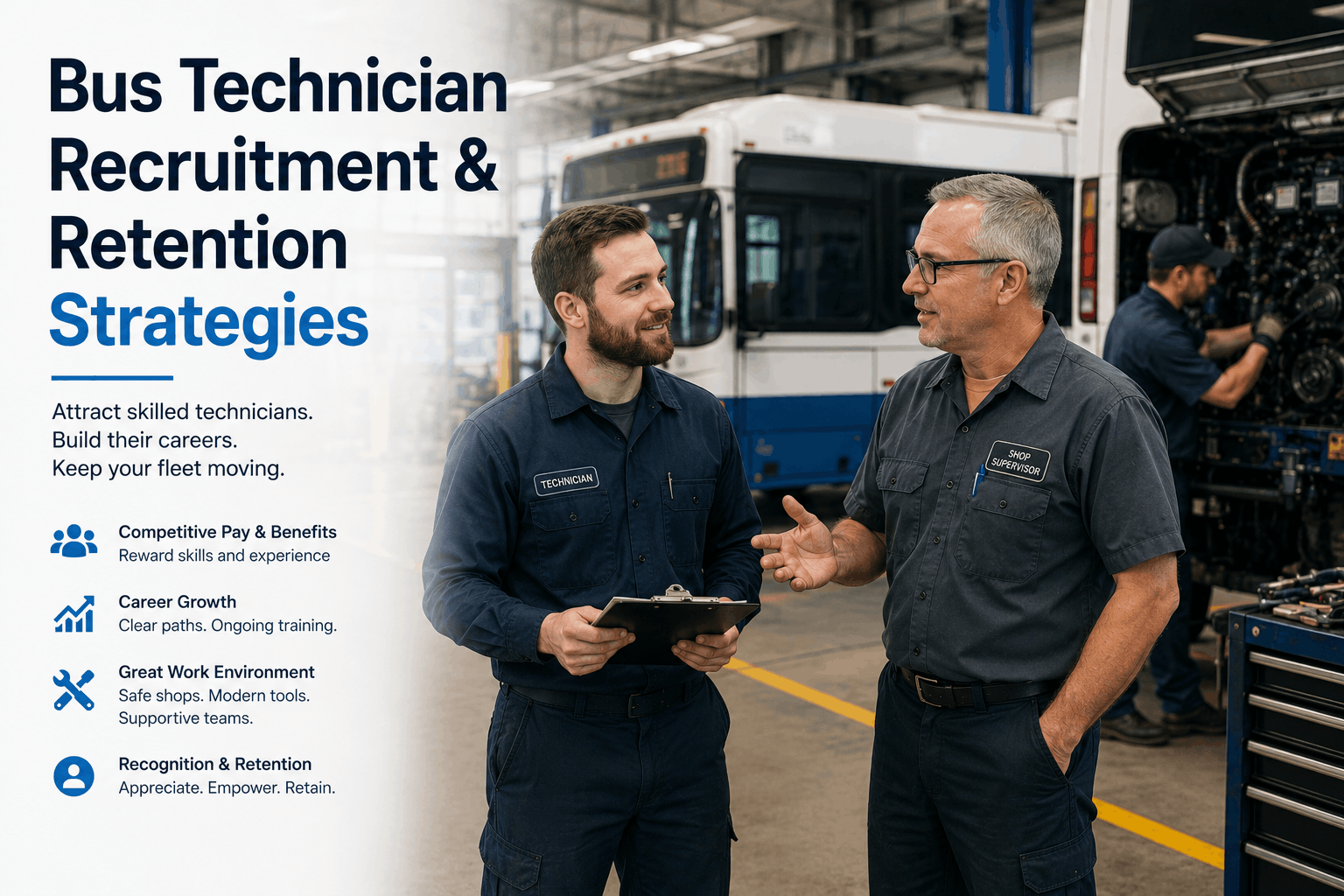
The bus industry faces a severe technician shortage. A fleet operator posted a job for a diesel mechanic in March 2025. Three months later, zero qualified applications. The posting went to industry sites, local vocational schools, and social media. Nothing. Meanwhile, two experienced technicians retired and one quit for a competitor fleet offering higher pay. The fleet now operates with two open positions and declining vehicle maintenance quality due to overwork. The shortage is industry-wide. The Bureau of Labor Statistics reports diesel mechanic jobs are growing faster than supply. A technician with 5+ years of bus experience commands $70,000-$85,000 annually, benefits, and has options. Fleets that lose experienced staff don't recover quickly. New technicians require 2-3 years of training before reaching full productivity. A fleet losing a senior technician loses $250,000+ in lost productivity and training costs before the replacement is productive. The solution: proactive recruitment (building a talent pipeline before you need it), competitive compensation and benefits, clear advancement paths, and retention systems that keep people engaged. One fleet director states: "We stopped treating recruitment as a seasonal emergency. We built relationships with vocational schools, created apprenticeship programs, invested in pay competitiveness, and created visible advancement paths. We went from perpetually understaffed to a waiting list of people wanting to work for us. Our quality improved and turnover dropped 70%." This guide explains how to recruit and retain skilled bus technicians in a tight labor market.
The technician shortage is real. Learn how leading fleets recruit, train, and retain skilled bus mechanics in a tight 2026 labor market using proven strategies.
The shortage has multiple causes. First, demographic shift: skilled technicians from the 1990s-2000s boom are retiring. Replacements aren't coming in equal numbers. Fewer young people pursue vocational careers (trades were stigmatized in education for decades—"go to college or fail"). Second, bus experience is specialized. A general mechanic can be trained into bus work. Finding someone with diesel experience is already difficult. Finding someone with five years of bus-specific experience is near-impossible. Third, competing industries: a diesel mechanic can work on trucks, construction equipment, or farm equipment. Bus fleets compete with higher-paying sectors (long-haul trucking pays $80,000-$90,000 with better benefits). Fourth, geographic dispersion: bus fleets are concentrated in cities. Rural mechanics can't access bus opportunities without relocating. Urban mechanics have transit system job alternatives that offer better stability and benefits. Fifth, burnout: the technician shortage creates overwork. Remaining staff work 50-60 hour weeks. They burn out and leave, worsening the shortage. A retention crisis becomes a recruitment crisis. Understanding these causes shapes recruitment strategy. You can't "solve" a demographic decline, but you can compete aggressively on compensation, benefits, flexibility, and advancement. One fleet HR director explains: "We realized we couldn't outcompete trucking on base salary. But we created benefits they don't offer: tuition reimbursement, on-site health clinic, flexible hours during school season (for techs with kids), clear advancement to supervisor/manager roles. Those benefits attract people who value stability over maximum hourly pay. We built a pipeline and stopped chasing."
Experienced technicians are retiring faster than new ones enter the profession. A technician who started in 1990 is now 55+. Their replacement would have started in 2015, but didn't. Fewer young people entered skilled trades due to educational bias toward college. The gap is widening. Recovery requires 5-10 years of strong vocational program growth—which hasn't happened yet.
Diesel mechanics are needed across multiple sectors: trucking (higher pay, more freedom), construction equipment, agricultural equipment, and power generation. Transit fleets compete with all of them for the same limited talent pool. To win, you must offer compelling reasons to choose bus work over alternatives.
The shortage creates a negative feedback loop: too many open positions → remaining staff overworked → burnout → more departures → more positions open → more overwork. Breaking this cycle requires either hiring faster (if possible) or improving working conditions and compensation to stem departures.
Successful fleets don't recruit when they have an open position. They recruit continuously, building a talent pipeline that's ready when someone leaves. Strategies include: (1) Relationships with vocational schools (partner with diesel programs, guest lectures, internships), (2) Apprenticeship programs (hire high school graduates, pay them while they learn), (3) Career events (attend trade fairs, vocational school open houses), (4) Employee referrals (incentivize current staff to recommend friends; referrals are your most reliable source), (5) Military partnerships (many diesel mechanics learn in the military; fleets near bases can recruit post-service), (6) Social media campaigns (TikTok, YouTube—show day-in-the-life of your technicians; make the job appealing to young people). One fleet implemented a comprehensive recruitment strategy: (1) Created a $5,000 employee referral bonus (if someone you refer stays one year, you get $5,000), (2) Partnered with a local diesel program to offer paid internships (interns earn $18/hour, learn on real buses, and 80% convert to full employment), (3) Launched an apprenticeship program (hire high school graduates at $16/hour, increase to $22/hour as they progress). Result: three years later, that fleet went from perpetually understaffed to a waiting list of applicants. Two apprentices became senior technicians. Referral bonus paid off 40 times (40 successful hires × $5,000). Investment: $200,000 total over three years. Value recovered: estimated $3 million in avoided recruitment costs and improved productivity.
You can't recruit and retain if compensation isn't competitive. The market rate for a diesel mechanic with 3-5 years experience is $60,000-$75,000 annually in most US markets. With 5+ years and bus specialization, it's $75,000-$90,000. Many fleet operators resist raising wages ("that's too expensive"). They then wonder why they can't fill positions. Wages are sticky—once you offer $55,000, it's hard to later justify $75,000 to existing staff. The solution: start competitive from the beginning. Research market rates in your region (BLS data, job boards, competing fleets). If your current technicians are below-market, you're bleeding retention. A $10,000 annual raise ($5/hour) seems expensive until you calculate the cost of losing someone ($250,000+ replacement cost). Compensation should include: base salary (market-competitive), overtime pay (time-and-a-half for hours over 40), benefits (health insurance, 401k match, paid time off—minimum two weeks), continuing education (tuition reimbursement for certifications), tools (each technician has a set allocated), and incentives (productivity bonuses, safety bonuses, perfect attendance bonuses). Total compensation should be transparent. A technician should see: base salary, benefits value (health insurance is worth $8,000-$15,000 annually), education benefits, tool allowance. Total package should be 110-120% of what competitor fleets offer. One fleet implemented a transparent compensation structure: technicians saw their total package was $78,000 base + $12,000 benefits + $3,000 education = $93,000 total compensation. Suddenly retention improved (people realized their total value) and recruitment became easier (competitive total package). They shifted from losing staff to building depth.
Entry technician (0-2 years): $48,000-$56,000. Mid-level technician (3-5 years): $62,000-$75,000. Senior technician (6+ years): $78,000-$92,000. Lead technician/Supervisor: $90,000-$110,000. Benefits typically add 15-20% to base salary value. Offering below-market requires strong non-monetary benefits to compete.
Health insurance (medical, dental, vision) worth $8,000-$15,000 annually. 401k match (3-5% of salary). Paid time off (minimum 15 days annually). Tuition reimbursement for certifications ($2,000-$5,000 annually). Tool allowance ($1,500-$3,000 annually). On-site health clinic (if fleet is large enough). Flexible scheduling (especially attractive to technicians with families). Productivity bonuses (5-10% of salary for meeting metrics).
Recruitment is expensive but retention is cheaper. A technician who stays four years and becomes a senior technician is worth far more than constant turnover. Retention strategies include: (1) Clear advancement path (junior → mid → senior → lead → supervisor), (2) Regular feedback and recognition (praise publicly, coach privately), (3) Reasonable hours (avoid chronic 60-hour weeks), (4) Quality tools and facilities (don't force skilled techs to work with ancient equipment), (5) Mentorship programs (pair junior with senior, formalize the relationship), (6) Career development (send people to advanced training), (7) Respect for expertise (listen to technician ideas on process improvements), (8) Stability and job security (no surprises about layoffs or fleet reductions). One fleet director explains the retention challenge: "We hired a senior technician for $82,000. Six months later a competitor offered $88,000 and he left. Replacing him cost us $250,000 in lost productivity and recruiting. We should have structured his compensation to include a path to $90,000 (through bonuses, raises, or supervisor opportunity) so he never had a reason to look elsewhere. Retention requires not just competitive entry pay but competitive advancement too." Exit interviews reveal: technicians leave for (1) better pay elsewhere, (2) better advancement opportunities, (3) better hours/less burnout, (4) family relocation. Items 2-4 are controllable. If you lose someone because they got a 10% raise elsewhere, that's a pay benchmark problem. If they leave because they wanted a lead role and you had none, that's a structure problem. These are fixable.
A fleet operator that invests in training builds loyalty and capability simultaneously. New technicians need structured training: (1) Safety orientation (three days covering shop safety, equipment, procedures), (2) Company systems training (maintenance management software, work order processes, quality standards), (3) Bus-specific training (how buses differ from trucks, safety-critical systems, common failure modes), (4) Hands-on apprenticeship (paired with senior technician for 6-12 months before independent assignment). Ongoing training keeps people engaged and progressing: advanced diesel certifications, electrical diagnostics, transmission rebuilds, welding, fleet safety updates. Fleets that fund certifications show lower turnover (people feel invested in). One transit authority spent $400 per technician annually on training (roughly $3,200 for eight techs). Turnover dropped from 35% to 12%. The math: $3,200 × 8 = $25,600 annual investment. Cost of replacing one technician = $250,000. Avoiding just one departure paid for training 10x over. Most fleets don't do this math. They see training as cost rather than investment. Technicians see it as a signal of commitment. A technician told their manager: "You paid for my Allison transmission certification. No other fleet I've worked for has done that. I'm going to stay because clearly you value my development."