California's CARB regulations — ICT, ACT, low-NOx mandates, and smoke inspection rules — are tightening in 2026, with penalties reaching $10,000 per day per violation. This guide explains exactly what bus fleets must do now to stay compliant, meet reporting deadlines, and avoid fines that can quickly exceed six figures.
CARB Compliance Guide 2026
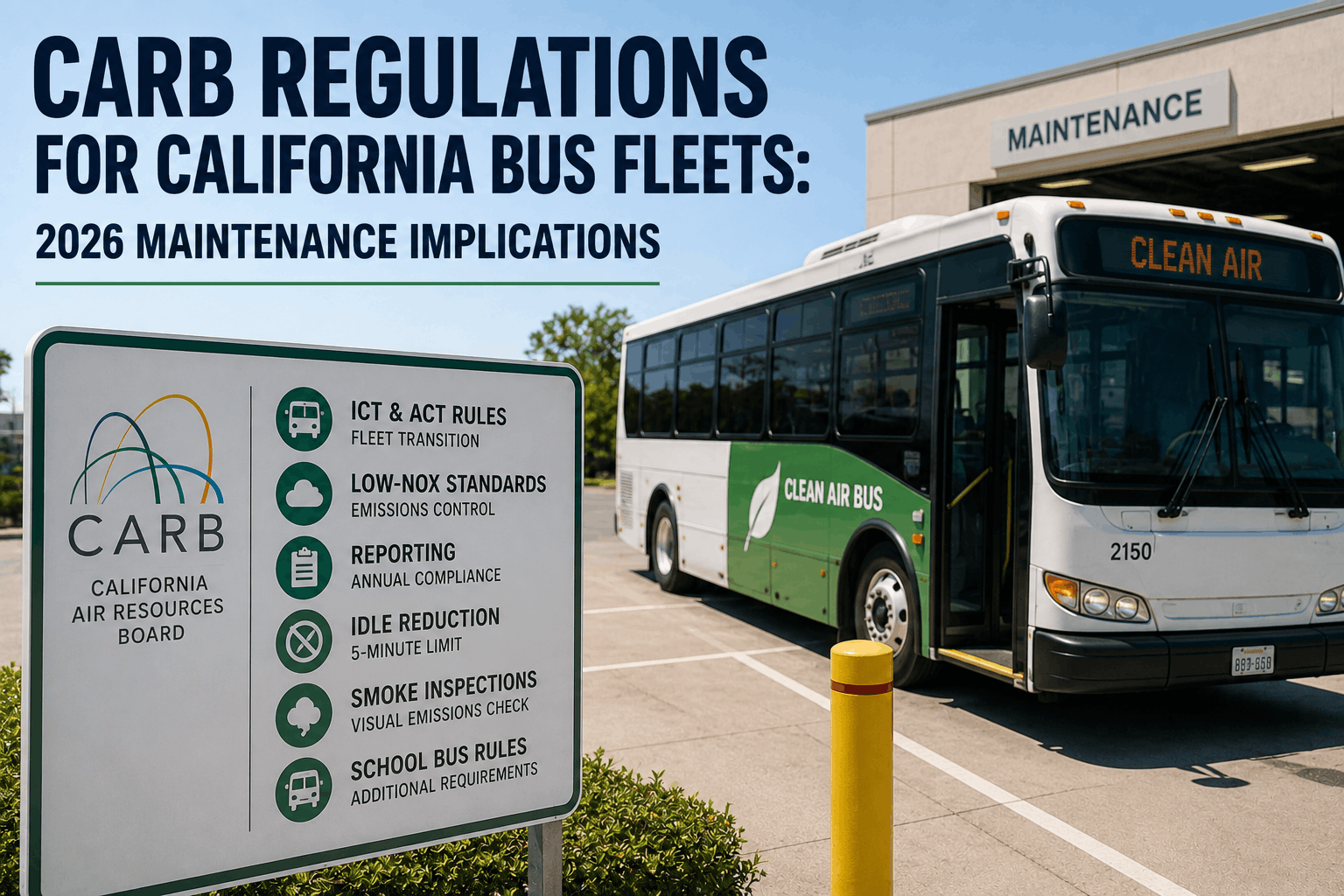
CARB Regulations for California Bus Fleets: 2026 Maintenance Implications
CARB rules every California bus fleet must follow in 2026 — ICT, ACT, low-NOx, reporting, idle limits, smoke inspections, school bus rules. Penalty schedule.
The Escalating Cost of CARB Non-Compliance
California bus fleets now face multi-layered enforcement. Failing to meet ICT electrification milestones, submitting late reports, or exceeding idle limits can trigger daily fines and trigger full fleet audits. The time to build a compliance system is now.
$10,000
Daily fine per violation
2040
Full ICT ZEV deadline
5 rules
Core regulations to track
100%
Smoke test pass requirement
Why a Single Compliance Platform Is Essential
Innovative Clean Transit (ICT)
Mandates all public transit agencies to transition to zero-emission buses. Phase-in timelines are based on fleet size, with large agencies hitting 25% ZEV purchases by 2026 and 100% by 2040.
Advanced Clean Trucks / Buses (ACT)
Requires manufacturers to sell an increasing percentage of zero-emission vehicles. Fleets buying new buses must track and report ZEV credits starting in 2024.
Low-NOx Engine Standards
EPA and CARB low-NOx rules require engines to meet near-zero emission levels. Maintenance of aftertreatment systems must be documented and parts must be OEM-verified.
Smoke Inspection Requirements
All diesel buses must pass opacity tests annually. CARB conducts roadside smoke inspections and requires fleet self-inspections. Failed tests ground the bus immediately.
Idle Limit Enforcement
Five-minute idle limit statewide, with stricter rules near schools. Telematics-based idle tracking is becoming the enforcement standard. Exceptions require documentation.
Reporting & Recordkeeping
Fleet owners must submit annual mileage, fuel, and emissions data to CARB. Digital records must be retained for 5 years and be retrievable within 48 hours of request.
CARB Compliance Roadmap 2024–2040
The Gantt chart maps every major CARB deadline from 2024 through 2040. The gold "NOW" line at 2026 shows exactly which phases are active and which deadlines are approaching. Use this to prioritize compliance investments.
Common CARB Violations and How to Avoid Them
Failed Smoke Opacity Test
Solution: Perform monthly self-inspections using a certified opacity meter. Document results and immediately repair any bus exceeding 5% opacity.
Missed ICT Reporting Deadline
Solution: Automate annual ICT compliance reports directly from your fleet management system. Set internal deadlines 30 days before CARB due dates.
Exceeding Idle Limits
Solution: Install telematics with idle alerts and driver coaching. Track idle time per bus per day and set targets below the 5-minute threshold.
Unapproved Aftertreatment Parts
Solution: Source all emissions-related parts from verified OEM suppliers. Maintain a digital parts traceability log linked to each repair order.
Incomplete Fleet Data Records
Solution: Integrate mileage, fuel, and maintenance data into a single CARB-ready export. Retain records for a minimum of 5 years digitally.
Ignoring ZEV Purchase Requirements
Solution: Model your fleet replacement plan against ICT milestones. Procure ZEV buses ahead of deadlines to avoid last-year compliance crunches.
CARB Compliance Progress Tracker
ICT ZEV Fleet Percentage
Track your current ZEV fleet percentage against the 2026 target. Each new electric bus moves you closer to the mandated threshold.
Smoke Test Pass Rate
Maintain 100% pass rate on all annual opacity tests. A single failure can trigger a fleet-wide audit.
Idle Compliance Rate
Percentage of buses staying under 5-minute idle limit. Telematics data drives weekly improvement.
Reporting On-Time Submission
ICT, ACT, and annual fleet reports filed before CARB deadlines. Automated reminders prevent late submissions.
Aftertreatment Parts Traceability
Percentage of emissions-related repairs with verified OEM parts and digital traceability records.
ZEV Infrastructure Readiness
Charging stations installed as percentage of fleet electrification plan. Infrastructure must scale with vehicle acquisitions.
CARB Compliance KPIs
ZEV Adoption Rate
Target: Meet or exceed ICT phase-in percentage for your fleet size. Track quarterly to avoid last-year compliance rushes.
Smoke Inspection Pass Rate
Target: 100% first-time pass on all opacity tests. A failure rate above zero triggers mandatory fleet self-audit.
Idle Violations per Month
Target: Under 1 incident per bus per month. Telematics-based coaching drives continuous improvement.
CARB Report Timeliness
Target: 100% of reports filed at least 7 days before the CARB deadline. Late filings incur fines even if data is complete.
Record Retrieval Readiness
Target: Any CARB-requested record retrievable within 2 hours. Digital organization eliminates the paper chase.
CARB audits used to keep me up at night. Now every emissions test, idle log, and ZEV purchase is tracked in one system. Our last audit request was fulfilled in under an hour, and we passed with zero violations.
Automate CARB Compliance and Eliminate Audit Risk
BusCMMS tracks every CARB deadline, smoke test, idle event, and ZEV milestone across your fleet. Book a demo to see how California fleets are turning compliance into a competitive advantage.
CARB Bus Fleet Compliance FAQs
What is the ICT regulation and how does it affect my bus fleet?
The Innovative Clean Transit rule requires all California public transit agencies to fully transition to zero-emission buses by 2040, with interim purchase requirements starting in 2024. Large agencies must ensure 25% of new bus purchases are ZEVs by 2026.
How often must diesel buses pass a smoke opacity test?
CARB requires annual smoke opacity self-inspections for all diesel buses. The opacity limit is 5% for most vehicles. CARB also conducts random roadside inspections. Failed tests result in immediate out-of-service orders.
What are the idle limit rules for school and transit buses?
California enforces a 5-minute idle limit statewide for all commercial vehicles, including buses. Stricter limits apply near schools (2 minutes or off entirely). Exceptions exist for temperature control and safety, but must be documented.
How does fleet management software help with CARB compliance?
A CMMS tracks smoke tests, idle telematics, ZEV fleet percentages, and reporting deadlines. It generates CARB-ready reports and maintains digital records for the required 5-year retention period.
What penalties does CARB impose for non-compliance?
Penalties can reach $10,000 per day per violation. CARB also has authority to issue cease-and-desist orders, impound vehicles, and revoke operating permits for repeated or severe violations.
When do I need to submit CARB compliance reports?
Reporting deadlines vary by rule. ICT reports are due annually by January 31. Smoke inspection records must be submitted within 30 days of testing. Idle data may be requested at any time by CARB enforcement.
CARB Compliance Is a Continuous Journey, Not an Annual Event
California's regulatory landscape for bus fleets will only intensify through 2040. Fleets that build compliance infrastructure now — automated reporting, telematics-based idle tracking, digital smoke test logs, and ZEV procurement tracking — will navigate the transition smoothly. Those that rely on spreadsheets and manual processes will face increasing fines and audit exposure. The path forward is clear: digitize every compliance touchpoint and let your fleet management system carry the burden of proof.