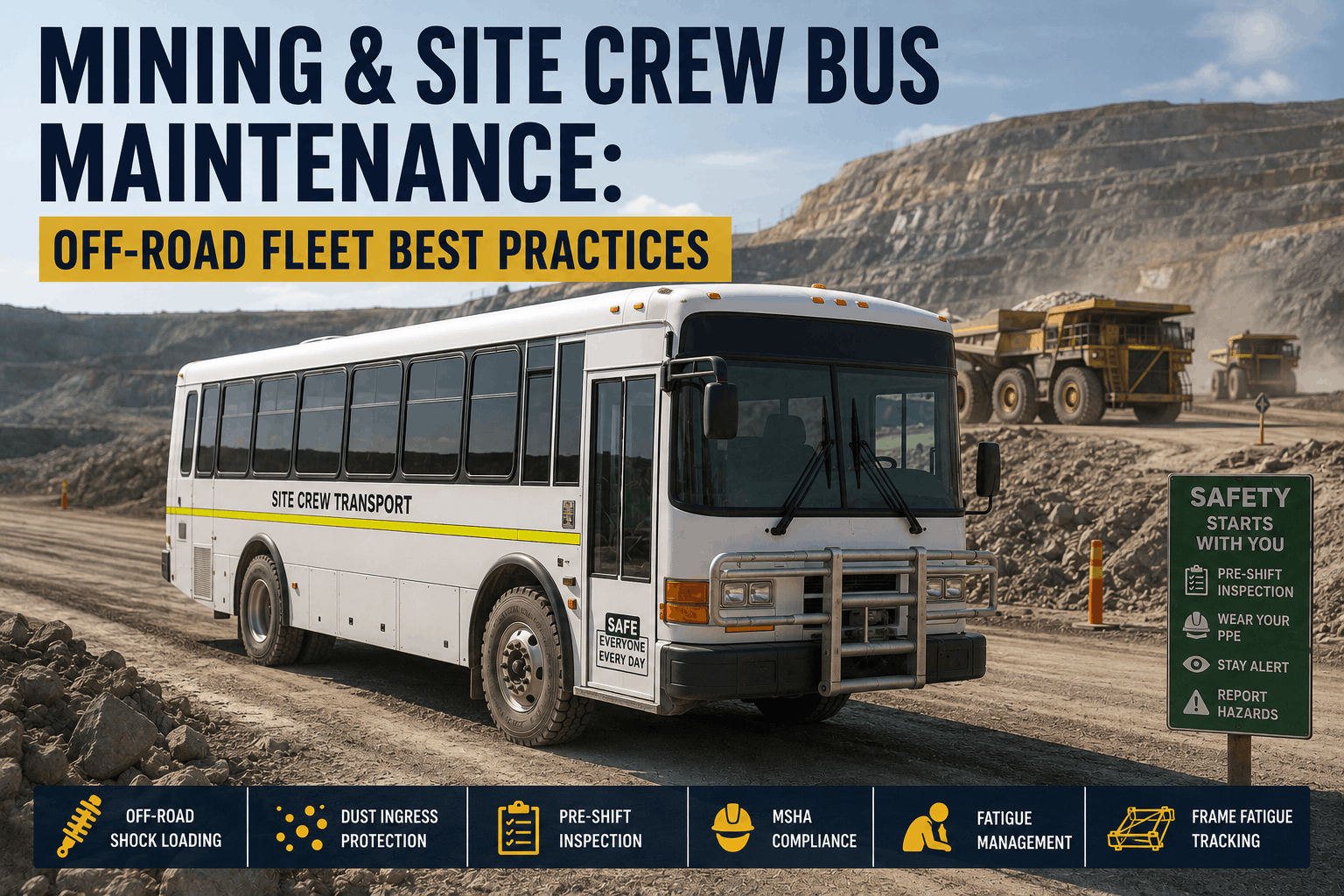
A 78-bus school district in Michigan noticed drivers complaining about "wandering" on the highway and "clunking" over speed bumps. The maintenance director assumed it was normal wear for 10-year-old buses. Then a bus experienced a tie rod end separation at 45 mph — the steering linkage disconnected. The bus left the road, hit a light pole, and injured two students. Investigation revealed that the tie rod end had been loose for months, noted in three driver DVIRs but never repaired. The maintenance director was fired. The district paid $2.3 million in settlements. The root cause: nobody understood how to inspect suspension and steering systems for dangerous wear. This guide covers every component, every wear indicator, and every inspection point your mechanics must know to keep buses handling safely.
Bus Suspension & Steering Maintenance Guide for Fleets
Inspect wear points. Detect failures early. Replace components before catastrophic separation. Keep buses handling safely.
Suspension & Steering Failure — Fleet Impact
Suspension and steering failures are progressive. Loose components get looser. Ignored clunks become separations. Inspections save lives and liability.
Steering System: From Steering Wheel to Front Wheels
The steering system has multiple wear points between the steering wheel and the front wheels. Each component can fail independently. The most common failure points: steering gear (sector shaft wear, internal leakage), pitman arm (loose on gear shaft), drag link (socket wear), tie rod ends (ball stud wear), and kingpins (vertical play). A bus with 1 inch of free play at the steering wheel rim (8-10 inches of steering wheel movement with no wheel response) is already dangerous. At 2 inches of rim play, the bus is out of service per FMCSA standards. The key is detecting wear before it reaches out-of-service levels. Measure steering wheel free play monthly — a sudden increase indicates component failure.
Steering Free Play — Action Guide
Measure free play with engine off, wheels straight. Gently turn steering wheel left/right until front wheels just begin to move. The movement before wheel response is free play.
"Our mechanic noticed 1.5 inches of steering wheel play during a routine PM. He ordered the bus to be parked and inspected the drag link — the socket had 3/8 inch of vertical movement, well beyond the 1/8 inch wear limit. That bus had been on the road the day before with a load of 50 students. We replaced the drag link that afternoon. The liability we avoided was incalculable."
Steering Component Wear Limits
Tie rod end vertical play — max 1/16" (1.6mm)
Drag link socket play — max 1/8" (3.2mm)
Steering gear output shaft — no detectable play
Kingpin axial play — max 1/8" (3.2mm)
Pitman arm nut torque — check annually (spec varies by manufacturer)
Replace any component exceeding wear limits immediately. Do not wait for next PM.
Suspension Components: Leaf Springs, Air Bags, & Shocks
Bus suspension has three primary configurations: leaf spring (older school buses), air suspension (modern transit and coach buses), or a combination (air over leaf). Leaf spring failures: cracked leaves, broken center bolts, shifted leaves, broken spring hangers, worn bushings. Air suspension failures: leaking air bags (cracks or abrasion), failed height control valves, leaking air lines, corroded leveling rods. Shock absorbers fail gradually — leaking oil, worn internal valves, loose mounts. Bad shocks cause excessive body roll, longer stopping distances, and tire cupping. The most dangerous failure is a broken leaf spring or blown air bag — the bus will lean severely, affecting steering and braking stability.
Leaf Spring Inspection Points
Air Suspension Inspection Points
A bus that leans to one side when parked has a failed suspension component — broken leaf spring, blown air bag, or frozen height control valve. Do not drive. Tow to shop. Corner leaning affects braking balance and steering.
Wheel Bearings & Axles: Overlooked Critical Components
Wheel bearing failure is catastrophic — the wheel can separate from the bus at highway speed. Bearings fail from lack of lubrication, over-tightening, contamination, or normal wear. Signs of failing bearings: excessive wheel end play (wiggle top of tire in/out), rough rotation feel when wheel is spun, growling or grinding noise, and grease leakage past seals. For oil-bath bearings (common on transit buses), check oil level and condition monthly — milky oil indicates water contamination. For grease-packed bearings, service interval is typically 30,000-50,000 miles or 12 months. Never re-use old wheel seals — always replace when bearings are serviced.
Wheel Bearing Service Intervals
Check wheel bearing end play every 30,000 miles or during brake service. Axial play (top of tire movement) should be 0.001-0.005 inches — barely detectable by hand. Loose play requires immediate bearing adjustment or replacement.
"A driver reported a 'growling noise' from the right front wheel for two weeks. The mechanic said it was just tire noise. On the highway at 55 mph, the right front wheel bearing seized. The wheel didn't separate, but the spindle was destroyed. Repair cost: $4,200 plus towing and three days downtime. The bearing had been dry — no grease, no oil. We now check wheel bearing end play and listen for noise at every PM. Two years, zero bearing failures."
Shock Absorbers: The Forgotten Safety Component
Bad shocks don't just make the ride uncomfortable — they increase stopping distance, cause tire wear, and reduce stability in emergency maneuvers. Shocks control spring oscillation. Without functional shocks, a bus continues to bounce after hitting a bump, reducing tire contact with the road. Test shocks with the bounce test: push down hard on the bumper and release. The bus should settle in 1-2 bounces. More than 2 bounces means shocks are worn. Also check for visible oil leaks — wet shock bodies indicate seal failure. Shocks typically last 50,000-100,000 miles. Replace in axle pairs. Never replace only one shock on an axle — the difference in damping force causes handling problems.
Shock Absorber Failure Signs
Alignment: Tires Tell the Story
Misalignment wears tires prematurely and reduces fuel economy by 5-10%. The most common alignment issues on buses: toe-out (front edges of tires point outward), camber (top of tire leans in or out), and caster (steering axis tilt). Tire wear patterns tell you which alignment angle is off. Feathering (smooth one direction, rough the other) indicates toe misalignment. Inside edge wear indicates negative camber. Outside edge wear indicates positive camber. Cupping (alternating high/low spots) indicates worn shocks or loose suspension components. Check alignment annually or when tires show irregular wear. Also check after any collision, pothole impact, or suspension component replacement.
Tire Wear Patterns — Root Cause
Preventive Maintenance Schedule for Suspension & Steering
This schedule summarizes inspection intervals for all chassis components. Adjust based on mileage and operating conditions — rough roads, winter potholes, and urban driving require more frequent inspections.
Chassis Preventive Maintenance Schedule
Document every inspection. Track component life per bus. Replace steering components in matched sets when possible.
Fleet Expert Review
Suspension and steering failures are the most dangerous in bus operations because they affect control. A failed tie rod end means no steering on one wheel. A broken leaf spring means the bus leans, brakes unevenly, and may roll. A seized wheel bearing means the wheel can separate. None of these failures happen instantly — they progress over weeks or months. The clunk you hear today becomes a tie rod separation next month. The wandering you feel at 55 mph becomes a loss of control when evading an obstacle. The fleets that prevent these failures inspect weekly, measure play monthly, and replace components before they fail. They also use maintenance software to track inspection dates, wear measurements, and component life. Because in suspension and steering, the cost of waiting is measured in crashes, not dollars.
The Bottom Line
Suspension and steering systems keep the bus connected to the road — literally. When they fail, drivers lose control. The warning signs are clear: steering wheel free play over 1 inch, clunking noises over bumps, wandering on the highway, leaning when parked, uneven tire wear, growling from wheels. These signs are not normal wear. They are progressive failures that will eventually cause a crash. Inspect every component monthly. Measure play, not just visual condition. Replace worn components immediately — deferring repairs is gambling with student and driver lives. BusCMMS tracks every chassis inspection, every measurement, every replacement. One dashboard gives you complete visibility into the safety of every suspension and steering component in your fleet.
Protect your fleet with proper chassis inspections — book a demo
Steering & Suspension Failure Is Preventable
BusCMMS tracks steering play measurements, suspension component inspections, wheel bearing service, and alignment checks. One dashboard keeps your fleet safe. Free 14-day trial.
Frequently Asked Questions
How much steering wheel free play is allowed on a school bus?
What are the signs of worn tie rod ends on a bus?
How often should bus air suspension air bags be replaced?
How do I check wheel bearing wear on a bus?
What causes a bus to wander or pull to one side while driving?
Can BusCMMS track suspension and steering inspections?
Every Component. Every Inspection. One Dashboard.
Steering gear, tie rods, kingpins, air bags, leaf springs, shocks, wheel bearings — all tracked. All inspected. All safe. Free 14-day trial.