A 200-bus transit fleet in Florida was using three different systems to manage compliance: paper DVIRs in binders, a spreadsheet for driver medical card expirations, and a separate software for annual inspection tracking. The compliance coordinator spent 15 hours every week hunting down missing documents, chasing drivers for expired medical cards, and organizing files for audit readiness. Then FMCSA announced a records request with 48-hour turnaround. The coordinator worked 18-hour days for two days straight — and still missed three expired medical cards. The fine: $8,000. The solution wasn't working harder — it was consolidating. Compliance management software brings every regulatory requirement into one dashboard: driver qualifications, vehicle inspections, maintenance records, and audit trails. This guide covers what compliance software does, which features matter for bus fleets, and how to select the right platform for 2026.
What Is Compliance Management Software for Bus Fleets?
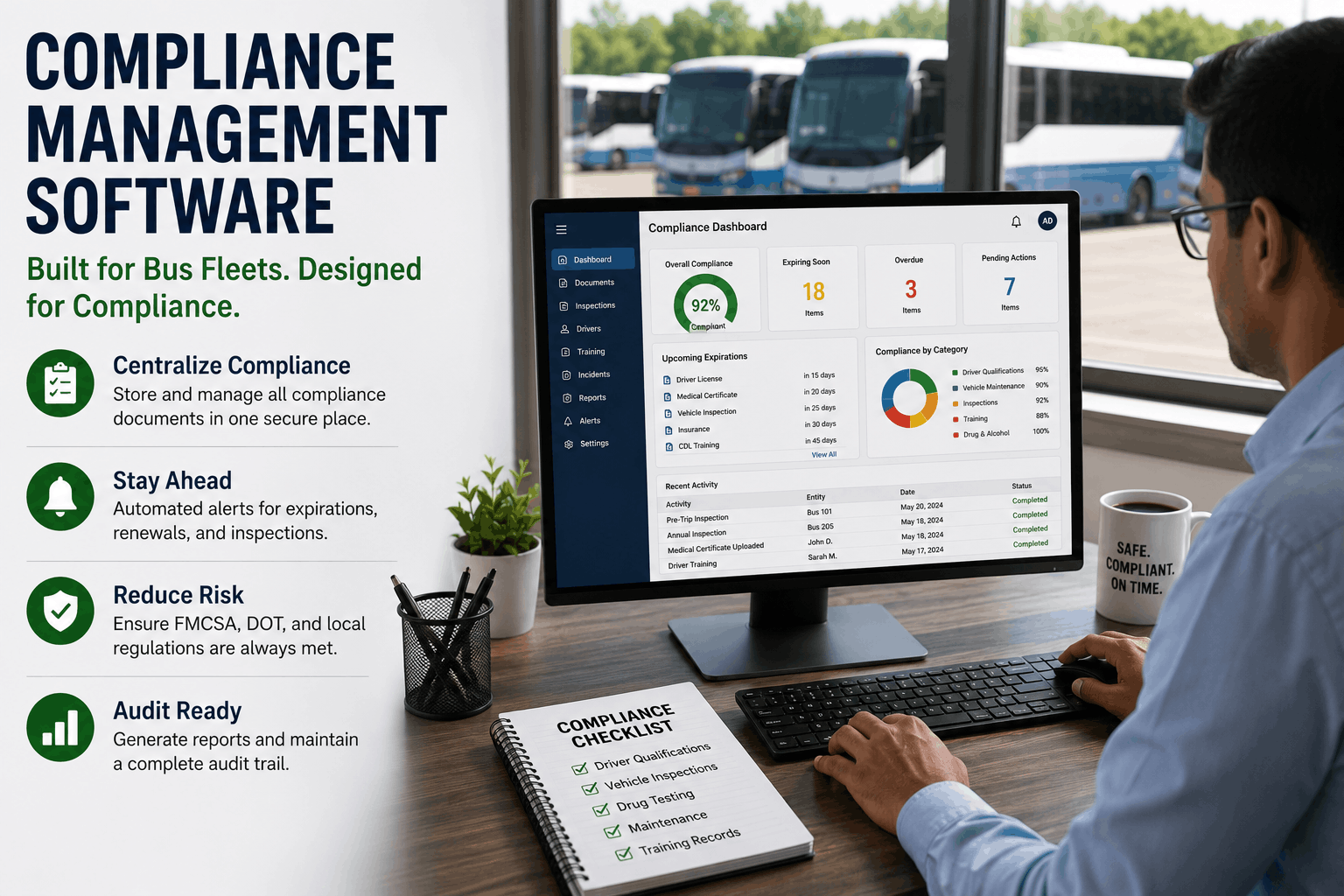
Compliance management software centralizes every regulatory requirement bus fleets face into a single digital platform. It tracks driver qualification files (medical cards, CDL endorsements, background checks), vehicle maintenance (DVIRs, annual inspections, 90-day exit checks), hours of service (ELD integration), drug and alcohol testing (Clearinghouse queries, random test tracking), and accident reporting. The software automatically calculates expiration dates, sends alerts before deadlines, stores documents with audit trails, and exports complete files for FMCSA requests. Unlike generic document management, compliance software for bus fleets is pre-configured with FMCSA regulations — it knows what documents are required, when they expire, and what triggers an audit violation. The best platforms integrate with ELDs, fuel cards, and telematics to auto-populate data, eliminating manual entry errors.
The best compliance software doesn't just store documents — it actively prevents violations by alerting you before deadlines expire. Schedule a demo to see automated compliance alerts in action.
Core Features Your Compliance Software Must Have
Not all compliance platforms are built for bus fleets. These features are non-negotiable:
BusCMMS includes all four core features plus bus-specific requirements like 90-day emergency exit inspections. Start free trial to see the complete feature set.
How Compliance Software Prevents Audit Violations
Audit violations happen when deadlines are missed, documents are lost, or signatures are incomplete. Compliance software prevents each failure mode.
Cloud vs On-Premise Compliance Software
Compliance software deployment options affect accessibility, cost, and maintenance. Cloud-based (SaaS) is the standard for 2026.
BusCMMS is cloud-based with offline mobile capability — drivers and mechanics can complete inspections without internet, syncing automatically when connectivity returns. Book a demo to see cloud compliance in action.
Implementation Roadmap: 90 Days to Audit-Ready
Successful compliance software implementation follows a structured approach. Month 1: Data migration. Export existing driver files, vehicle records, and maintenance history. Import into compliance platform. Set up expiration alerts for medical cards, CDLs, and annual inspections. Configure user roles (admins, mechanics, drivers). Month 2: Pilot deployment. Select 5-10 drivers and 5-10 buses for pilot. Run parallel paper and digital for 2 weeks. Train maintenance supervisors and lead mechanics. Adjust workflows based on feedback. Month 3: Full deployment and driver rollout. Launch driver mobile app for DVIRs. Train all drivers (30-minute session per driver). Go live with all compliance tracking. Monitor daily for first 2 weeks. By day 90, your fleet should be fully digital with all compliance documents stored, all expiration dates tracked, and audit-ready exports available in seconds.
Compliance Software ROI: What to Expect
Compliance software is not a cost — it's an investment that prevents penalty exposure and reduces administrative labor. Calculate your ROI using these factors.
BusCMMS typically pays for itself within 4-6 months through penalty prevention and labor savings alone. Calculate your specific ROI — book a demo.
Frequently Asked Questions
What is compliance management software for bus fleets?
Compliance management software centralizes driver qualification files, vehicle maintenance records (DVIRs, annual inspections), drug and alcohol testing, and audit trail documentation into one platform with automated expiration alerts.
How does compliance software prevent audit violations?
It sends automated alerts before deadlines (medical cards, annual inspections, Clearinghouse queries), enforces signature chains for DVIRs, stores all documents indefinitely, and produces audit-ready exports in seconds.
Can compliance software integrate with our existing ELD?
Yes. Most compliance platforms integrate with major ELD providers to sync hours of service data, odometer readings, and driver assignment information automatically.
How long does it take to implement compliance software?
Typical implementation takes 60-90 days including data migration, pilot testing, driver training, and full deployment. Cloud-based platforms are faster (2-4 weeks for basic setup).
Is compliance software required by FMCSA?
FMCSA does not require specific software, but electronic records and signatures are explicitly authorized. Compliance software is the most efficient way to meet Part 391, 395, 382, and 396 requirements.
Can BusCMMS manage both driver and vehicle compliance?
Yes. BusCMMS unifies driver qualification files, DVIRs, annual inspections, 90-day exit checks, Clearinghouse query tracking, and maintenance records — complete FMCSA compliance in one dashboard.