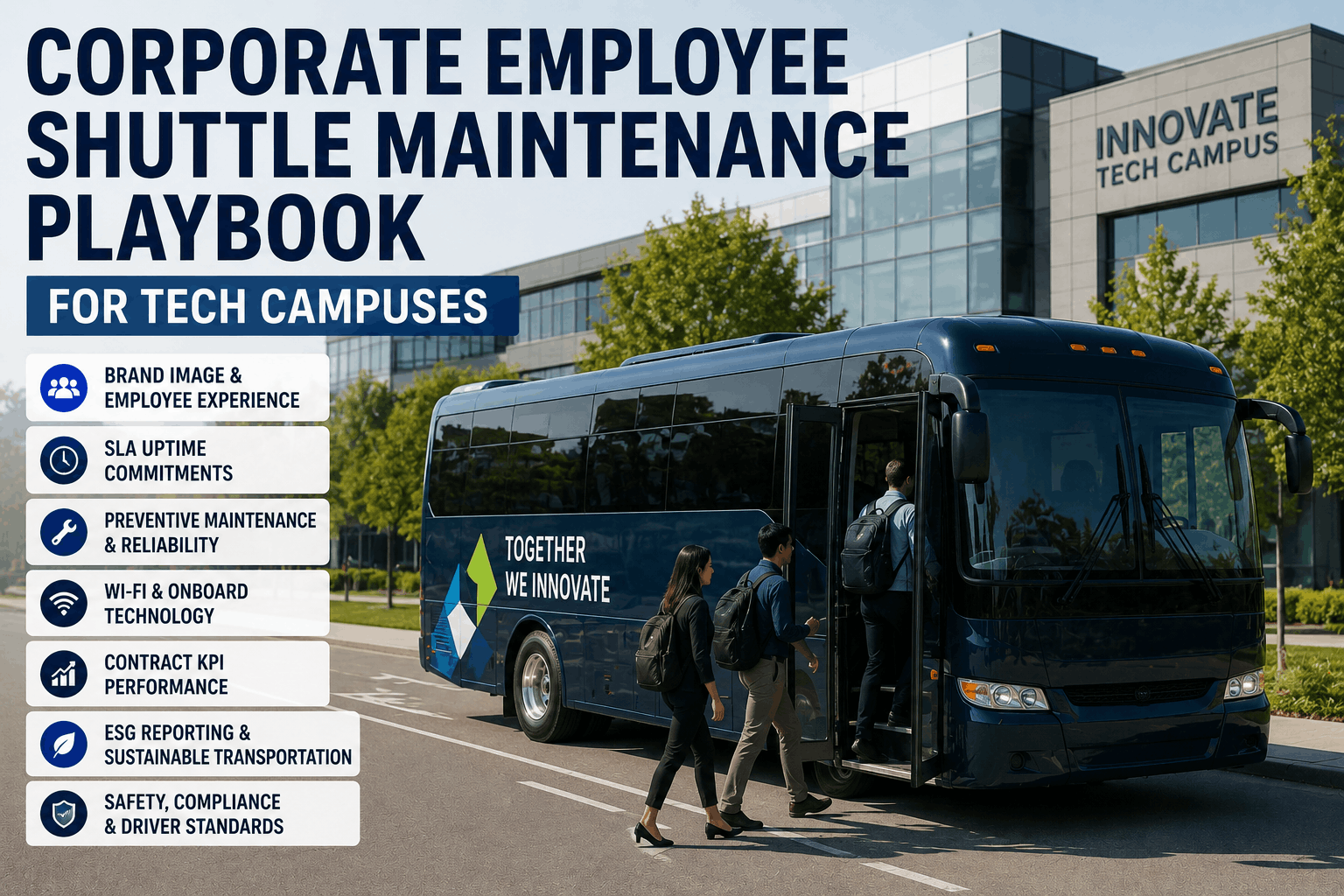
Corporate employee shuttle programs are judged the moment a rider steps aboard, not at the end of a maintenance cycle. A single Wi-Fi outage, a late pickup, or a rough-running engine on a tech campus shuttle becomes a visible brand moment for the employer sponsoring the ride. Start Trial to see how BusCMMS gives corporate shuttle operators the SLA tracking, PM records, and ESG-ready reporting needed to run a campus commuter fleet that protects brand image instead of undermining it.
Prove Your Shuttle Program Is Meeting Every Contract SLA
BusCMMS connects vehicle uptime, driver safety records, and amenity fault logs into a single reporting view so fleet managers can defend SLA performance in every quarterly stakeholder review.
Why Corporate Shuttle Maintenance Is a Brand and Compliance Issue
A tech campus shuttle is a rolling extension of the employer brand, and every missed pickup or dead onboard Wi-Fi router becomes visible to the exact talent pool the company is trying to retain. Facilities that Book Demo with BusCMMS see how route completion history, PM records, and amenity fault logs combine into a single reliability picture a transportation manager can present without pulling data from three separate spreadsheets. Tracking the right contract KPIs consistently is what turns a shuttle vendor relationship into a defensible partnership rather than a recurring source of employee complaints.
SLA Uptime Monitoring
BusCMMS logs route completion, on-time pickup, and vehicle downtime by shuttle, giving contract managers a live view of SLA performance against the signed agreement.
Wi-Fi and Amenity Uptime Log
Onboard Wi-Fi, USB charging, and climate control faults are logged per vehicle, turning rider complaints into a trackable maintenance record instead of an anecdote.
PM Compliance History
Scheduled versus completed preventive maintenance is tracked per vehicle, showing whether the fleet is meeting the service intervals the contract requires.
Driver Safety Scorecards
Incident reports, harsh-braking events, and inspection findings roll up into a per-driver safety record that supports both coaching and liability documentation.
ESG Emissions and Ridership Reporting
Fuel consumption, ridership counts, and vehicle class data export directly into the format sustainability teams need for corporate ESG disclosures.
Contract KPI Dashboard
Every metric named in the transportation services contract is tracked in one dashboard, replacing manual vendor scorecards with live operational data.
Key Metrics for Corporate Employee Shuttle Programs
01
On-Time Route Completion Rate
Primary SLA Metric
Route completion rate measures the share of scheduled shuttle runs that departed and arrived within the contracted time window, and it is the single number most transportation contracts use to judge vendor performance. BusCMMS logs actual departure and arrival times against the published schedule automatically from driver check-ins, so a completion rate above 97 percent can be confirmed without a manual audit at renewal time.
Baseline 86%
Current 94%
02
Vehicle Amenity Uptime
Rider Experience Signal
Amenity uptime tracks whether onboard Wi-Fi, USB charging, and climate control were functional for each scheduled trip, since a working router matters as much to a commuting employee as an on-time arrival. BusCMMS logs amenity faults reported through driver checklists or rider tickets, converting a soft complaint into a hard maintenance metric that can be tied back to a specific vehicle and repair.
Baseline 71%
Current 89%
03
PM Compliance Rate Across Fleet
Execution Consistency
Sustained PM compliance above 90 percent is the precondition for a shuttle fleet that avoids mid-route breakdowns during peak commute hours, when a single stranded vehicle affects hundreds of employees. BusCMMS tracks scheduled versus completed PM work by vehicle, making quarterly compliance trend visible in the same dashboard used for contract reporting.
Baseline 68%
Current 92%
04
Driver Safety Incident Rate
Liability Indicator
Incident rate per hundred thousand miles is the metric most corporate safety and legal teams request before renewing a shuttle contract, and a declining trend is direct evidence that driver coaching and vehicle inspections are working. BusCMMS logs incidents, near-misses, and inspection findings per driver, building the documented safety record a campus security review will ask for.
Baseline 45%
Current 78%
05
Maintenance Cost per Seat-Mile
Financial Reliability Indicator
Cost per seat-mile combines labor, parts, and contractor spend into one figure that finance teams can compare across vendors or campus locations, making it the financial validation of a reliability program. BusCMMS tracks cumulative maintenance cost per vehicle over time, enabling quarter over quarter comparisons without pulling invoices from a separate accounting system.
Baseline 52%
Current 81%
06
ESG Reporting Data Completeness
Sustainability Signal
Completeness of fuel, ridership, and emissions data determines whether the shuttle program can actually support a corporate ESG disclosure, and gaps in this data are one of the most common reasons sustainability teams reject vendor submissions. BusCMMS captures fuel and ridership data at the vehicle level automatically, closing the gap between operational logs and reportable ESG figures.
Baseline 60%
Current 96%
Corporate Shuttle Program Metrics: Quick Reference
Scroll for more
| Contract Metric | Measurement Period | Target Signal | BusCMMS Data Source | Review Frequency |
|---|---|---|---|---|
| Route Completion Rate | Weekly | Above 97% | Driver check-in timestamps | Weekly review |
| Amenity Uptime | Monthly | Above 90% | Amenity fault log by vehicle | Monthly |
| PM Compliance Rate | Quarterly | Sustained above 90% | PM schedule vs completion | Monthly |
| Safety Incident Rate | Rolling 90 days | Declining per driver | Incident and inspection log | Monthly |
| Cost per Seat-Mile | Quarterly | Declining QoQ | Cumulative cost per vehicle | Quarterly |
How BusCMMS Supports the Corporate Shuttle Playbook
A corporate shuttle program is only as defensible as the records behind it, and BusCMMS connects route history, PM compliance, amenity faults, and ESG data into one timeline per vehicle so a transportation manager can walk into a quarterly business review with evidence instead of estimates. When completion rate is holding above 97 percent, PM compliance is sustained above 90 percent, and ESG data is exporting cleanly, that is the record that keeps a shuttle contract renewed and the employer brand intact. Facilities can Start Trial and begin building this record from the first route logged in BusCMMS.
Real-Time SLA Tracking
BusCMMS logs departure and arrival times against the contracted schedule automatically, keeping route completion rate current for every stakeholder review.
Amenity Fault Logging
Wi-Fi, charging, and climate faults are logged per vehicle and trip, turning rider complaints into a maintenance record tied to a specific repair.
Driver Safety Analytics
Incident and inspection data roll up into a per-driver safety score that supports coaching decisions and contract liability documentation.
ESG-Ready Reporting Exports
Fuel, ridership, and emissions data export in the format sustainability teams need, closing the gap between shuttle logs and ESG disclosures.
Building a Corporate Shuttle Maintenance Program: Implementation Steps
01
Audit Current Shuttle Fleet Records
Pull existing PM history, route schedules, and incident logs into BusCMMS to establish a single source of truth for every vehicle on campus routes.
02
Define Contract SLA Thresholds
Enter the completion rate, uptime, and safety thresholds named in the transportation contract so BusCMMS can flag performance against the agreed targets.
03
Digitize PM Schedules per Vehicle
Move every preventive maintenance interval into BusCMMS by vehicle, replacing paper logs or spreadsheets with a schedule the system tracks automatically.
04
Set Up Amenity and Wi-Fi Fault Logging
Configure driver checklists and rider ticketing to log amenity faults directly into BusCMMS, closing the gap between complaints and maintenance action.
05
Build Monthly Stakeholder Reporting
Schedule a monthly export of SLA, safety, and cost metrics from BusCMMS for facilities, HR, and finance stakeholders who oversee the shuttle budget.
06
Expand Tracking to ESG and Sustainability Metrics
Once core SLA tracking is stable, extend BusCMMS reporting to fuel and ridership data so the shuttle program supports corporate sustainability disclosures.
Frequently Asked Questions
What is a corporate employee shuttle maintenance playbook?
It is a structured approach to tracking SLA uptime, PM compliance, driver safety, and amenity reliability on a corporate campus shuttle fleet, so vendor performance and brand impact can be measured rather than assumed.
How does BusCMMS support SLA uptime tracking for campus shuttles?
BusCMMS logs departure and arrival times against the contracted schedule automatically, giving transportation managers a live completion rate they can report without a manual audit.
Why does Wi-Fi reliability matter for employee shuttle programs?
Onboard Wi-Fi is treated as a core commuting benefit by most tech campus riders, and repeated outages generate visible complaints that reflect directly on the sponsoring employer's brand.
How is ESG reporting connected to shuttle maintenance data?
Fuel consumption and ridership figures logged during routine maintenance and dispatch become the raw data sustainability teams need for transportation emissions disclosures.
Can BusCMMS support multiple corporate campuses or contract operators?
Yes. BusCMMS reporting compares SLA, safety, and cost metrics across campuses or operators, letting a corporate transportation team benchmark vendors against each other.
Turn Shuttle Maintenance Records Into a Defensible Contract Story
BusCMMS gives corporate transportation teams the SLA history, safety records, and ESG-ready data to prove a campus shuttle program is protecting both the employee experience and the employer brand.