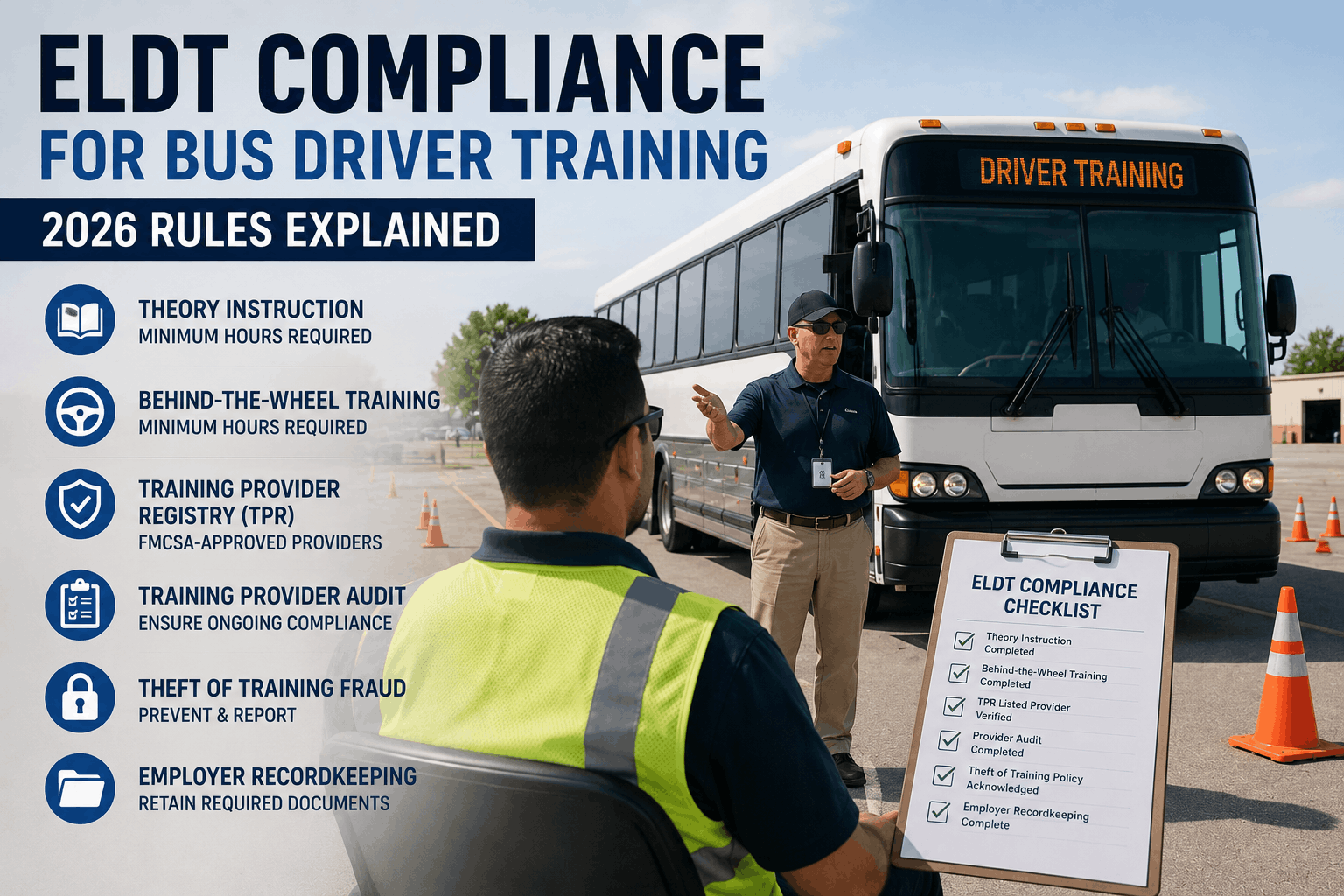
Entry-level driver training rules changed permanently with the ELDT mandate, and bus carriers who rely on non-listed training providers or accept fraudulent certificates face FMCSA audits and driver disqualification. This 2026 guide breaks down theory and behind-the-wheel hour requirements, TPR listing verification, provider audit defense, and employer recordkeeping so every new bus driver enters service fully compliant.
ELDT Compliance Guide 2026
ELDT Compliance for Bus Driver Training: 2026 Rules Explained
ELDT compliance for bus drivers in 2026. Theory + BTW hours, TPR listing, training provider audit, theft of training fraud, employer recordkeeping.
The Risk of ELDT Non-Compliance
FMCSA can disqualify drivers trained by unlisted providers and fine carriers up to $5,833 per violation for employing improperly trained CDL holders. A single audit finding that a driver's certificate is invalid can cascade into a fleet-wide review.
$5,833
Fine per non-compliant driver
100%
TPR verification required
30+ hours
Minimum theory training (bus)
15+ hours
Minimum BTW training (bus)
Why ELDT Compliance Is a Fleet-Wide Responsibility
Theory Hours Requirement
School bus, transit, and motorcoach drivers must complete a minimum number of theory hours covering basic operation, safe operating practices, advanced procedures, and vehicle systems. Online-only providers must be TPR-listed.
Behind-the-Wheel (BTW) Training
Range and public road training must be delivered by a listed provider. No self-certification. Employers must retain the BTW curriculum and instructor credentials on file.
TPR Listing Verification
Only providers listed on FMCSA's Training Provider Registry can issue valid certificates. Employers must verify TPR status before accepting any driver's ELDT certificate.
Training Provider Audit Defense
FMCSA periodically audits TPRs. If your chosen provider loses their listing, drivers trained by them may be retroactively disqualified. Keep copies of all training records.
Theft of Training Fraud
Fraudulent ELDT certificates are a growing problem. Carriers must scrutinize certificate origin and cross-check with TPR data. Accepting a fake certificate exposes the carrier to liability.
Employer Recordkeeping
Carriers must maintain ELDT certificates, theory curriculum outlines, and BTW logs for each driver. These records must be available at roadside inspections and compliance reviews.
ELDT Compliance Readiness Radar
The radar chart instantly reveals that five of six ELDT compliance areas are at full readiness. The lone gap — TPR Listing verification at 90% — requires verifying one remaining provider before the fleet can claim complete ELDT compliance.
Common ELDT Mistakes That Lead to Audit Failures
Accepting Unverified TPR Certificates
Solution: Before onboarding, check every ELDT certificate against the FMCSA TPR database. Document the verification date and the provider's active listing status.
Inadequate Theory Hour Documentation
Solution: Require training providers to supply a detailed curriculum outline and clock-hour log. File these with the driver qualification packet.
Missing Behind-the-Wheel Records
Solution: Retain BTW training logs showing date, duration, maneuvers practiced, and instructor signature. Digital storage makes retrieval instantaneous during audits.
Overlooking Provider Audit Status
Solution: Monitor your training providers quarterly. If a provider loses TPR listing, immediately audit drivers trained by them and arrange supplemental training if necessary.
Falling for Certificate Fraud
Solution: Cross-check the certificate number, provider name, and curriculum with TPR records. Any discrepancy is a red flag that requires investigation before the driver operates a bus.
Not Retraining After Rule Changes
Solution: FMCSA updates ELDT curriculum requirements periodically. Review your training provider's curriculum annually and confirm it meets the latest standards.
ELDT Compliance Preparation Progress
Current Driver Certificate Audit
Verify every active driver's ELDT certificate against TPR. Flag any discrepancies and resolve before the next compliance review.
New Hire Verification Protocol
Create a pre-hire checklist requiring TPR verification and curriculum review before the driver's first day behind the wheel.
Training Provider Watchlist
Maintain a list of approved providers with their TPR listing expiration dates. Review quarterly for any status changes.
Recordkeeping System Update
Digitize all ELDT certificates, theory outlines, and BTW logs. Organize by driver for instant retrieval during audits.
Fraud Detection Training
Train hiring managers to spot fraudulent ELDT certificates. Document the training and create a reporting process for suspicious documents.
Annual ELDT Policy Review
Schedule an annual review of your ELDT compliance program. Update policies based on FMCSA rule changes and audit findings.
ELDT Compliance KPIs
Certificate Verification Rate
Target: 100% of active driver ELDT certificates verified against TPR within the last 12 months.
TPR Listing Audit Frequency
Target: Quarterly review of all training providers' TPR status with documented results.
New Hire Compliance
Target: Zero drivers onboarded without a completed and verified ELDT certificate on file.
Record Retrieval Speed
Target: Any ELDT record retrievable within 2 minutes during a compliance audit.
Fraud Detection Rate
Target: 100% of fraudulent certificates identified before the driver operates a bus.
We discovered that two of our drivers had certificates from a provider that lost its TPR listing. Because we had digitized all ELDT records, we identified the issue in hours and arranged supplemental training before our next compliance review.
Make ELDT Compliance a Standard Operating Procedure
BusCMMS tracks ELDT certificates, TPR verification, and driver training records in one system. Book a demo to see how your fleet can eliminate compliance gaps and defend every driver's qualifications in an audit.
ELDT Compliance FAQs
What are the minimum ELDT hours for bus drivers?
FMCSA requires a minimum of 30 hours of theory training and 15 hours of behind-the-wheel training for Class B CDL bus drivers. Specific hour breakdowns vary by vehicle type and endorsement.
How do I verify a training provider is TPR-listed?
Search the FMCSA Training Provider Registry by provider name or ID number. Document the verification date and listing status. Re-verify quarterly or before accepting any new certificates from that provider.
Can a driver be retroactively disqualified if their provider loses TPR listing?
Yes. FMCSA may require drivers to retrain if their original provider is removed from the registry for cause. Maintain copies of all training records to support a defense or to expedite supplemental training.
What is the penalty for employing a driver without valid ELDT?
Fines can reach $5,833 per violation, and the driver may be placed out of service. Repeated violations can trigger a fleet-wide compliance review.
How long must ELDT records be kept?
Employers must maintain ELDT certificates and training records for the duration of the driver's employment plus 3 years after separation. Digital storage is recommended for quick retrieval.
Does fleet management software help with ELDT compliance?
Yes. A CMMS with driver qualification management can store ELDT certificates, track TPR verification dates, and generate audit-ready reports that prove every driver meets federal training standards.
ELDT Compliance Is a Continuous Verification Process
FMCSA's ELDT rule makes carrier responsibility clear: you must verify training provider listing status, retain complete training records, and guard against fraudulent certificates. A digital system that automates TPR checks, stores all ELDT documentation, and alerts you to expiring certificates transforms compliance from a periodic scramble into a daily operational standard. The result is zero unqualified drivers, complete audit defense, and full confidence in every driver who turns the key.