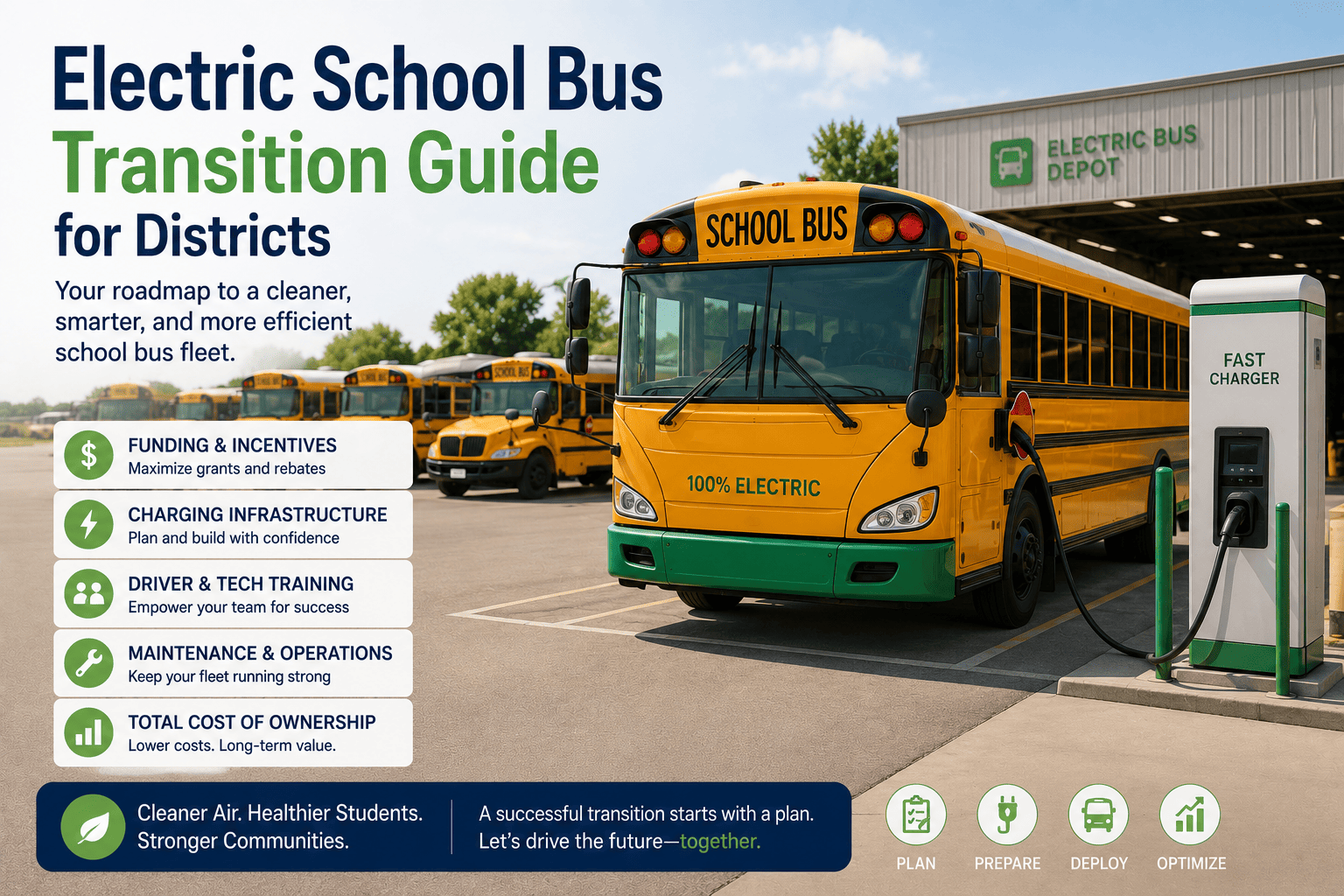
A 250-bus school district in Maryland committed to transitioning its entire fleet to electric by 2030. They applied for EPA Clean School Bus Program funding, secured $8 million, and ordered 25 electric buses. Then the real work began: depot electrical upgrades ($1.2 million), charging infrastructure installation ($500,000), driver training on range management, mechanic training on high-voltage systems, and route planning for winter range reduction. The first electric buses arrived in 2025. By spring 2026, 15 of the 25 were in regular service. The other 10 were still in the depot — waiting for charger installations and trained mechanics. The lesson: electric bus transition is more than buying buses. It's infrastructure, training, route planning, and maintenance transformation. This guide covers everything districts need for a successful electric school bus transition: funding, charging, range planning, driver training, mechanic certification, and maintenance program changes.
Funding sources. Charging infrastructure. Range planning. Driver training. Mechanic certification. Maintenance transformation.
The EPA Clean School Bus Program is the primary federal funding source for electric school buses. $5 billion allocated through 2026. Funding rounds: annual competitive grants and rebates. Priority districts: low-income, rural, tribal, and high-need districts receive priority scoring. Funding covers: electric buses (up to $345,000 per bus), charging infrastructure (up to $30,000 per charger), workforce training (driver and mechanic training), and project management. Applications require: transition plan (5-10 year roadmap), community engagement documentation, infrastructure readiness assessment, and maintenance plan. Most successful applications demonstrate matching funds (district or utility contributions). Utility partnerships are highly valued — letters of commitment from local electric utilities strengthen applications. Many districts hire grant writers for EPA applications (cost $5,000-15,000, often recouped in first award). State-level funding also available in many states (CA, NY, NJ, MA, CO, IL, WA, OR).
Charging infrastructure is often the bottleneck in electric bus transition. Lead time for electrical upgrades: 12-24 months. Steps: conduct depot electrical assessment (load study, panel capacity, transformer size). Engage utility early (6-12 months before planned charger installation). Determine charging strategy: Level 2 AC (19.2 kW, 6-8 hour charge, $5,000-10,000 per charger) for overnight depot charging — sufficient for most school bus routes (120-150 mile range). DC Fast Charging (60-90 kW, 2-3 hour charge, $50,000-150,000 per charger) for midday top-ups or long routes — higher cost, faster charge. Most school districts use Level 2 overnight charging as primary strategy. Smart charging software prevents demand spikes and reduces utility demand charges. Site electrical upgrades can cost $500,000-2,000,000 for 25-50 buses. Plan for phased infrastructure: install capacity for full fleet transition over 5-10 years rather than all at once.
Electric bus range varies significantly by season. Rated range (manufacturer spec): 120-150 miles. Summer range (80°F+): 110-130 miles. Winter range (32°F): 75-95 miles. Extreme cold (0°F): 60-80 miles. The biggest range killer: cabin heating. Pre-conditioning while plugged in saves 15-20% range. Route planning must account for winter range reduction. Match routes to range: assign electric buses to shorter routes (under 80 miles) in winter, longer routes in summer. Keep 20% range safety margin. Monitor state of charge in real time. BusCMMS tracks SOC per bus and flags any bus departing below minimum threshold. For districts with mixed diesel/electric fleets, reserve diesel buses for longest winter routes or routes with limited charging access. As battery technology improves, range will increase. For 2026 models, expect 5-10% range improvement over 2023 models.
Electric buses require new skills for both drivers and mechanics. Driver training (4-8 hours per driver) covers: range management (state of charge monitoring), regenerative braking feel, winter range reduction mitigation (pre-conditioning), charging procedures (depot charging protocols, emergency charging), and safety (high-voltage awareness, emergency disconnect locations). Most drivers adapt quickly — electric buses are quieter, smoother, and easier to drive than diesel. Mechanic training is more extensive (40-80 hours per mechanic). High-voltage certification required for any work on electric bus systems. Training covers: battery safety (lockout/tagout, personal protective equipment), thermal management system, electric motor and inverter, high-voltage cable inspection, diagnostic software, and charger maintenance. Many districts send mechanics to OEM training programs (Cummins, Thomas Built, Blue Bird, IC Bus). Cost: $2,000-5,000 per mechanic. Most states require certified electric bus technicians for warranty compliance. Uncertified mechanics cannot perform warranty work.
Electric bus maintenance is simpler but different. Eliminated from PM: oil changes (every 5,000-7,500 miles), fuel filters, air filters (engine), transmission service, DPF/DOC/SCR/DEF system, exhaust system inspection, turbocharger/EGR service, and belts/hoses (most). Added to PM: battery state of health check (every 10,000 miles — warranty critical), high-voltage cable inspection, thermal management coolant, charger PM, regen braking calibration, and 12V auxiliary battery check. Maintenance cost savings: $2,000-5,000 per bus annually compared to diesel. Brake life: 2-3x longer due to regenerative braking. However, battery replacement at year 10-12 costs $15,000-30,000 — budget for this in lifecycle cost planning. Use CMMS software to track EV-specific PM (battery SOH, HV cable inspection, charger maintenance). Document every battery SOH check for warranty compliance — missing one check can void the $150,000 battery warranty.
Electric school bus transition is a multi-year journey, not a one-time purchase. Start with depot electrical assessment (12-24 months lead time). Apply for EPA funding annually (most districts succeed on second or third attempt). Plan phased transition (5-10 buses per year, not entire fleet at once). Train drivers and mechanics before buses arrive (6 months minimum). Match routes to range (shorter routes in winter, longer routes in summer). Use CMMS software to track EV-specific maintenance and battery warranty requirements. Districts that plan succeed. Districts that rush fail with buses parked and chargers not installed. The transition is worth it — lower operating costs, quieter operation, zero tailpipe emissions — but only with proper planning. Start planning now.
Electric school bus transition requires planning across six areas: funding (EPA Clean School Bus Program + state incentives), charging infrastructure (12-24 month lead time), range planning (winter reduction to 60-80 miles), driver training (4-8 hours per driver), mechanic certification (40-80 hours, HV safety), and maintenance program changes (eliminate diesel PM, add EV-specific checks). Districts that plan succeed. Districts that rush fail with buses parked and chargers not installed. Start with depot electrical assessment. Apply for funding annually. Plan phased transition (5-10 buses per year). Use CMMS software to track EV maintenance and battery warranty. The transition is worth it: lower operating costs ($5,000-12,000 annual savings per bus), quieter operation, zero tailpipe emissions. But only with proper planning.