A 142-bus school district in Ohio ran two identical 2018 diesel buses side by side. Bus 401 followed the manufacturer's severe-duty maintenance schedule religiously. Bus 402 got oil changes when someone remembered. By 2025, Bus 401 had 312,000 miles and was still on its original engine with compression within 8% of factory spec. Bus 402 was on its second engine at 189,000 miles — a $28,000 replacement. The difference wasn't luck. It was maintenance. Every bus engine follows the same physics: wear accumulates faster when oil degrades, coolant corrodes, and air filters clog. The fleets that get 400,000+ miles from a diesel engine don't have magic mechanics. They have disciplined systems. Here's exactly what they do.
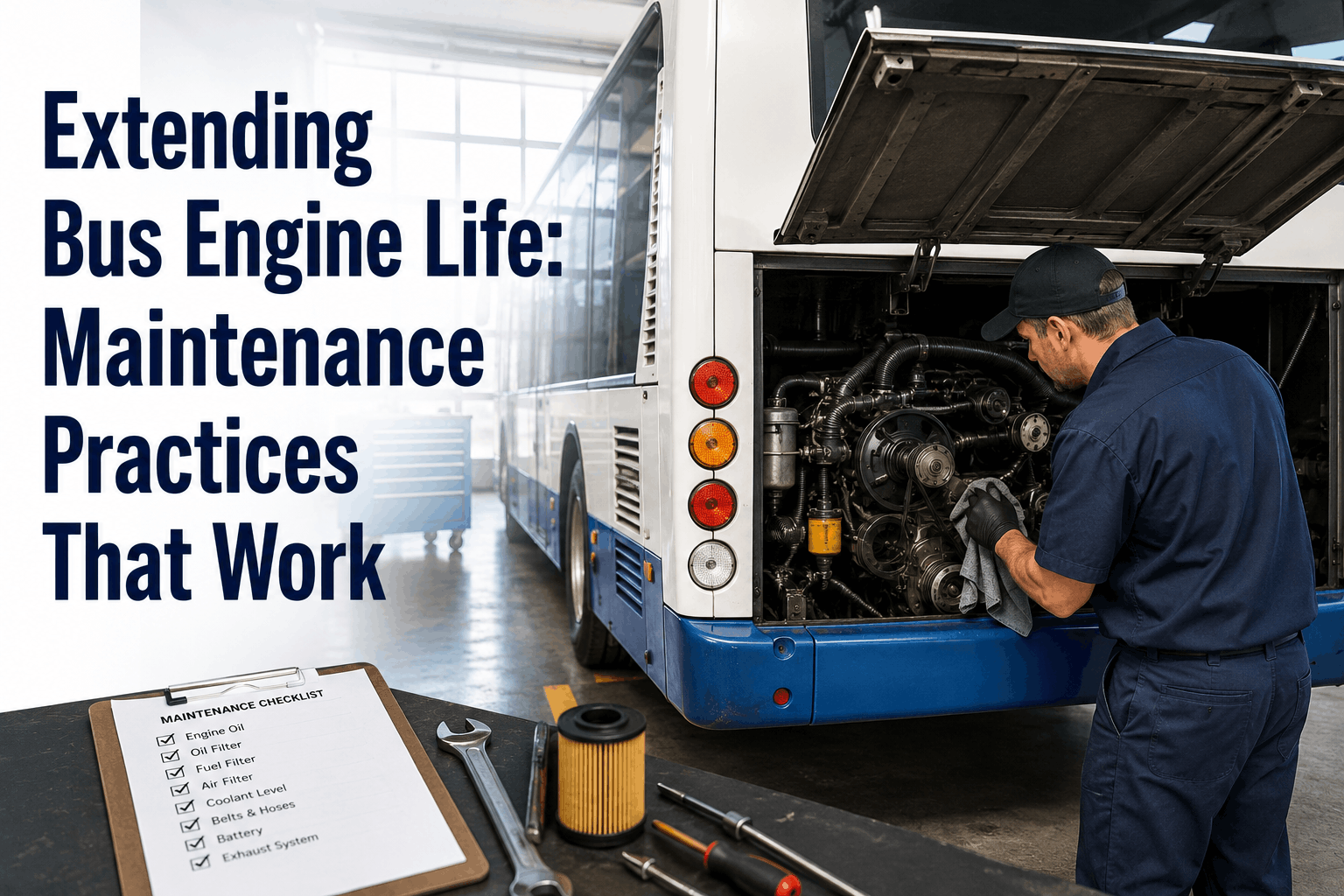
Extending Bus Engine Life: Maintenance Practices That Work
Oil analysis. Cooling system care. Fuel quality. Air filtration. Catch failures early. Add 100,000+ miles to your bus engines.
Diesel Bus Engine — Real Fleet Data
Every skipped oil change shortens engine life by 15,000–30,000 miles. The math doesn't work.
Oil & Lubrication: The #1 Engine Life Factor
The single most impactful maintenance practice for bus engine longevity is disciplined oil changes with analysis. Diesel engines shear oil molecules, accumulate soot, and build acidic byproducts that corrode bearings. Conventional 15W-40 oil degrades faster — 5,000–7,500 mile intervals. Full synthetic extends to 10,000–15,000 miles but ONLY with oil analysis verification. The fleets getting 500,000+ miles test every 5,000 miles. High iron (over 100 ppm) indicates cylinder liner wear. High copper (over 30 ppm) points to bearing failure starting. High viscosity indicates soot loading — time to shorten intervals. Oil analysis costs $30–$50. Catching one bearing failure early saves $25,000 in engine replacement. The fleets that skip analysis are gambling.
Oil Analysis — What to Watch
Test every 5,000–7,500 miles. Track trends, not single samples. One bad sample is a warning — two is a problem.
Oil Change Intervals by Duty
Never exceed manufacturer maximum even with synthetic. Extended oil drains without analysis destroy engines.
Cooling System: The Silent Engine Killer
Coolant is the most neglected fluid in bus fleets — and the most damaging when ignored. Diesel engines run at 195–210°F. Coolant that loses its additive package allows cavitation erosion. Cylinder liners pit. Coolant enters combustion chambers. White smoke appears. By then, the engine requires overhaul or replacement. Test coolant every 20,000 miles for nitrite levels (diesel-specific additive), pH (8.5–10.5), and freeze point. Replace coolant at 50,000 miles or 24 months, whichever comes first. For extended-life coolant, replace at 100,000 miles but test every 20,000. One pitted liner costs $15,000–$25,000 to repair. Coolant testing costs $25. Do the math.
Coolant Deterioration Over Time (Untested)
Nitrite levels below 600 ppm = cavitation erosion risk. Test every 20,000 miles. Replace coolant at 50,000 miles or 24 months.
Coolant Neglect Consequences
Cylinder liner pitting (requires engine teardown)
Water pump seal failure
Radiator clogging from scale deposits
Cylinder head cracking from localized overheating
Repair cost: $15,000–$35,000
Proper Cooling Maintenance
Test nitrites, pH, freeze point every 20,000 miles
Replace coolant at 50,000 miles or 24 months
Use diesel-specific SCA (Supplemental Coolant Additive)
Spin-on coolant filter changes with every oil change
Annual coolant program cost: $150–$300 per bus
Fuel & Air Systems: The Combustion Triad
Diesel engines need clean fuel, clean air, and proper injection timing. Contaminated fuel ruins injectors — $800–$1,200 per injector, six to eight per engine. Dirty air filters increase restriction, raising exhaust temperatures and accelerating turbo wear. Fleets with 500,000+ mile engines change primary fuel filters every 10,000–15,000 miles and secondary (final) filters every 20,000–30,000 miles. They drain water from fuel tanks weekly. They change air filters when the restriction gauge shows 20–25 inches H₂O — not on a calendar. They send fuel samples for analysis annually to detect microbial growth (diesel bug) or water contamination. One bad tank of fuel with water can destroy a full set of injectors in 100 miles.
Air Filter Restriction — Replacement Guide
Never change air filters on a mileage schedule alone. Use the restriction gauge. Dusty environments require more frequent changes.
"We had a bus with a fuel injector knock at 180,000 miles. Lab analysis showed water contamination from a leaking fuel cap and microbial growth in the tank. The previous fleet had never drained the fuel tank water separator. That single bus cost us $7,200 in injectors plus labor. Now every bus gets weekly water drain and annual fuel analysis. Three years, zero injector failures."
Warning Signs: Catch Engine Failure Early
The fleets that extend engine life beyond 500,000 miles don't ignore warning signs. They train drivers and mechanics to recognize early failure indicators — and they have systems to document and act on them. Hard starting (especially cold) points to low compression or worn injectors. Excessive white smoke at startup indicates coolant in combustion chambers (cracked head or blown gasket). Blue smoke is oil burning — worn rings, valve seals, or turbo seals. Black smoke is over-fueling — injector issues or air restriction. Unusual knocking or ticking that changes with engine speed means bearing or valvetrain problems. Every one of these signs, ignored for 500 miles, turns a $5,000 repair into a $30,000 engine replacement.
Hard starting + white smoke + coolant loss = cylinder head failure in progress. Stop bus immediately. Tow to shop. Do not drive.
Immediate Action — Stop Driving
Schedule Inspection — Monitor Closely
The 400,000-Mile Engine Maintenance Schedule
This condensed schedule shows what matters for engine longevity. The fleets hitting 500,000+ miles on original engines follow this religiously. No shortcuts.
Engine Longevity Maintenance Schedule (Diesel)
Document every inspection. Track component life per bus.
Fleet Expert Review
The difference between a 250,000-mile engine and a 500,000-mile engine is not luck or brand preference. It's oil analysis, coolant testing, fuel filtration, and acting on warning signs immediately. Every skipped maintenance interval shortens engine life by 15,000–30,000 miles. Every ignored warning sign turns a $5,000 repair into a $30,000 replacement. The fleets that get long engine life don't have bigger budgets. They have better discipline. And they use software to enforce that discipline — automated PM scheduling, oil analysis tracking, coolant test reminders, and driver defect logs that actually trigger work orders.
The Bottom Line
Bus engines are designed for 500,000+ miles. Most never reach it because maintenance gaps kill them first. Oil analysis catches bearing wear before catastrophic failure. Coolant testing prevents cavitation erosion. Fuel filtration protects injectors. Air filter discipline protects turbos. And warning signs — ignored for one day, one week, one month — turn into engine replacements that cost $25,000–$45,000. BusCMMS tracks all of it: oil analysis due dates, coolant test intervals, filter change schedules, and driver-reported defects with automatic work orders. The fleets with disciplined maintenance systems get to 500,000 miles. The rest replace engines. Choose which one you want to be.
Stop Engine Failures Before They Start
BusCMMS schedules oil analysis, coolant tests, fuel filter changes, and air filter inspections automatically. Track every engine health metric on one dashboard. Free 14-day trial.
Frequently Asked Questions
How many miles can a diesel bus engine last with proper maintenance?
How often should I test engine oil on school buses?
What coolant additive is required for diesel bus engines?
What are the signs of a failing diesel engine?
How often should fuel filters be changed on diesel buses?
Can BusCMMS track oil analysis results and trends?
Diesel + Electric + CNG. Every Fuel Type. One System.
Engine health tracking for diesel. Battery SOH for electric. Cylinder checks for CNG. All PM schedules. All warning signs. All on one dashboard. Free 14-day trial.