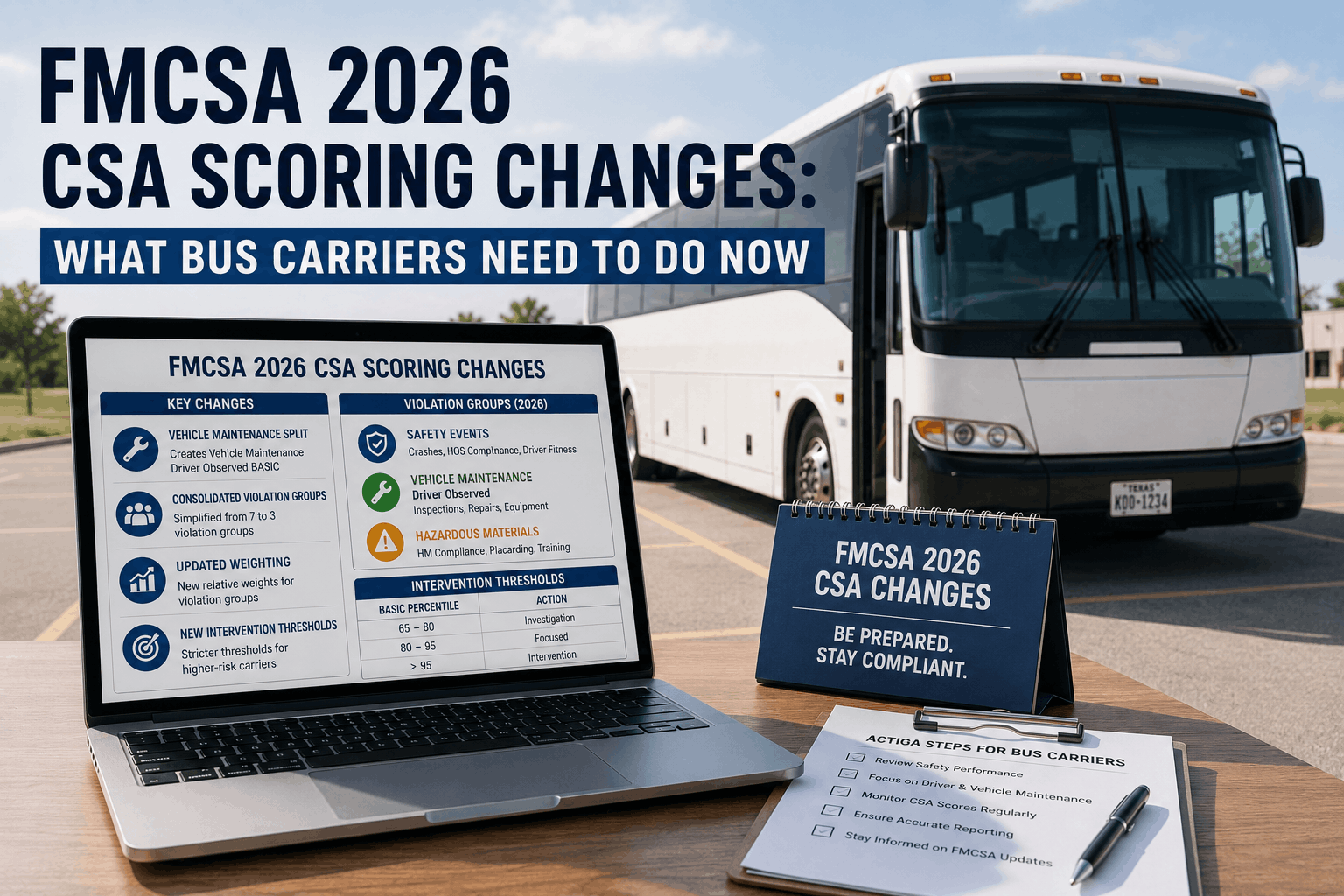
FMCSA is rolling out the most significant CSA scoring overhaul in years — splitting Vehicle Maintenance into two categories, consolidating violation groups, and adjusting intervention thresholds. Bus carriers who don't adapt their compliance tracking now will see their scores deteriorate even if their safety performance hasn't changed. This guide breaks down every 2026 change and what to do about it.
CSA 2026 Update Guide
FMCSA 2026 CSA Scoring Changes: What Bus Carriers Need to Do Now
Plain-English breakdown of FMCSA 2026 CSA scoring changes for bus carriers. Vehicle Maintenance split, consolidated violation groups, new thresholds.
The Stakes: Scores Will Shift Without Action
The 2026 changes re-weight violations and split categories, meaning a carrier's percentile could jump 10–15 points overnight — without a single new inspection. Proactive preparation prevents an artificial plunge into intervention territory.
10–15 pts
Potential overnight score swing
7 → 8
BASICs after VM split
30+
Violations re-weighted
100%
Prep target before effective date
The 2026 Changes That Will Rewrite Your CSA Score
Vehicle Maintenance Split
Vehicle Maintenance is splitting into "Vehicle Maintenance" and "Vehicle Maintenance: Driver Observed." Pre-trip defects from driver reports now live in a separate BASIC, increasing visibility and accountability.
Consolidated Violation Groups
Dozens of similar violation codes are being merged. Fewer, broader categories mean each violation carries more weight and a single roadside issue can hit your score harder.
Severity Weight Adjustments
Critical violations (brakes, steering, lights) are being re-weighted upward. A single out-of-service brake violation will impact your score more heavily than in previous years.
New Intervention Thresholds
The percentile that triggers an FMCSA warning letter or targeted roadside inspection is being recalibrated. Carriers near the current threshold may find themselves flagged under the new system.
Crash Indicator Enhancements
Crash data is being integrated more aggressively with vehicle maintenance records. Post-crash inspections that reveal maintenance deficiencies will compound the score impact.
DataQs Challenge Timelines
The window for challenging violations is being standardized. Carriers must act faster to correct errors, or the points will become permanent faster than before.
Projected Score Impact of 2026 Changes
The waterfall shows exactly how the 2026 changes cascade. The Vehicle Maintenance split and violation consolidation push your score up, while proactive DataQs challenges and a tightened PM program can offset some of the increase. The net result demands immediate preparation.
Immediate Actions for Bus Carriers
Audit Current Violations Against New Groups
Map every existing violation to its new 2026 category and weight. Identify which drivers and buses will be most impacted by the VM split.
File Pending DataQs Now
Challenge any remaining correctable violations before the new challenge timelines take effect. A clean record before the transition protects your score.
Separate Driver-Observed Defects
Start tracking pre-trip defects separately from shop-discovered issues. This prepares your team for the VM: Driver Observed BASIC and improves accountability.
Re-Train Drivers on Pre-Trip Thoroughness
With driver-observed defects now in their own BASIC, incomplete inspections will hit your score faster. Reinforce pre-trip rigor immediately.
Model Your Projected Score
Use FMCSA's preview tool or your CMMS to project your score under the new methodology. Identify which BASIC will cross the threshold first.
Increase Preventive Maintenance Frequency
The re-weighting of critical violations makes catching brake and tire wear early even more important. Accelerated PMs are your best defense.
Preparation Progress for 2026 CSA Transition
Violation Mapping Complete
All active violations mapped to new 2026 categories. Impact analysis completed for every driver and vehicle.
DataQs Challenges Filed
All eligible challenges submitted before the new timeline takes effect. Response tracking active.
Driver-Observed Defect Tracking Live
Digital DVIRs now separate driver-found defects from shop-found issues. Data feeds into new reporting structure.
Driver Training Completed
All drivers retrained on pre-trip procedures under the new scoring framework. Refresher sessions scheduled quarterly.
Score Projection Modeled
New score calculated using preview methodology. Intervention risk areas identified and mitigation plans in place.
PM Frequency Adjusted
Accelerated PM schedules deployed for high-risk vehicle groups. Digital checklists updated with new weight-specific items.
2026 CSA Transition KPIs
Violation Mapping Accuracy
Target: 100% of violations mapped to new categories. Any unmapped violation is a score risk post-transition.
DataQs Success Rate
Target: Above 60% of challenges resolved favorably before the new timeline limits take effect.
Driver Defect Separation Rate
Target: 100% of DVIR defects categorized correctly as driver-observed or shop-found.
Projected Score vs. Threshold Gap
Target: At least 10 percentile points below the new intervention threshold in every BASIC.
PM Acceleration Completion
Target: All high-risk vehicles on accelerated PM schedule within 30 days of program launch.
The 2026 changes could have pushed us into intervention territory overnight. But by mapping our violations early, filing DataQs challenges, and separating driver defects, we held our score steady through the transition.
Prepare Your CSA Score for the 2026 Changes
BusCMMS automatically maps violations to new categories, tracks driver-observed defects separately, and projects your score under the new methodology. Book a demo to see the transition tools in action.
FMCSA 2026 CSA Scoring FAQs
When do the 2026 CSA scoring changes take effect?
FMCSA is phasing in changes throughout 2026. The Vehicle Maintenance split and violation consolidation take effect mid-year. Carriers should prepare now rather than waiting for the effective date.
How does the Vehicle Maintenance split work?
The current Vehicle Maintenance BASIC is being divided into two categories: Vehicle Maintenance (shop-found defects) and Vehicle Maintenance: Driver Observed (pre-trip and DVIR-reported defects). Each will have its own percentile score and intervention threshold.
Will my score automatically change on the effective date?
Yes. FMCSA will recalculate all carriers' scores using the new methodology. Your score could shift 10–15 percentile points without any new inspections, depending on your violation mix.
How can I project my score under the new rules?
Use your CMMS to map existing violations to the new categories and weights. BusCMMS includes a 2026 score projection tool that shows exactly where your score will land after the transition.
What should I do if my projected score crosses the threshold?
File all pending DataQs challenges immediately. Accelerate PM schedules to prevent new violations. Increase driver training on pre-trip inspections. Every point of improvement counts.
Does the FMCSA provide a preview tool for the new scoring?
FMCSA is releasing a preview environment where carriers can see their recalculated scores before the official transition. Check the SMS website for availability.
The 2026 Changes Reward Preparation, Punish Inaction
FMCSA's CSA scoring overhaul is the most significant change in years, and bus carriers who wait to adapt will see their scores deteriorate through no fault of their own. By mapping violations now, filing DataQs challenges, separating driver-observed defects, and accelerating PM schedules, you can hold your score steady through the transition. The carriers who prepare will emerge with a competitive compliance advantage. The carriers who don't will be explaining intervention letters to their insurance providers.