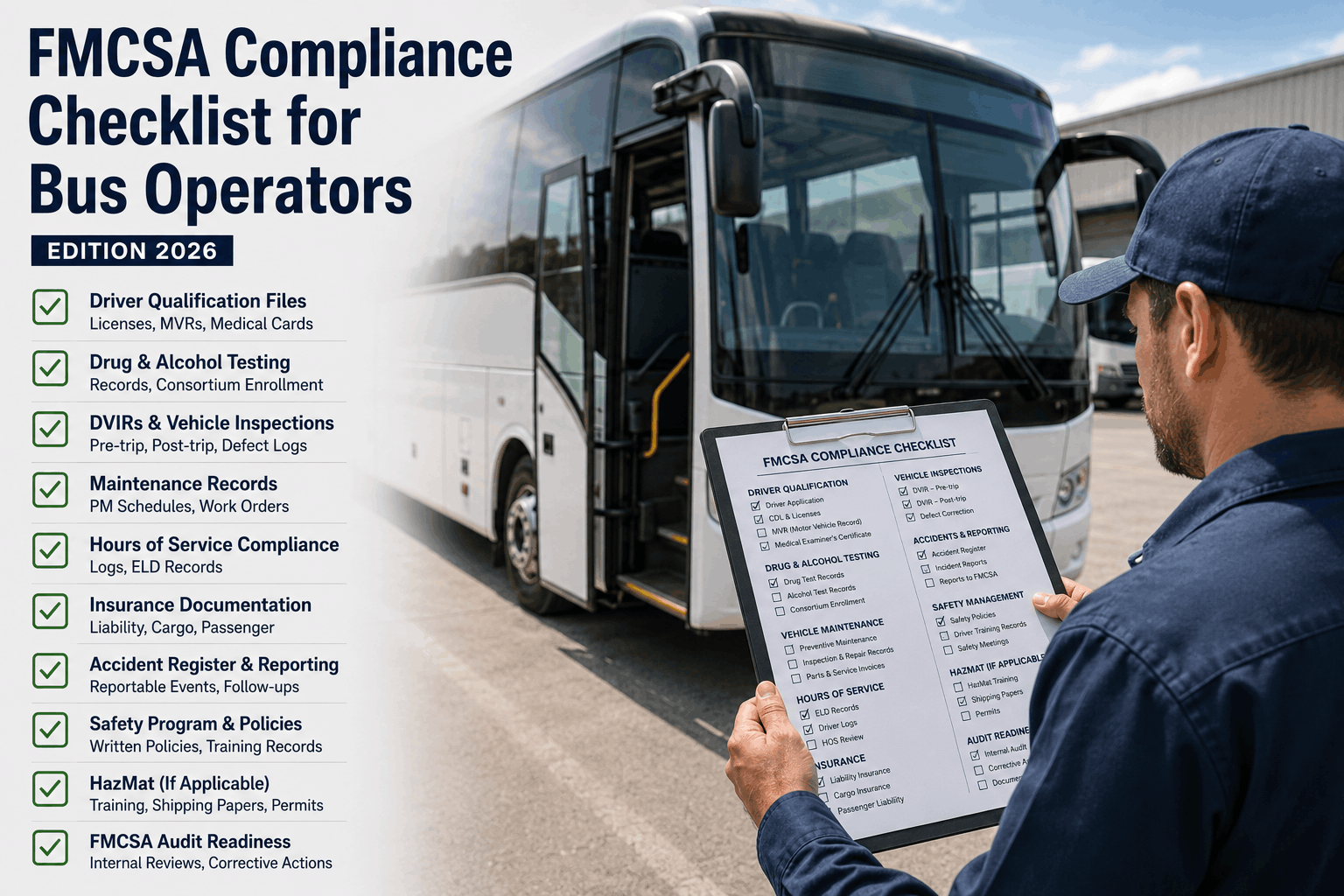
FMCSA Compliance Checklist for Bus Operators (Edition)
A 150-bus school district in Pennsylvania thought they were compliant. They had DVIRs in binders. Their annual inspections were up to date. Their drivers had current medical cards. Then an FMCSA auditor spent three days going through their files. The findings: 14 missing pre-employment drug tests, 8 drivers with expired medical cards, 6 buses with annual inspections overdue by 2-5 months, and 23 missing DVIR repair certifications. Total proposed fine: $187,000. Conditional safety rating: 18 months. The superintendent asked: "How did this happen?" The answer: compliance isn't a feeling — it's a checklist. And they didn't have one. This is that checklist. Every section of FMCSA regulations that applies to bus operators, translated into actionable requirements. Use it to self-audit before FMCSA does.
2026 FMCSA Compliance
6
Key Compliance Areas for Bus Operators
Driver qualifications. Hours of service. Drug and alcohol testing. Vehicle maintenance. Accident reporting. Safety rating management.
$23,048
Max penalty per violation
93%
of carriers fail audits
24 mo
CSA violations stay on record
Driver Qualification Files (49 CFR Part 391)
Every driver operating a commercial motor vehicle must have a complete qualification file. Missing any document creates a violation. Here's what must be in every driver's file, and how long to keep it.
§391.11
Driver Qualification — General Requirements
Driver must be at least 21 years old, able to speak/read English, and physically qualified. Must have valid CDL with proper endorsements (passenger, school bus, air brake). Must not be disqualified from operating a CMV.
BusCMMS tracks CDL expiration and endorsements with 60/90-day renewal alerts
§391.21
Driver Employment Application
Signed and dated application must include: driver's full name, address, date of birth, Social Security number, employment history for prior 3 years, accident/conviction history, and list of all states where licensed. Retain for 3 years after driver separation.
BusCMMS stores digital driver applications with employment history attachments
§391.23
Background Check & Prior Employer Inquiry
Must investigate driver's safety performance history for prior 3 years. Inquire about DOT drug/alcohol violations, accidents, and prior employment. Written documentation of all inquiries must be retained. If prior employer fails to respond, document attempts.
BusCMMS tracks prior employer verification with due date alerts
§391.41
Medical Examiner's Certificate (DOT Medical Card)
Valid DOT medical card (Form MCSA-5876) or medical variance (Form MCSA-5870). Must be renewed every 24 months (or less if condition requires). Expired medical card = driver not qualified. Retain for 3 years after driver separation.
BusCMMS tracks medical card expiration dates with 30/60/90-day alerts
§391.51
Driver Qualification File Retention
Complete driver qualification file must be retained for 3 years after driver leaves employment. File must include: application, background check results, medical certificate, road test certificate or CDL copy, annual review of driving record, and any variances or waivers.
BusCMMS stores all driver qualification documents indefinitely with role-based access
Drug and Alcohol Testing (49 CFR Part 382 & Part 40)
2026 drug testing rates: 50% of drivers for drugs, 10% for alcohol annually. The Clearinghouse is now fully connected to state DMVs — "prohibited" status triggers automatic CDL downgrade.
§382.301
Pre-Employment Testing
Must receive a negative pre-employment drug test result and full Clearinghouse query before a driver performs any safety-sensitive function. There are no exceptions. A driver cannot start work while waiting for test results.
BusCMMS tracks pre-employment test status and blocks driver assignment until cleared
§382.305
Random Testing Program
Annual random testing: 50% of driver positions for drugs, 10% for alcohol. Selections must be scientifically random and spread across all 4 quarters. All CDL drivers in the pool at all times — including part-time and contracted drivers.
BusCMMS manages random test selection notifications and tracks completion per driver
§382.701
FMCSA Clearinghouse Compliance
Annual limited query for every employed CDL driver. Full pre-employment query before hiring. Positive results must be reported within 24 hours. "Prohibited" status triggers automatic CDL downgrade by state DMV.
BusCMMS tracks annual query due dates and stores query confirmation records
Part 396 is the most cited section in bus fleet audits. Daily DVIRs, 90-day emergency exit inspections, annual comprehensive inspections, and record retention — all required.
Emergency exits, push-out windows, and emergency door marking lights. Signature and date required. Bus-specific requirement — not in trucking regulations.
§396.17 — Annual Inspection
Requirement
Every 12 months
Appendix A comprehensive inspection. Sticker or decal on vehicle at all times. Retention: 14 months.
Use this checklist for monthly self-audits. Check every box. Document every check. Address every gap.
Driver
Driver Qualification Files
☐ Valid CDL with proper endorsements ☐ Current DOT medical card (not expired) ☐ Signed employment application ☐ Prior employer inquiries for 3 years ☐ Annual MVR review ☐ Road test certificate or CDL copy ☐ Medical variance (if applicable)
Hours
Hours of Service
☐ ELD compliance (no paper logs unless short-haul exception) ☐ No 15-hour on-duty violations ☐ No 10-hour driving violations ☐ 60/70-hour rule compliance ☐ 34-hour restart properly documented
Testing
Drug & Alcohol
☐ Random test selections complete (50% drug, 10% alcohol) ☐ Pre-employment negative tests on file ☐ Annual Clearinghouse limited queries ☐ Post-accident testing procedures documented ☐ Return-to-duty process for any violations
Vehicles
Vehicle Maintenance (Part 396)
☐ Daily DVIRs complete with 3-signature chain ☐ 90-day emergency exit inspections ☐ Annual inspections current (not expired) ☐ Maintenance records retained (vehicle life + 6 months) ☐ Inspector certifications current
BusCMMS automates every item on this checklist. Digital driver files. HOS integration. Drug test tracking. DVIRs. 90-day exits. Annual inspections. One dashboard. Every bus. Every driver. Book a demo to see complete FMCSA compliance automation.
6 Parts of FMCSA. 1 Dashboard. 100% Compliance.
Driver qualification files. Hours of service. Drug and alcohol testing. Vehicle maintenance (Part 396). Accident reporting. CSA score management. All automated. All audit-ready. Free 14-day trial.
What are the 2026 FMCSA drug and alcohol testing rates?
FMCSA requires 50% annual random drug testing rate and 10% annual random alcohol testing rate for calendar year 2026. Selections must be scientifically random and spread across all 4 quarters.
How often must bus emergency exits be inspected?
49 CFR 396.3 requires emergency exits, push-out windows, and emergency door marking lights to be inspected every 90 days. Documentation must include date, inspector name, and pass/fail results.
What is the penalty for a missing DVIR?
Missing or incomplete DVIR carries a minimum penalty of $1,270 per day per missing record. Missing repair certification increases penalty. Maximum civil penalty per violation is $23,048.
How long must driver qualification files be retained?
Driver qualification files must be retained for 3 years after the driver leaves employment. This includes application, medical certificate, prior employer inquiries, and annual MVR reviews.
Does FMCSA require electronic DVIRs in 2026?
Paper DVIRs remain legal, but FMCSA final rule FMCSA-2025-0115 (effective March 23, 2026) explicitly authorizes electronic DVIRs. Digital records create better audit trails and are recommended.
What triggers an FMCSA compliance audit?
High CSA BASIC scores (above 65th percentile), crash history, complaints, or random selection. New carriers are audited within first 12 months. Maintenance BASIC violations are the most common trigger.
What Fleets Using BusCMMS Report
"FMCSA audited us for the first time in 5 years. They requested 10 driver files and 10 vehicle files. With BusCMMS, I exported every required document in 15 minutes. The auditor said it was the most organized file presentation she'd ever seen. Zero findings. Zero fines. Zero follow-up." — Transportation Director, 85-bus school district, Virginia
Join the 7% That Pass Audits Clean
Every section of FMCSA compliance, automated. Driver files. HOS. Drug testing. Part 396. Accident reports. CSA. One dashboard. Every bus. Every driver. Free 14-day trial.