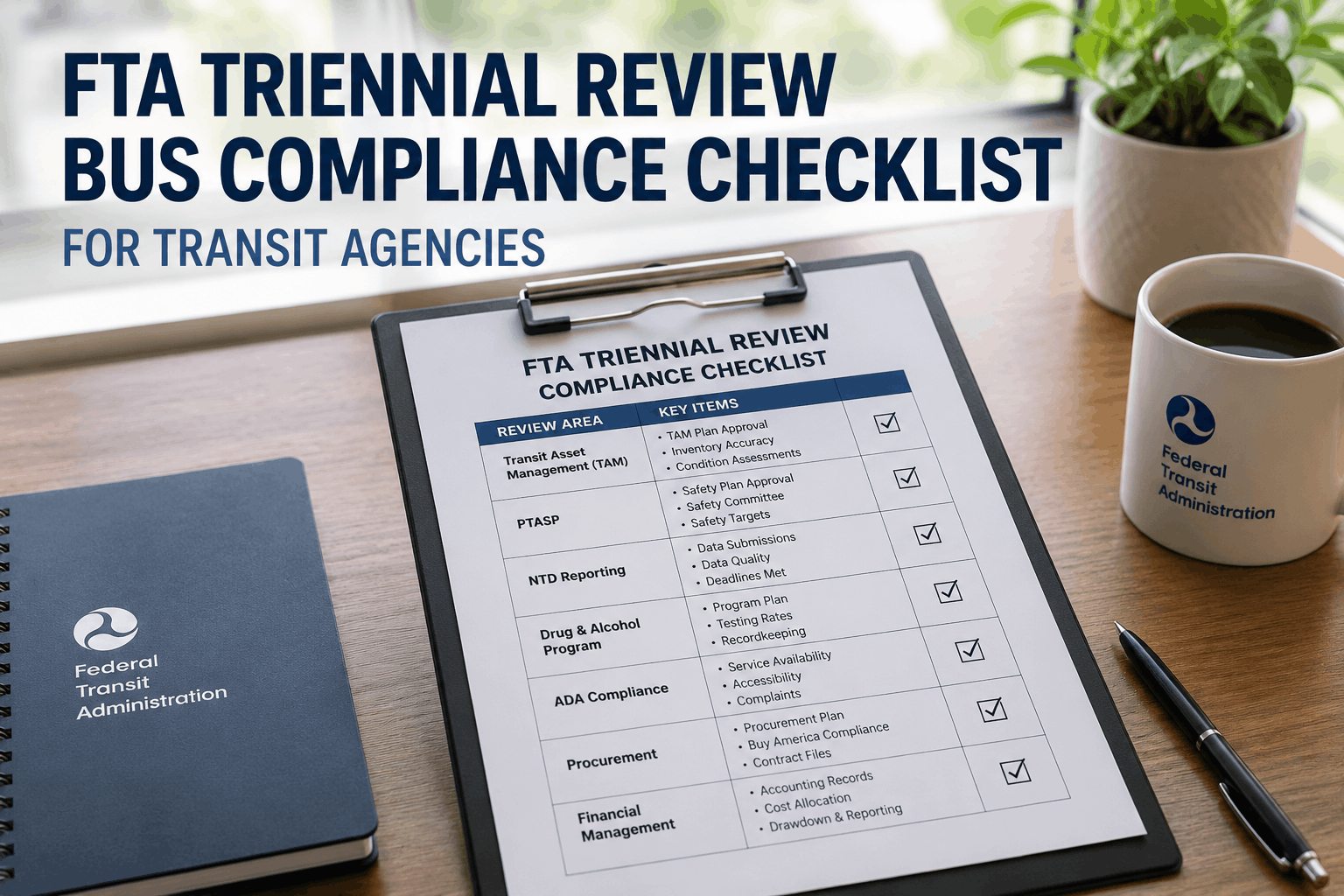
The FTA triennial review is the Federal Transit Administration's comprehensive compliance audit of transit agencies receiving federal financial assistance. This review examines safety, asset management, financial accountability, civil rights, procurement, and operational performance across all federally funded programs. The FTA triennial review bus compliance checklist presented here provides transit agencies with a structured approach to preparing for this rigorous assessment, covering the Transit Asset Management (TAM) plan, Public Transportation Agency Safety Plan (PTASP), National Transit Database (NTD) reporting, drug and alcohol testing program, ADA compliance, procurement standards, and financial management requirements. Agencies that approach triennial review preparation as an ongoing compliance discipline rather than a reactive audit exercise are better positioned to demonstrate effective stewardship of federal funds and maintain uninterrupted grant eligibility.
Compliance Guide 2026
FTA Triennial Review Bus Compliance Checklist
Complete FTA compliance checklist covering TAM plan, PTASP, NTD reporting, drug & alcohol testing, ADA, procurement, and financial management. 100+ items grouped by review area.
Why Annual FTA Compliance Preparation Prevents Grant‑Eligibility Risks
FTA triennial reviews are not optional—they determine whether a transit agency continues to receive federal formula grants and discretionary funding. A single area of non‑compliance, such as incomplete NTD reporting or an outdated TAM plan, can trigger corrective action plans that divert resources from operations. Agencies that treat triennial review preparation as an ongoing process, rather than a last‑minute audit scramble, consistently achieve higher pass rates and maintain uninterrupted funding. This checklist provides the structured documentation evidence that FTA reviewers expect, organized by the six core compliance domains.
Fleet data shows that agencies using a digital compliance system reduce audit preparation time by 60% and close findings 40% faster. Book a demo to see how BusCMSS enforces annual compliance intervals and maintains a permanent audit trail.
FTA Triennial Review Bus Compliance Checklist: Key Areas
Transit Asset Management (TAM)
Maintain a complete TAM plan with asset inventory, condition assessments, and performance targets. FTA reviewers verify accuracy and progress.
Public Transportation Agency Safety Plan (PTASP)
Document safety policies, hazard identification, mitigation strategies, and safety committee activity. Must be current and reviewed annually.
National Transit Database (NTD) Reporting
Submit accurate NTD reports on time. Maintain supporting records for safety, financial, and operational data. Incomplete submissions trigger scrutiny.
Drug and Alcohol Testing Program
Maintain random testing pools, post‑accident protocols, and return‑to‑duty procedures. Compliance rates must meet FTA thresholds.
ADA Compliance and Civil Rights
Ensure accessible service, paratransit eligibility, facility accessibility, and complaint resolution processes. Document training and service metrics.
Procurement and Financial Management
Follow federal procurement standards: competitive bidding, cost analysis, contract management. Maintain complete grant expenditure records.
FTA Triennial Review Compliance Checklist: Detailed Domain Breakdown
The six primary domains each contain specific documentation requirements and performance evidence that FTA reviewers examine. This breakdown provides transit agencies with a comprehensive view of what to prepare for each area.
Transit Asset Management (TAM) Plan Compliance
Asset Inventory & Condition
FTA reviewers verify that the agency maintains a complete TAM plan with asset inventory, condition assessments, performance targets, and investment strategies for each asset class. The review examines whether the agency tracks asset condition using the four FTA condition categories (Excellent, Good, Fair, Poor) and documents progress toward performance targets over the reporting period. Agencies must demonstrate that the TAM plan is updated annually and that asset condition data informs capital investment decisions.
PTASP Safety Plan Documentation
Safety Management
The Public Transportation Agency Safety Plan must document the agency's safety management approach, including safety policy statements, hazard identification processes, mitigation strategies, and safety performance measures. FTA reviewers examine whether the agency has established a safety committee, conducts regular safety meetings, and tracks hazard mitigation activities. The review also evaluates whether the agency has designated a Chief Safety Officer and implemented an accident reporting and investigation procedure.
NTD Reporting Accuracy and Timeliness
Data Compliance
The National Transit Database is FTA's primary data collection system for transit agency performance and financial information. The triennial review verifies that agencies submit NTD reports on time, that reported data is accurate, and that supporting documentation is maintained for audit purposes. Reviewers examine safety and security event reporting, financial data accuracy, and service performance metrics. Agencies with incomplete NTD reporting or unexplained data inconsistencies face increased scrutiny and potential grant action.
Drug and Alcohol Testing Program Compliance
Workplace Safety
FTA‑regulated drug and alcohol testing programs require transit agencies to maintain random testing pools, conduct pre‑employment and post‑accident testing, and document return‑to‑duty procedures for employees who test positive. The triennial review examines testing policy documentation, random testing pool management, testing records, and compliance rate calculations. Reviewers verify that agencies maintain testing records for the required retention period and that the program is administered in accordance with FTA regulations.
ADA and Civil Rights Compliance
Accessibility & Equity
FTA requires transit agencies to comply with ADA regulations for accessible service, complementary paratransit, and facility accessibility. The triennial review examines ADA policy documentation, complaint handling procedures, service accessibility metrics, and paratransit eligibility determination processes. Reviewers evaluate whether the agency maintains accessible vehicles, provides ADA training to employees, and tracks service accessibility improvements. Agencies with documented ADA compliance demonstrate commitment to civil rights and equitable service delivery.
Procurement and Financial Management
Grant Oversight
Federal procurement standards require transit agencies to conduct competitive bidding, perform cost analysis, and manage contracts in accordance with FTA guidance. The triennial review examines procurement policies, contract files, cost analysis documentation, and grant expenditure records. Reviewers verify that agencies maintain financial management systems that track grant expenditures, document cost allocation, and support FTA financial reporting requirements. Agencies with complete procurement records and accurate financial management demonstrate responsible stewardship of federal funds.
FTA Triennial Review Compliance Checklist – Core Items
This 10‑point checklist covers the minimum documentation and performance evidence required for each compliance domain. Use it during annual internal audits, pre‑review preparations, and anytime your agency modifies a federal grant program.
FTA Triennial Review Pass Rate by Compliance Area
This chart shows that while TAM and PTASP often pass, procurement and drug/alcohol areas frequently have findings. BusCMSS helps agencies address these gaps by centralizing policy documents, contract files, and testing records, and by sending automated reminders for annual updates. Start a free trial to see how digital compliance checklists improve first‑review pass rates.
Common FTA Compliance Gaps and Root Causes
Outdated TAM Asset Inventory
Cause: No annual update process. Fix: Schedule an annual asset verification and integrate with maintenance records. BusCMSS automates this update.
Incomplete PTASP Hazard Log
Cause: Safety committee meetings not documented. Fix: Require safety committee minutes with hazard action items. Use a template in BusCMSS.
NTD Data Discrepancies
Cause: Manual data entry errors. Fix: Implement system‑to‑system data feeds; validate prior to submission. BusCMSS integrates with NTD reporting tools.
Drug Testing Compliance Rate Below Threshold
Cause: Random pool not refreshed or testing not performed. Fix: Use random selection software and track every test in a centralized database.
ADA Complaint Handling Delays
Cause: No tracking system for complaints. Fix: Maintain a complaint log with resolution dates and actions. BusCMSS provides a complaint tracking module.
Incomplete Procurement Files
Cause: Contract files missing cost analysis or bid justification. Fix: Create a checklist for each procurement action. BusCMSS attaches required documents to each contract record.
Our agency manages 220 buses and receives over $8M in annual FTA funding. Before we adopted the BusCMSS compliance module, we struggled to track TAM updates and PTASP revisions across multiple departments. The FTA triennial review is now a streamlined process—we have a single source of truth for all compliance documents. In our last review, we had zero findings, and the FTA reviewer commented on the quality of our documentation organization.
Automate FTA Triennial Review Compliance with BusCMSS
BusCMSS schedules annual compliance reviews per domain, attaches checklists to each grant, requires document uploads, and generates a permanent compliance history. Never miss a TAM update or NTD submission deadline again.
FTA Triennial Review Bus Compliance FAQs (USA)
What is the FTA triennial review bus compliance checklist?
A comprehensive set of documentation and performance standards covering TAM, PTASP, NTD, drug/alcohol, ADA, and procurement—the basis of FTA's compliance audit.
How often does the FTA conduct triennial reviews?
Every three years for agencies receiving federal assistance. The schedule is risk‑based; some agencies may face more frequent reviews.
What happens if a transit agency fails the FTA triennial review?
FTA issues corrective action requirements. If not addressed, grant funding may be restricted or eligibility revoked. Agencies must develop a corrective action plan.
How can BusCMSS help with FTA triennial review preparation?
BusCMSS centralizes all compliance documents, schedules annual reviews, tracks checklist completion, and maintains an audit trail. It reduces preparation time and improves first‑review pass rates.
What documentation is required for FTA procurement compliance?
Procurement policies, contract files, cost analysis, bid records, and grant expenditure documentation. All must follow 2 CFR Part 200.
How do I track PTASP safety committee meeting minutes?
Store meeting minutes and attendance records in a central repository with a version history. BusCMSS provides a dedicated safety committee module.
What is the minimum NTD data retention period?
Supporting records for NTD submissions must be retained for at least three years after the submission date. FTA may request them during an audit.
Does BusCMSS track annual compliance deadlines?
Yes. BusCMSS sends automated reminders for TAM updates, PTASP reviews, NTD submission dates, and testing program deadlines—ensuring nothing is overlooked.
Stay Ahead of FTA Compliance — Start Your Review Preparation Today
FTA triennial review is not an event—it is a continuous process of documentation, performance measurement, and program improvement. By using this checklist and a digital compliance system like BusCMSS, transit agencies can transform audit preparation from a frantic scramble into a well‑organized, evidence‑based demonstration of federal grant stewardship. When every TAM plan, PTASP document, and NTD submission is tracked and accessible, the review becomes an opportunity to showcase your agency's commitment to safety, accountability, and public service.