School bus compliance is not optional — and it's not just about passing an annual inspection. For school districts, contractors, and transportation providers, compliance affects funding eligibility, insurance rates, parent confidence, student safety, and legal liability. The FMCSA, state DOTs, and local education agencies all have overlapping requirements: driver qualification files, daily DVIRs, 90-day emergency exit inspections, annual inspections, drug and alcohol testing, Clearinghouse queries, and maintenance record retention. A single missing document can trigger fines starting at $1,584 per day, out-of-service orders, and damage to your safety rating that follows your fleet for 24 months. Most compliance failures aren't caused by bad equipment — they're caused by disconnected recordkeeping. This guide explains how school bus fleets can improve compliance performance using connected CMMS workflows, automated alerts, and audit-ready documentation.
Learn practical methods to improve school bus compliance, reduce operational risk, and increase fleet reliability with proven maintenance workflows.
School bus compliance spans multiple regulatory domains. Driver qualification files (49 CFR Part 391) require employment applications, prior employer inquiries, current medical cards, CDL copies with P/S endorsements, annual MVR reviews, and annual violation lists. Vehicle maintenance (49 CFR Part 396) requires daily DVIRs with 11-point inspections, 90-day emergency exit inspections, annual comprehensive inspections, and repair certification records. Drug and alcohol testing (49 CFR Part 382) requires pre-employment tests, random testing (50% drug, 10% alcohol), Clearinghouse pre-employment and annual queries, and return-to-duty documentation. Hours of service (49 CFR Part 395) requires ELD compliance for interstate trips and proper recordkeeping for intrastate exceptions. When these records are maintained in disconnected systems, compliance gaps multiply.
A school bus compliance program cannot rely on paper binders, filing cabinets, or disconnected spreadsheets. The system should capture every regulatory requirement and make it searchable on demand. Driver qualification files must include complete employment applications, prior employer inquiries, current medical certificates, CDL copies with P/S endorsements, annual MVR reviews, annual violation lists, and safety performance history. Vehicle records must include daily DVIRs, 90-day emergency exit inspections, annual inspection reports, maintenance work orders, and repair certifications. Drug and alcohol records must include pre-employment test results, random test selections, Clearinghouse query confirmations, and return-to-duty documentation. When these records are stored in a CMMS, audit preparation becomes a 30-second export instead of a 3-week treasure hunt.
Compliance failures rarely happen because a district doesn't know the rules. They happen because deadlines are missed, documents are lost, or signatures are incomplete. Connected compliance systems prevent these failures through automation. When medical card expiration dates are tracked in a CMMS, the system sends alerts 30, 60, and 90 days before expiration. When a DVIR defect is reported, the system automatically creates a work order and blocks dispatch until repair certification is complete. When a 90-day exit inspection is due, the system schedules it and escalates to management if missed. When an annual inspection is approaching, the system alerts maintenance 60 days in advance. This shift from manual tracking to automated compliance reduces violation risk by 60-80%.
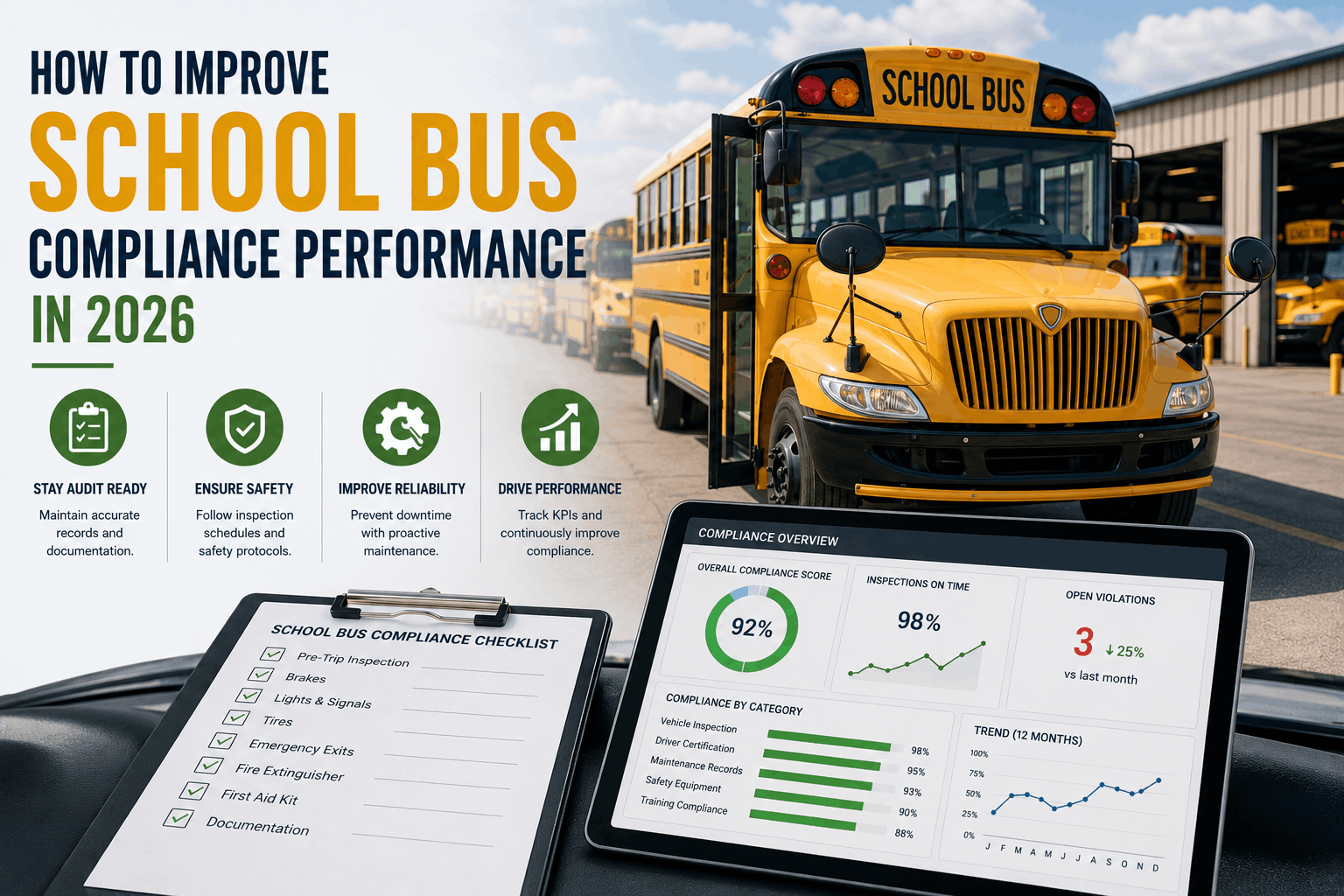
Compliance improves when managers review the right metrics on a consistent schedule. Weekly reviews catch problems before they become violations. The dashboard should show medical card expiration status, CDL endorsement expiration status, DVIR completion rate, 90-day exit inspection compliance, annual inspection due dates, Clearinghouse query due dates, random test completion rates, and repeat defect rates. These KPIs should be shared with transportation directors, maintenance supervisors, and safety officers. A weekly compliance review meeting that lasts 30 minutes and reviews exception reports prevents the 3-week panic when an audit notice arrives.
Most compliance failures are not caused by one major oversight. They come from small gaps repeated across months: expired medical cards not caught, DVIR signatures missing, 90-day exit inspections missed, annual inspections expired, Clearinghouse queries forgotten, or driver files incomplete. These gaps make audits stressful and expensive. The fix is not working harder — it's automating the tracking and alerts.
School bus compliance is strongest when records are connected, deadlines are automated, and KPIs are reviewed weekly. The most common violations — expired medical cards, missing DVIR signatures, missed 90-day exit inspections, and incomplete driver files — are all preventable with a modern CMMS. Fleets that treat compliance as a daily operational metric instead of an annual audit event consistently pass inspections with zero findings.
Improving school bus compliance performance requires moving from reactive paper tracking to proactive digital management. Key actions: implement digital driver qualification files with expiration alerts, deploy mobile DVIRs with 3-signature chain and photo documentation, auto-schedule 90-day exit inspections, track annual inspections 60 days in advance, manage Clearinghouse queries per driver, and review compliance KPIs weekly. A CMMS connects all these requirements into one dashboard, turning audit preparation from a crisis into a routine export. School districts that make this transition reduce violation risk, lower operational stress, and keep students safe.