A driver notices a subtle vibration in the suspension and reports it to the dispatcher through radio chatter. By the time the message reaches the maintenance shop, it's been diluted: "Something feels wrong with the rear." The technician can't reproduce the issue. Days later, the same driver reports it again, and again the communication breaks down. Eventually, the suspension component fails catastrophically during revenue service, creating a roadside breakdown that costs thousands in emergency repairs and jeopardizes passenger safety. This scenario repeats thousands of times daily across bus fleets operating without digital driver-technician communication. Miscommunication delays repairs. Vague defect reports lead to unproductive shop visits. Critical safety issues fall through the cracks. Yet when drivers and technicians communicate through integrated digital workflows—where drivers report defects with photos, location data, and specific symptoms, and technicians can ask clarifying questions and provide feedback—repair efficiency improves 30-40%, defect resolution time drops 25-35%, and safety incidents decline measurably. Modern fleet software enables seamless driver-technician collaboration through digital defect reporting, work order visibility, and real-time bidirectional communication that eliminates information loss and accelerates problem resolution.
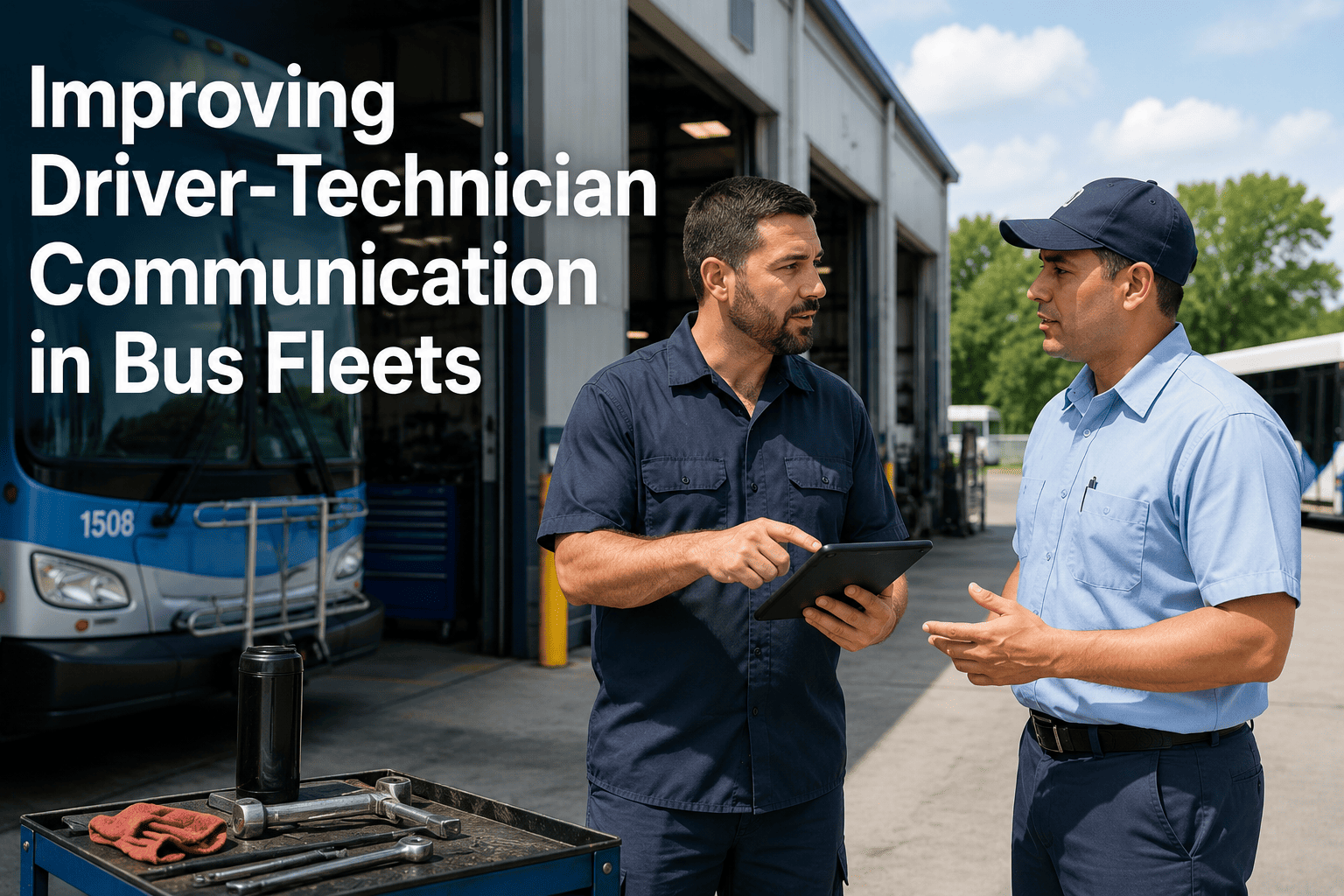
Improving Driver-Technician Communication in Bus Fleets
Digital defect reporting reduces repair delays 25-35%. Connected workflows fix issues faster, safer, and right the first time.
Bus fleet communication has historically relied on radio and phone calls. A driver reports a defect verbally. Dispatch writes it down (or doesn't, if they're busy). The message gets passed to the maintenance shop, often losing detail in translation. By the time a technician hears about the issue, it's vague, incomplete, and lacks context. "The bus has a noise" is useless. "The left front wheel area has a grinding noise when turning left, particularly audible above 25 mph, started yesterday morning on Route 14" is actionable. Radio-based defect reporting inevitably loses detail. Additionally, there's no documentation. The driver reports an issue; dispatch has no obligation to record it. Even if they do, the record is often lost in a logbook never reviewed again. When a roadside breakdown occurs, you have no historical record proving that the issue was previously reported and ignored. This creates liability and regulatory risk. Furthermore, radio communication creates bottlenecks. A driver must get dispatch on the radio—often difficult during peak hours when everyone's communicating simultaneously. The dispatcher must then relay the message to the shop. This chain of command delays issues reaching technicians. By the time a technician understands the problem, hours or days have passed. Urgent safety issues get deprioritized because their severity isn't clear to anyone except the driver. Finally, radio communication provides no mechanism for technicians to ask clarifying questions or provide feedback to drivers. If a repair doesn't fully resolve an issue, the driver reports it again, and the cycle repeats without learning. The technician never understands whether their repair worked or whether the reported symptoms indicate a different underlying problem. This lack of feedback creates endless diagnostic cycles that consume technician time without resolving problems.
Modern fleet software enables drivers to report vehicle defects through mobile-first apps designed for quick, accurate reporting. A driver completes their pre-trip inspection and notices a cracked taillight. Instead of radioing dispatch and hoping the message gets through, they open the fleet app, select their vehicle, tap "Report Defect," describe the cracked light, specify the location (left rear), and take a photo if the app supports it. The report is instantly submitted to the maintenance system with a timestamp, driver ID, vehicle ID, defect category, description, photo, and location. The maintenance team immediately sees the defect in their work queue, prioritized by severity. If it's a safety-critical issue (brake warning light, steering problem), the system flags it and alerts supervisors. If it's a maintenance item (cracked light, cosmetic damage), it goes into the standard queue. The driver can see the status of their submitted defect: "Submitted," "Acknowledged," "In Progress," or "Resolved." If a technician needs clarification, they can send a message through the app: "Is the grinding noise present when cold, hot, or both?" The driver receives the notification and responds, providing crucial diagnostic information. This bidirectional communication enables technicians to reach correct diagnoses faster. Research on digital DVIR (Driver Vehicle Inspection Reports) systems shows that when drivers report specific, detailed defects with photos, first-time repair success rates reach 92%. Without photos and detailed descriptions, technicians spend time diagnosing problems that drivers could have described more precisely, leading to incomplete repairs and repeated visits for the same vehicle. Additionally, digital defect reporting creates comprehensive audit trails. Every defect reported, every work order generated, every technician assignment, every repair status update is logged with timestamps. When a vehicle is involved in a safety incident, you have complete documentation of what issues were reported, when they were reported, and what repairs were performed. This protects both the fleet operator and demonstrates due diligence to regulators.
When drivers report defects through digital systems, and technicians document repairs through work orders, the maintenance status of every vehicle becomes visible to dispatchers in real time. A dispatcher checking the fleet dashboard sees that Bus 47 has a reported brake issue marked "Do Not Dispatch Until Repaired." This prevents the vehicle from entering service with a known safety problem. Without this visibility, dispatchers might unknowingly send a vehicle out with unrepaired defects. With vehicle maintenance status visible, dispatchers can make informed decisions: route Bus 47 to the shop immediately, or route it to the yard for overnight repair? Is there a vehicle with less severe issues that can substitute for this route? Drivers can also see the status of their reported defects in the app. "My defect report from Monday is still showing 'Submitted'?" A driver can follow up. "I reported the AC was broken two weeks ago and it's still not fixed." Visibility drives accountability. Maintenance managers can see which buses consume disproportionate repair resources. Is Bus 12 being repaired for the same problem repeatedly? That suggests the technician isn't addressing root causes or the bus should be scheduled for major overhaul. Analytics dashboards aggregate defect data: which components fail most frequently, which drivers report the most defects (indicating possible maintenance awareness or driving habits), which technicians close work orders most completely. This data informs preventive maintenance adjustments, technician training, and fleet replacement decisions. Additionally, shop coordination improves dramatically with digital communication. A technician who needs a specific part can see availability in the parts system before ordering. A supervisor can see which technicians are available to take on work orders. A technician can see that Bus 15 is waiting for a part—they don't start work on it until the part arrives. This reduces wasted technician time and improves shop efficiency.
Transportation operators face regulatory scrutiny around vehicle maintenance and driver safety. Regulators ask: "What defects were reported on vehicles involved in safety incidents? What repairs were performed? When? By whom?" Radio and manual logbook systems can't answer these questions definitively. Digital defect reporting and work order systems provide complete, timestamped, audit-ready records. If a bus is involved in a collision, investigators can pull the complete maintenance history for that specific vehicle: every defect reported by any driver, every repair performed, every inspection completed. This transparency demonstrates that the operator maintained the vehicle to regulatory standards or, if maintenance gaps are discovered, provides clear accountability for correcting them. FTA (Federal Transit Administration) regulations require documentation of vehicle maintenance. School district transportation supervisors must maintain records of vehicle condition and repairs. OSHA requires documentation of safety-critical repairs. Digital CMMS systems generate all required documentation automatically. When an audit or investigation begins, you export the complete record rather than assembling documents manually or reconstructing missing information. This dramatically reduces audit time and risk. Additionally, digital communication enables safety-critical defects to be prioritized automatically. When a driver reports "brake warning light illuminated," the system immediately flags this as safety-critical and alerts maintenance supervisors and dispatchers. The vehicle is marked "Do Not Dispatch" pending inspection. This prevents high-risk vehicles from entering service due to communication delays or human error. In contrast, with radio-based reporting, critical safety issues might be buried among routine maintenance requests and lost in the communication chain. Finally, digital communication supports compliance with hours-of-service regulations and driver rest requirements. When a bus is sent to the shop for repairs, the hours-of-service clock pauses. Drivers waiting for a vehicle to be repaired need accurate information about when it will be ready. With digital communication, technicians can update drivers: "Repair will be completed by 2 PM; you'll be back on the road for the 3 PM pullout." This prevents driver compliance violations and demonstrates good faith effort to maintain schedules while ensuring safety.
Driver-technician communication is the connective tissue of fleet maintenance. Radio-based reporting creates information loss, delays, and miscommunication that lead to safety issues and inefficiency. Digital communication—integrated defect reporting, real-time status visibility, bidirectional messaging, and complete audit trails—transforms fleet operations. Fleets implementing digital communication see repair efficiency improve 30-40%, first-time repair rates jump from 64% to 92%, and regulatory compliance improves measurably. The gap between fleets with digital communication and those relying on radio chatter is widening rapidly.
Drivers, technicians, dispatchers, and supervisors work toward a single goal: keep buses safe, compliant, and on schedule. But they can only achieve this goal if information flows seamlessly among them. When a driver reports a defect, it must reach a technician with full context and urgency. When a technician completes a repair, dispatchers must know the vehicle is ready. When regulatory audits occur, you must have complete documentation. Digital communication systems—enabled by modern CMMS platforms—create this information flow. The result is safer operations, more efficient repairs, better compliance, and teams aligned around vehicle safety and reliability.
"Before BusCMMS digital defect reporting, we relied on radio chatter and paper forms. Defects got lost, work orders took days to reach the shop, and we had no documentation of what was reported and fixed. Now, drivers report defects in the app with photos. Technicians receive complete information, ask clarifying questions if needed, and update status in real time. Dispatchers see vehicle maintenance status and avoid dispatching unsafe buses. From defect report to repair completion is now 25-35% faster, and we have complete audit trails for compliance. It's transformed how our operation works."
— Maintenance Director, Urban Transit Agency (380-bus operation)