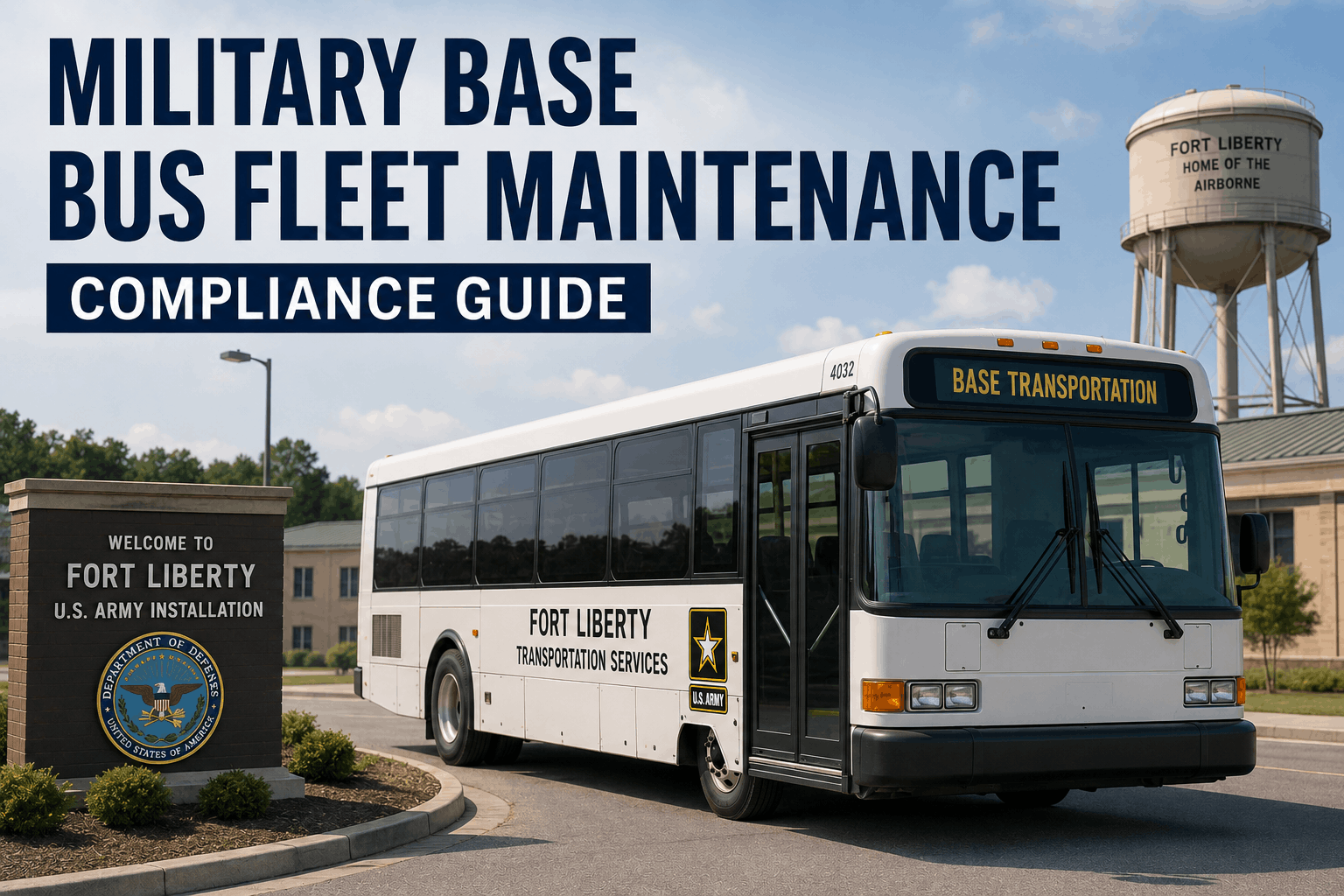
A military base bus fleet answers to a different set of rules than a commercial operator, with GSA fleet card reconciliation, installation access authority, and Anti-Terrorism/Force Protection plans layered on top of standard DOT requirements. A missed PM interval or an undocumented security check does not just risk a breakdown, it risks the contract itself. Start Trial to see how BusCMMS gives contractor fleet managers the compliance records, PM history, and readiness reporting a base transportation office expects.
Keep Your Base Contract Audit-Ready Year Round
BusCMMS connects PM compliance, GSA fleet card records, and AT/FP inspection logs into one dashboard so contractor fleet managers can respond to a base audit without pulling files from three systems.
Why Military Base Bus Fleets Face a Different Compliance Standard
A base transportation contract sits at the intersection of USDOT regulation and installation authority, which means a contractor fleet manager has to satisfy both a federal inspector and a base security office at the same time. Contractors that Book Demo with BusCMMS see how PM records, fleet card reconciliation, and AT/FP inspection logs combine into one reportable file for the next contract review. Tracking these records consistently is what keeps a base transportation contract in good standing through the next renewal cycle.
GSA Fleet Card Reconciliation
Fuel and maintenance purchases made against GSA fleet cards are logged per vehicle, matching spend records to the assigned unit for reconciliation.
DoD Security Clearance Vehicle Access Log
Vehicle access and driver clearance status are recorded alongside dispatch records, supporting installation security office reviews.
FedFleet Reporting Export
Utilization, mileage, and cost data export in a format aligned with federal fleet reporting requirements, reducing manual data entry at reporting time.
USDOT vs Installation Authority Tracking
Inspection and compliance requirements are tracked separately by federal DOT rule and installation-specific policy, avoiding confusion between the two.
Contractor MX Program Compliance
PM intervals defined in the maintenance contract are tracked per vehicle, showing whether the contractor is meeting the service schedule on paper.
AT/FP Inspection Records
Anti-Terrorism and Force Protection vehicle inspection checklists are logged per run, building the documented record base security will request.
Key Metrics for Military Base Bus Fleet Contracts
01
PM Compliance Rate Against Contract
Primary Contract Metric
PM compliance against the contracted schedule is the metric most base transportation offices review first at contract renewal, since it is the clearest indicator of whether the fleet is being maintained as agreed. BusCMMS tracks scheduled versus completed PM per vehicle, giving contractor fleet managers a defensible compliance number for every review.
Baseline 66%
Current 93%
02
GSA Fleet Utilization Rate
Cost Efficiency Signal
Fleet utilization tracks how consistently vehicles are dispatched relative to fleet size, a figure federal fleet managers use to justify vehicle counts at budget review. BusCMMS logs dispatch and mileage per vehicle, supporting utilization reporting without a separate tracking spreadsheet.
Baseline 58%
Current 85%
03
AT/FP Inspection Completion Rate
Security Compliance
AT/FP inspection completion tracks whether every scheduled security inspection was performed and documented, a requirement that installation security offices audit independently of standard DOT inspections. BusCMMS logs AT/FP checklist completion per run, closing the documentation gap before an audit finds it.
Baseline 74%
Current 97%
04
Contractor SLA Adherence
Contract Performance
SLA adherence tracks on-time route completion and vehicle availability against the terms defined in the base transportation contract, the primary figure used at contract review to justify renewal. BusCMMS logs completion and downtime by vehicle, keeping SLA performance visible ahead of the review date.
Baseline 79%
Current 96%
05
Vehicle Security Clearance Compliance
Access Control Signal
Security clearance compliance tracks whether every driver assigned to a base run held valid installation access at the time of dispatch, a record base security offices request during incident reviews. BusCMMS ties dispatch records to driver clearance status, keeping this record current automatically.
Baseline 83%
Current 99%
06
Fleet Readiness Rate
Operational Readiness
Fleet readiness rate measures the share of the contracted fleet available for immediate dispatch at any given time, a core figure for both mission planning and contract performance review. BusCMMS calculates readiness from real-time vehicle status, giving base liaisons a live number instead of a weekly estimate.
Baseline 70%
Current 94%
Base Bus Fleet Compliance Metrics: Quick Reference
Scroll for more
| Compliance Metric | Measurement Period | Target Signal | BusCMMS Data Source | Review Frequency |
|---|---|---|---|---|
| PM Compliance Rate | Quarterly | Sustained above 90% | PM schedule vs completion | Monthly |
| Fleet Utilization | Monthly | Above 80% | Dispatch and mileage log | Monthly |
| AT/FP Inspection Rate | Weekly | Above 95% | Security checklist completion | Weekly review |
| SLA Adherence | Monthly | Above 95% | Route completion and downtime log | Monthly |
| Fleet Readiness Rate | Daily | Above 90% | Real-time vehicle status | Weekly review |
How BusCMMS Supports Base Transportation Contract Compliance
A base transportation contract is renewed on the strength of its records, and BusCMMS connects PM compliance, fleet card reconciliation, AT/FP inspections, and readiness data into one file per vehicle so a contractor fleet manager can respond to any audit request immediately. When PM compliance is sustained above 90 percent, AT/FP inspections are complete, and readiness rate is holding near contract target, that is the record that supports contract renewal instead of a performance review flag. Contractors can Start Trial and begin building this record from the first vehicle logged in BusCMMS.
Real-Time Readiness Tracking
BusCMMS calculates fleet readiness from live vehicle status, giving base liaisons a current number instead of a delayed weekly estimate.
Fleet Card Spend Logging
Fuel and maintenance purchases against GSA fleet cards are matched to the vehicle and unit, supporting monthly reconciliation.
AT/FP Checklist Tracking
Security inspection checklists are logged per run, building the documented record base security offices request during reviews.
Contract SLA Reporting
Route completion and vehicle downtime are tracked against the contracted SLA, keeping performance visible ahead of renewal.
Building a Base Bus Fleet Compliance Program: Implementation Steps
01
Audit Current Fleet and Contract Records
Pull existing PM history, fleet card data, and prior audit findings into BusCMMS to establish a baseline for the contracted fleet.
02
Map Federal and Installation Requirements
Separate USDOT inspection requirements from installation-specific policy so each vehicle's checklist reflects both standards correctly.
03
Digitize PM Schedules per Contract Terms
Enter PM intervals exactly as defined in the maintenance contract so compliance tracking matches the language the base will audit against.
04
Configure AT/FP Checklist Logging
Build security inspection checklists into the driver dispatch workflow so AT/FP documentation is captured automatically per run.
05
Set Up GSA Fleet Card Matching
Connect fuel and maintenance purchase records to the assigned vehicle in BusCMMS to simplify monthly fleet card reconciliation.
06
Prepare Contract Renewal Reporting
Export PM compliance, SLA adherence, and readiness data ahead of each contract review cycle to support renewal negotiations.
Frequently Asked Questions
What is a military base bus fleet maintenance compliance guide?
It is a structured approach to tracking PM compliance, GSA fleet card records, and AT/FP inspection documentation for contractor-operated bus fleets serving a military installation.
How is a base bus contract different from a commercial fleet contract?
A base contract layers installation security requirements and AT/FP inspection standards on top of standard USDOT rules, requiring separate documentation for each authority.
How does BusCMMS support GSA fleet card reconciliation?
BusCMMS matches fuel and maintenance purchases to the assigned vehicle and unit, simplifying the monthly reconciliation process against fleet card statements.
What records does a base transportation office typically audit?
Most reviews cover PM compliance history, AT/FP inspection logs, driver clearance status, and SLA performance against the contracted service schedule.
Can BusCMMS support multiple base contracts under one operator?
Yes. BusCMMS reporting separates fleets by installation and contract, letting a contractor operating at multiple bases track compliance for each independently.
Keep Your Base Transportation Contract in Good Standing
BusCMMS gives contractor fleet managers the PM records, security checklists, and readiness data needed to pass every base audit and support contract renewal.