Multi-trigger preventive maintenance scheduling is the single most important operational practice that separates high-performing bus fleets from struggling ones. The industry standard "whichever comes first" scheduling logic—triggered by mileage, engine hours, or calendar dates simultaneously—eliminates the catastrophic blind spots of single-trigger approaches. A bus fleet that relies only on mileage-based PM triggers will inevitably miss services on idle vehicles, seasonal operations, and high-idling routes. Multi-trigger PM scheduling, integrated with telematics data and automated CMMS platforms like Bus CMMS, ensures no maintenance obligation slips through the cracks. This comprehensive guide explains the mathematics of multi-trigger logic, demonstrates real-world fleet impacts, teaches implementation strategies for U.S. bus operators, and provides the technical foundation for understanding why multi-trigger scheduling delivers 25–35% maintenance cost reductions and 18–25% uptime improvements.
Single-trigger PM misses idle buses. Master multi-trigger logic (mileage + engine hours + calendar) and eliminate 70–80% of unplanned breakdowns.
Before understanding why multi-trigger scheduling works, we must understand why single-trigger scheduling fails. The most common single trigger is mileage: "Oil change at 20,000 miles." This logic works perfectly for buses that spend 90% of time on highways, where mileage accurately reflects engine work. A highway bus averaging 65 MPH accumulates 20,000 miles over roughly 310 hours of engine operation. The relationship between miles and engine work is predictable. However, most U.S. bus fleets don't operate purely on highways. School buses run stop-and-go routes. City transit buses spend 60–70% of time idling in traffic. Airport shuttles have high idle time between arrivals. These operational patterns break the mileage-only assumption.
Consider two buses with identical 100,000-mile odometer readings. Bus A is a highway intercity coach averaging 6.8 miles per gallon (indicating steady highway cruise at 55 MPH). Bus B is a city transit bus averaging 4.3 miles per gallon (indicating frequent stops, acceleration, braking, idle time). The fuel economy difference directly reflects operating conditions. Bus A's 100,000 miles represents approximately 14,700 engine hours at 55 MPH cruise. Bus B's 100,000 miles represents approximately 23,200 engine hours due to constant acceleration/deceleration cycles. Bus B's engine has been under stress 57% longer than Bus A. Engine lubrication degrades faster under stress. A mileage-only PM schedule that services both buses identically at 100,000 miles is catastrophically wrong: Bus B is under-serviced (needs service at 14,700 miles equivalent work) while Bus A is potentially over-serviced (could safely extend past 100,000 miles).
The second failure mode of single-trigger (mileage) PM is the dormant vehicle problem. A school bus used for 180 days per year might accumulate only 8,000 miles annually. At a 20,000-mile oil change interval, the bus would theoretically require service every 2.5 years. Lubrication doesn't age on a mileage clock; it ages on a calendar clock. Mineral-based engine oil oxidizes and loses viscosity after 12 months in storage, regardless of mileage. A mileage-only schedule would leave oil in that bus for 30 months—far beyond safe service life. Calendar triggers solve this: "Oil change every 12 months OR 20,000 miles, whichever comes first." A seasonal bus would be serviced annually regardless of mileage accumulation.
The third failure mode is the newly-acquired used bus. A fleet purchases a six-year-old diesel coach with 385,000 miles, budgeting for a transmission service at 400,000 miles. At current utilization (8,000 miles/month), the bus will hit 400,000 miles in 1.875 months. But it might hit its next calendar service interval (annual transmission service) before reaching 400,000 miles. A single-trigger (mileage-only) approach might miss the calendar trigger entirely, resulting in a transmission operating without fluid change for 14+ months when driven at lower utilization.
Major OEMs (Cummins, Detroit Diesel, Volvo) explicitly recommend multi-trigger scheduling in their service literature. The American Bus Association, American School Bus Council, and FMCSA all cite multi-trigger scheduling as best practice. Leading U.S. fleets have adopted multi-trigger PM as the minimum standard for compliance and cost control.
Mileage Triggers measure distance traveled. They're appropriate for highways and long-distance routes where engine work correlates directly to distance. A diesel highway coach averaging 6.0 MPG will accumulate approximately 3,333 engine hours per 20,000 miles traveled (20,000 miles ÷ 6.0 MPG = 3,333 gallons; at ~60 MPH cruise, 3,333 gallons ÷ 60 MPH per gallon = 55.5 hours of running time; but steady-state city operation at same distance would yield 4,650 hours). Mileage triggers fail when operating patterns deviate from highway norms.
Engine-Hour Triggers measure actual engine operation time independent of distance. Engine hours directly correlate to bearing stress, lubrication degradation, fuel system stress, and cooling system load. An engine running at idle burns fuel but accumulates minimal miles; it should be serviced based on hours, not miles. Engine hours are captured automatically via OBD-II ports (On-Board Diagnostics) on modern buses. Older buses (pre-2000) don't have OBD data; for these vehicles, engine hours must be estimated from fuel consumption or manual tachometer readings. Modern Bus CMMS integrates OBD data directly, capturing engine hours with 99% accuracy.
Calendar Triggers measure time elapsed, typically in months or years. They address the reality that fluids age chemically regardless of usage. Mineral-based diesel engine oil oxidizes after 12–18 months in service (shelf life is shorter for unused oil in storage). Transmission fluid, coolant, hydraulic fluid, and fuel all degrade on calendar timelines. A bus driven 3,000 miles per year still accumulates 36,000 miles in 12 years; it still needs an oil change annually even if mileage targets suggest service isn't due for years. Calendar triggers ensure no fluid is left in service past chemical limits.
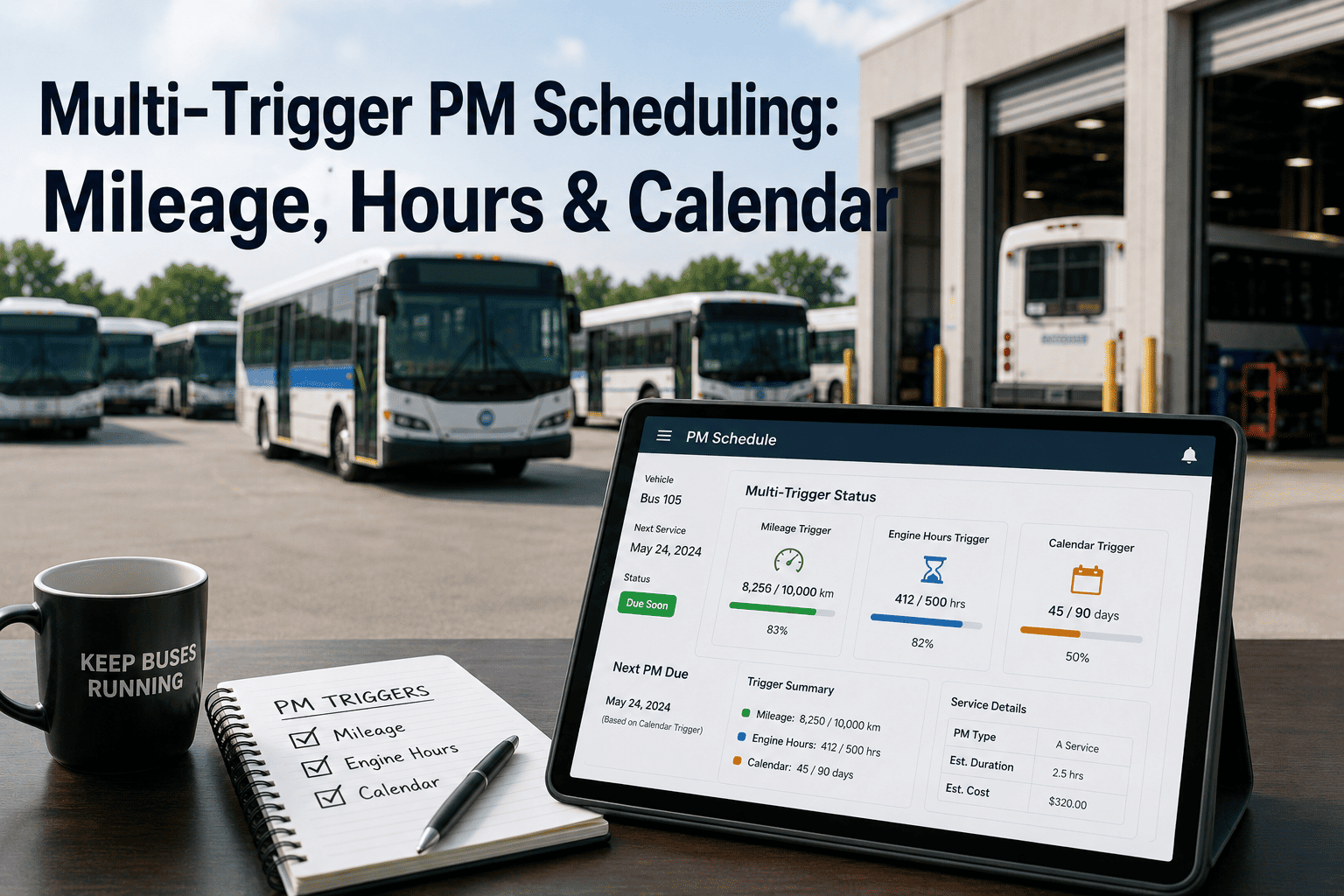
The "whichever comes first" logic ensures the most conservative (earliest) trigger controls scheduling. A diesel bus PM schedule might read: "Oil change: 20,000 miles OR 400 engine hours OR 12 months, whichever occurs first." If the bus is driven hard (accumulating 400 engine hours in 8,000 miles at 5 MPG), the engine-hour trigger fires first. If the bus sits idle in winter (accumulating 500 miles but 1,000 engine hours from heating cycles), calendar triggers potentially fire first. The CMMS system continuously tracks all three, compares them against thresholds, and generates work orders when any threshold is reached first.
For a mixed fleet with diesel, CNG, and electric buses, each fuel type has different trigger thresholds. Diesel oil change might trigger at (20,000 miles OR 400 hours OR 12 months). CNG injector inspection might trigger at (50,000 miles OR 1,000 hours OR 12 months). Electric battery diagnostic might trigger at (25,000 miles OR 6 months OR 80% battery capacity remaining). A CMMS designed for bus fleets has fuel-type-specific trigger templates built-in.
See multi-trigger logic in Bus CMMS – free trial, no credit card
Multi-trigger PM scheduling is only as good as the data feeding it. Manual tracking of mileage (reading odometers), engine hours (checking tachometers), and calendar dates (using spreadsheets) fails at 30+ buses. Errors accumulate: a driver misreads an odometer, a fuel fill-up is incorrectly logged, a PM service due date is missed because it's buried in a spreadsheet. Telematics integration—automatic GPS and OBD data collection—eliminates human error and enables accurate, scalable multi-trigger scheduling.
Modern buses (2008+) have OBD-II ports that broadcast: mileage, engine hours, fuel consumption, engine temperature, diagnostic codes, battery voltage, and 50+ other data points in real-time. GPS receivers on vehicles capture exact latitude/longitude, which is translated into verified mileage (±0.1% accuracy vs. ±5–10% for manual odometer reading). When integrated into Bus CMMS, this data feeds directly into PM scheduling logic. The system doesn't wait for a dispatcher to manually log mileage; it knows the current mileage at all times. It doesn't rely on OBD scans that happen quarterly; it reads engine hours continuously.
The financial case for telematics is strong: hardware and monthly service cost $40–80 per bus per month. For a 45-bus fleet, that's $21,600–43,200 annually. Payback comes from multiple sources: (1) fuel savings (5–10% from driver behavior coaching and route optimization), (2) reduced emergency breakdowns (70% fewer = $120,000+ annual savings), (3) extended component life (accurate PM prevents over-service that wastes parts), and (4) predictive maintenance (catching failures before they happen). Total first-year ROI typically exceeds 300% on mid-sized fleets.
For older buses (pre-2008) without integrated OBD ports, aftermarket telematics hardware can be retrofitted ($400–1,200 per bus, one-time). Payback is achieved within 12–18 months through the same fuel + maintenance savings channels.
Integrate GPS & telematics – see Bus CMMS integration options
Step 1: Data Audit (Week 1–2) Pull 24–36 months of maintenance records. Calculate the current PM compliance rate: of all scheduled services, how many were completed on time? For every major component failure (transmission, engine, brakes), determine when it would have been caught by multi-trigger PM vs. when it actually failed. This historical audit reveals the savings potential. A fleet that has experienced 6 transmission failures in the past 24 months might have prevented 4–5 of them with multi-trigger scheduling (assuming the failures resulted from skipped services or extended intervals beyond safety margins).
Step 2: PM Schedule Design (Week 3–6) Using OEM specifications (Cummins, Volvo, Allison, Westport), design PM schedules with three triggers each. Customize trigger thresholds based on your fleet's actual operating data: if your buses run 10% city and 90% highway (different from the OEM assumption of 50/50), adjust the city-operation threshold downward. If your fleet operates at sea level (different from OEM test conditions at higher elevation), check if air filter intervals should be adjusted. Build 8–12 PM templates to cover fuel types and duty cycles.
Step 3: CMMS Setup (Week 7–10) Input all PM schedules into Bus CMMS. Configure telematics integration: connect your GPS provider (e.g., Samsara, Verizon, Geotab) and OBD data feeds. Set up work order templates with fuel-type-specific parts lists and procedure notes. Test the system with 8–10 pilot buses: load their service history and verify that the system correctly calculates which services are now overdue and which are upcoming.
Step 4: Pilot Execution (Week 11–14) Run the pilot group on CMMS-scheduled PM. Track compliance, part availability, and shop throughput. Expect 1–2 weeks of learning curve and process adjustments. By week 4 of the pilot, pilot buses should achieve 95%+ PM compliance with near-zero missed services.
Step 5: Full Rollout (Week 15–24) Expand to remaining buses in cohorts of 15 every 2 weeks. By end of week 24, all buses are on multi-trigger PM. Expected outcomes: PM compliance improves 20–25 percentage points, unplanned breakdowns drop 60–75%, uptime improves 15–20 percentage points, and maintenance costs drop 28–35%.
Before multi-trigger PM, we had three transit buses break down monthly with major issues. It was reactive chaos. After implementing multi-trigger scheduling with Bus CMMS, we went to zero major breakdowns per month for the first time in our 15-year operating history. The engine-hour trigger caught problems we'd completely miss with mileage alone. Our fleet uptime jumped from 74% to 91%. For a 38-bus fleet, that's $140,000 extra annual revenue from buses staying operational instead of sitting in the shop.
What's the difference between mileage and engine-hour triggers?
Mileage measures distance; engine hours measure time the engine is actually running. A high-idle city bus with 20,000 miles might have 30,000 engine hours. A highway bus with 20,000 miles might have 15,000 engine hours. Engine hours capture stress better; multi-trigger logic accounts for both.
How do I get engine-hour data from older buses without OBD ports?
Estimate from fuel consumption (gallons used ÷ MPG = rough engine hours) or retrofit with aftermarket telematics hardware ($400–1,200 per bus). Retrofit hardware installs in 2–3 hours and captures OBD data retroactively. Payback is 12–18 months from fuel savings alone.
What happens if I only use calendar triggers without mileage/hour triggers?
You'll over-service high-utilization buses (replacing fluids/components before they're worn) and waste money. Multi-trigger logic ensures you service at the earliest need point, not later. Calendar-only triggers would cost 10–15% more annually in wasted service while still missing mileage/hour-related issues on high-use vehicles.
Can multi-trigger PM reduce uptime even more than I expect?
Yes. Fleets moving from reactive to multi-trigger PM often exceed their initial projections. Prevention of major component failures (transmission, engine) cascades: one prevented engine failure saves 1–2 weeks of downtime plus $15,000–30,000 in unplanned repair cost. Over 12 months, this compounds significantly.
How often should I adjust multi-trigger thresholds after implementation?
Quarterly for the first year (as you collect real-world failure data), then annually. You'll likely find that some thresholds can be extended (data shows components have longer life) and others need to be tightened (specific component failures indicate shorter interval needed). Let actual fleet experience drive continuous refinement.
What if I have a very small fleet—is multi-trigger PM worth the investment?
Yes, even for 10–15 buses. Multi-trigger logic prevents the catastrophic failures that disproportionately impact small fleets (one bus breakdown = 7% capacity loss vs. 2% on 50-bus fleet). ROI is faster on small fleets because prevention has higher percentage impact. Use spreadsheets or low-cost CMMS until you reach 30 buses.
How does multi-trigger PM handle seasonal variation in utilization?
Calendar triggers ensure seasonal buses are serviced annually regardless of usage. Engine-hour and mileage triggers adjust naturally to actual operating patterns. A school bus running 9 months/year will accumulate fewer hours/miles annually, but calendar triggers will still fire, preventing the dormant fluid problem.
Can I implement multi-trigger PM manually or do I need CMMS software?
Theoretically yes with a detailed spreadsheet, but it fails above 30 buses due to data entry errors. A CMMS like Bus CMMS automates the tracking, eliminates human error, and scales to any fleet size. Cost ($8–18 per bus/month) is typically recovered within 3–6 months from reduced breakdowns.
Multi-trigger PM scheduling has transitioned from "best practice" to "minimum standard" for professional bus fleet operators in the United States. The technology is mature, the ROI is undisputed, and the alternative (reactive maintenance or single-trigger PM) is economically indefensible. Any fleet operating 20+ buses that has not implemented multi-trigger scheduling is leaving $100,000–$300,000 on the table annually. The investment in CMMS software and telematics integration pays back within 4–6 months. After payback, it's pure profit: lower maintenance costs, higher uptime, fewer emergency breakdowns, and better safety. Leading transit agencies, school districts, and charter operators have all standardized on multi-trigger PM as the baseline operational model.