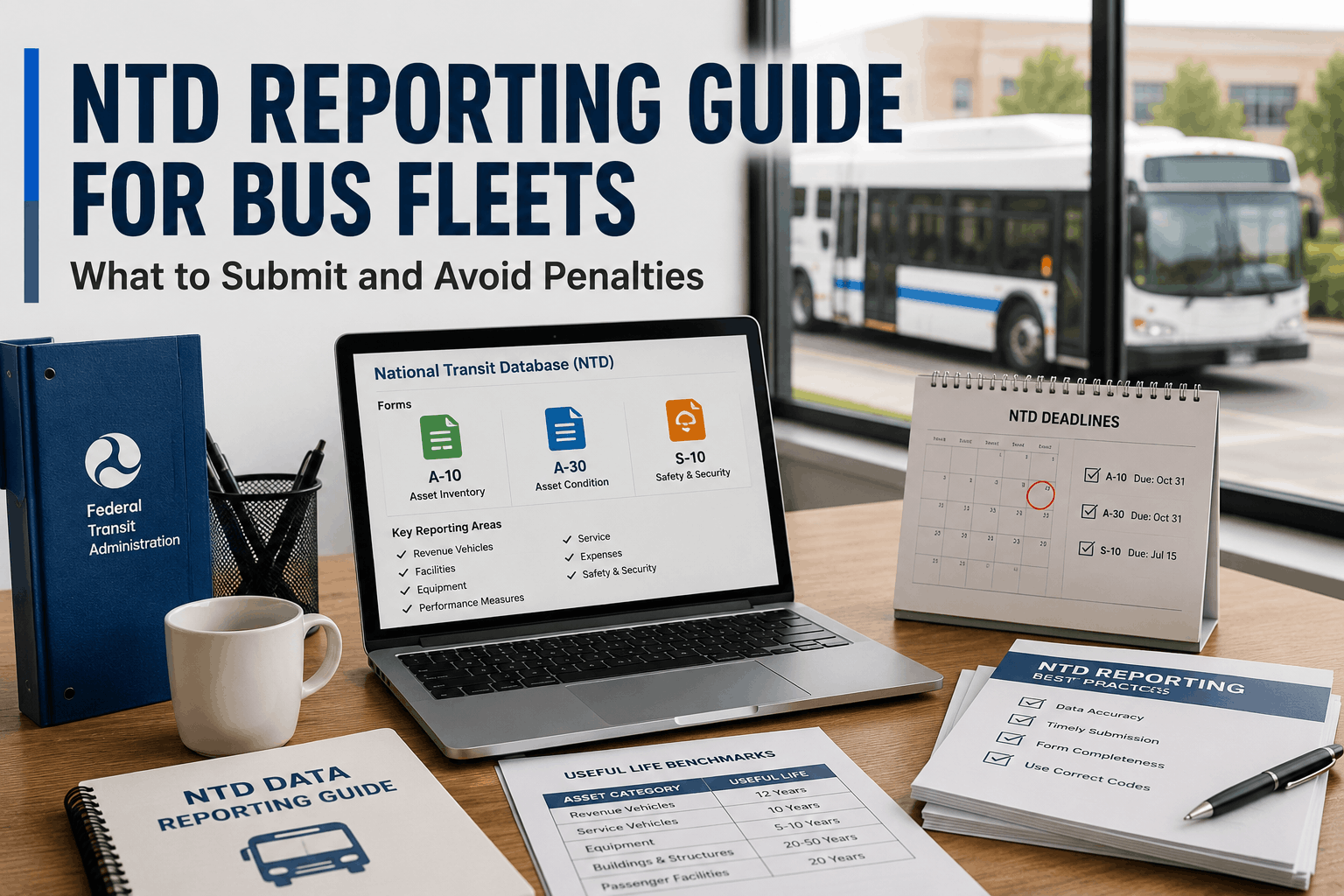
NTD reporting errors cost transit agencies thousands in delayed reimbursements and compliance penalties every year. This guide breaks down exactly what bus fleets must submit — A-10, A-30, S-10 forms, useful life benchmarks, common rejection triggers — and provides a complete deadline calendar to keep your agency penalty-free.
NTD Reporting Guide 2026
NTD Reporting Guide for Bus Fleets: What to Submit and Avoid Penalties
Complete NTD reporting guide for bus fleets. A-10, A-30, S-10 forms, fixed guideway, useful life benchmarks, common reporting errors, deadline calendar.
The Financial Risk of Incomplete NTD Data
Transit agencies that submit inaccurate or late NTD reports face 10–25% reimbursement delays on federal grants. The average penalty package — including corrective action plans, resubmission costs, and delayed funding — exceeds $15,000 per cycle. Accurate, on-time reporting protects your operating budget.
10–25%
Reimbursement delay on errors
$15,000+
Average penalty per reporting cycle
3 forms
Core NTD submissions for bus fleets
100%
On-time accuracy target
Why Accurate NTD Reporting Matters
Federal Funding Eligibility
NTD data determines Section 5307 and 5339 formula allocations. Inaccurate vehicle inventory or mileage directly reduces the grant amount your agency receives.
Asset Condition Benchmarks
The FTA uses your reported useful life benchmarks to evaluate capital replacement requests. Overstated condition or understated mileage flags your fleet for audit.
Service Consumption Tracking
Monthly vehicle revenue miles and hours feed the national transit database. Discrepancies with fuel consumption or maintenance logs trigger automatic rejection.
Safety & Incident Reporting
S-10 forms capture major safety events and casualties. Incomplete or late filing not only risks penalties but also exposes the agency to liability after incidents.
Compliance Continuity
Triennial reviews cross-check NTD submissions against your TAM plan and PTASP records. Inconsistencies become findings that require expensive corrective action.
Peer Comparison Data
NTD data is the basis for industry benchmarking. Accurate reporting helps your agency justify funding requests and identify operational efficiency opportunities.
Useful Life Benchmarks by Bus Type
Useful life benchmarks vary by vehicle type and length. Submitting accurate build dates, mileage, and condition ratings against these benchmarks determines whether your fleet qualifies for replacement grants.
NTD Form Requirements for Bus Fleets
A-10: Revenue Vehicle Inventory
Report every active bus with VIN, build date, length, fuel type, seating capacity, and ADA accessibility. Update monthly for additions, retirements, and reassignments.
A-30: Service Data
Submit monthly revenue miles, revenue hours, and deadhead miles. Reconcile against fuel logs and GPS data. Discrepancies over 5% will be rejected automatically.
S-10: Safety & Security
File major incidents, fatalities, injuries, and property damage within 30 days. Include contributing factors and corrective actions. Late submissions incur mandatory penalties.
Form R-20: Asset Condition
Rate each revenue vehicle on the FTA TERM scale (1–5). Condition ratings must be based on actual inspection data, not estimates. Updated annually at minimum.
Form D-10: Maintenance Facility
Report maintenance facility condition, square footage, and capacity. Required for agencies operating 50+ vehicles. Misreporting affects capital grant eligibility.
Federal Funding Allocation Summary
Break down operating and capital expenses by federal, state, and local sources. Match figures to your general ledger. Missing allocations delay reimbursement.
NTD Reporting Preparation Progress
Vehicle Inventory Audit
Verify VIN, build date, and fuel type for every bus. Reconcile A-10 inventory against your TAM plan and actual fleet roster.
Mileage & Fuel Reconciliation
Cross-check odometer readings and fuel consumption logs against A-30 submissions. Resolve discrepancies before the deadline.
Incident Report Compilation
Gather all S-10 reportable incidents from the reporting year. Ensure contributing factor analysis and corrective actions are documented.
Condition Rating Update
Assign TERM condition ratings based on the most recent PM inspection data. Document the methodology used for each rating.
Financial Data Aggregation
Match operating and capital expenses to the general ledger. Break out federal share amounts exactly as required by the grant agreement.
Pre-Submission Validation
Run FTA validation rules internally. Fix all errors and warnings before the official submission. Confirm all forms are signed by the designated officer.
Common NTD Reporting Errors That Trigger Penalties
Mileage Mismatch Between Forms
Solution: Automate mileage capture from GPS or telematics. Reconcile A-30 mileage against fuel logs before submission. Never use estimated figures.
Missing VIN or Build Date
Solution: Maintain a digital vehicle master file synced with your A-10 inventory. Flag any missing fields during monthly data quality checks.
Incorrect Asset Condition Rating
Solution: Base TERM ratings on documented PM inspection results, not driver reports. Attach inspection photos or maintenance notes as evidence.
Late S-10 Incident Filing
Solution: Set a 15-day internal deadline for incident reports. Use a digital workflow that auto-alerts the safety manager when an incident occurs.
Fuel Type Misclassification
Solution: Map each bus to the correct NTD fuel type code. Verify that electric buses are classified as "Electric" not "Other" to avoid grant calculation errors.
Financial Allocation Discrepancies
Solution: Reconcile federal share amounts against the grant agreement before submission. Involve the finance department in the NTD review process.
NTD Submission KPIs
On-Time Submission Rate
Target: 100% of forms filed before the deadline. Late submissions trigger mandatory FTA notification and penalty assessment.
First-Pass Acceptance Rate
Target: Above 95%. Track form rejection rate. Each rejection adds 2–4 weeks of resubmission processing time.
Data Discrepancy Rate
Target: Under 2% variance between NTD and source data. Measure mileage and financial discrepancies monthly to catch drift early.
Asset Condition Update Frequency
Target: At least quarterly updates. Annual-only updates result in outdated ratings that trigger triennial review findings.
Submission Cycle Time
Target: Under 5 business days from data close to final submission. Measure to identify bottlenecks in internal review and approval processes.
Our NTD submission used to take three people two weeks and still came back with errors. After digitizing our vehicle inventory and automating mileage capture, we submit in two days with a 100% first-pass acceptance rate.
Automate NTD Reporting and Eliminate Penalties
BusCMMS syncs your vehicle inventory, mileage, and maintenance data directly into NTD-ready reports. No manual reconciliation, no late filings, no funding delays. Book a demo to see NTD automation in action.
NTD Reporting FAQs for Bus Fleets
What are the NTD reporting deadlines for transit agencies?
Monthly reports are due 30 days after month-end. The annual report is due within 120 days of the fiscal year close. S-10 incident reports must be filed within 30 days of the event.
What vehicles must be included in the A-10 inventory?
All revenue vehicles that carry passengers in scheduled service must be reported, including spare buses. Maintenance and supervisor vehicles are excluded unless they occasionally carry passengers.
How are useful life benchmarks determined?
The FTA sets minimum useful life benchmarks by vehicle type and length. For example, a 40-foot diesel bus has a 14-year or 500,000-mile benchmark. Buses exceeding either threshold qualify for replacement funding.
What happens if I submit incorrect NTD data?
The FTA will reject the submission and require resubmission within a specified timeframe. Repeated errors can delay grant reimbursements by months and may trigger a focused triennial review of your reporting practices.
Can a CMMS help with NTD reporting?
Yes. A CMMS that tracks vehicle inventory, mileage, fuel consumption, and maintenance events can auto-populate A-10, A-30, and condition rating forms. This eliminates manual data entry and ensures consistency across all submissions.
Do electric buses have different NTD reporting requirements?
Electric buses must be reported with the fuel type "Electric" and include energy consumption data in kilowatt-hours. Useful life benchmarks for electric buses are typically 12 years, matching standard diesel buses of the same length.
Accurate NTD Reporting Protects Your Funding
NTD reporting is not optional paperwork — it's the foundation of your federal funding relationship. By maintaining a digital vehicle inventory, automating mileage capture, updating condition ratings quarterly, and validating all forms before submission, transit agencies eliminate the most common rejection triggers. The result is faster reimbursements, zero penalties, and complete confidence during triennial reviews. Start with this guide, audit your current submissions, and build a reporting process that keeps your agency penalty-free every cycle.