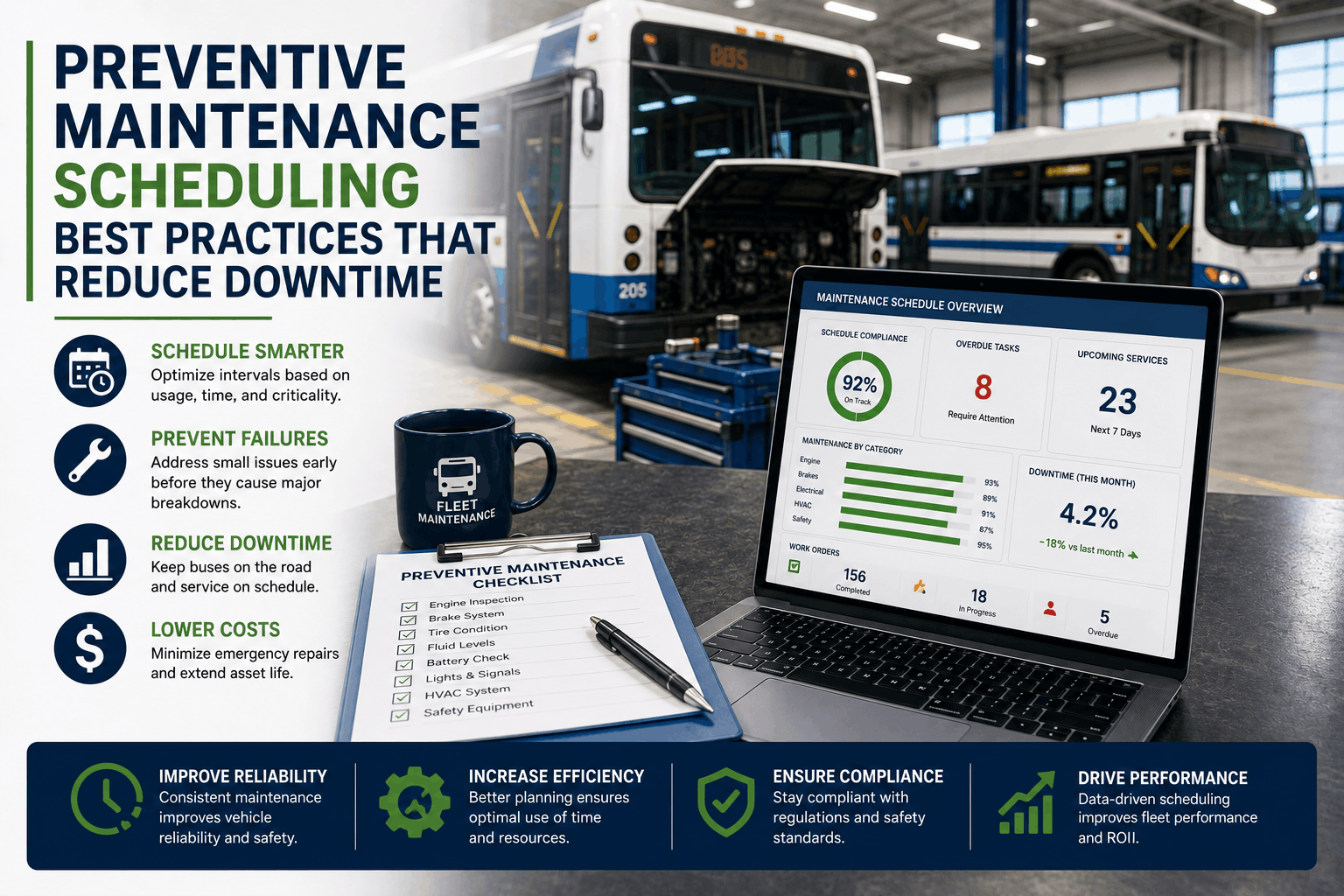
Preventive maintenance scheduling is the backbone of fleet reliability. A well-scheduled PM program prevents breakdowns, extends asset life, controls costs, and reduces emergency repairs. But scheduling is where most fleets struggle. Manual scheduling leads to missed PMs, overloaded weeks, underutilized capacity, and compliance gaps. Automated scheduling transforms this process. A CMMS with intelligent PM scheduling calculates due dates based on mileage, engine hours, or calendar intervals, generates work orders automatically, sends advance alerts, and balances workload across available technicians. The result is higher compliance, lower breakdown frequency, and less overtime. This guide explores strategies, benchmarks, and real-world examples that help organizations optimize preventive maintenance scheduling and lower operating costs.
Explore strategies, benchmarks, and real-world examples that help organizations optimize preventive maintenance scheduling and lower operating costs.
Manual PM scheduling using spreadsheets, calendars, or wall charts fails for predictable reasons. Spreadsheets miss due dates when not opened daily. Calendar reminders are ignored or dismissed. Wall charts are only visible in the office. There is no escalation when PMs become overdue. Workload is not balanced across technicians. There is no visibility into upcoming PM demand. The result is PM compliance below 80%, which significantly increases breakdown risk. Fleets with manual scheduling typically achieve 60-75% PM compliance. Automated scheduling consistently achieves 90-95%+ compliance.
Effective PM scheduling requires five core components. First, trigger-based scheduling: PMs should be triggered by mileage, engine hours, or calendar intervals based on actual usage, not fixed dates. Second, advance alerts: notifications should be sent 30, 60, and 90 days before PM due dates to give maintenance teams planning time. Third, auto work order generation: when a PM becomes due, the system should automatically create a work order with required tasks, parts list, and estimated labor hours. Fourth, workload balancing: PMs should be distributed evenly across available technician capacity to avoid peaks and valleys. Fifth, escalation and reporting: overdue PMs should be escalated to supervisors and managers, with compliance dashboards available at all times.
Automated PM scheduling eliminates the failure modes of manual scheduling. When PM due dates are calculated automatically, there is no chance of spreadsheet error. When advance alerts are sent to maintenance supervisors and operations teams, there is no excuse for being surprised by an approaching due date. When work orders are created automatically, there is no delay between due date and action. When workload is balanced automatically, no technician is overloaded while another sits idle. When overdue PMs are escalated, management visibility ensures accountability.
To optimize PM scheduling, managers must track the right metrics weekly. The dashboard should show PM compliance percentage (target 95%+), PMs due in next 7/14/30 days, PMs overdue (target zero), average days overdue for late PMs, PM demand by week for next 3 months (capacity planning), PM labor hours vs estimated, and parts availability for upcoming PMs. These KPIs should be reviewed in a weekly scheduling meeting with maintenance supervisors and operations leads.
Most PM scheduling failures are not caused by lack of effort — they're caused by system gaps. No advance alerts mean PMs are discovered when already overdue. No auto work orders mean delay between due date and action. No workload balancing means PMs pile up during certain weeks. No parts integration means PMs are scheduled without verifying parts availability. The fix is implementing a CMMS with automated scheduling, advance alerts, auto work order generation, workload balancing, and parts integration.
Preventive maintenance scheduling is most effective when automated, integrated, and reviewed weekly. The five components — trigger-based scheduling, advance alerts, auto work orders, workload balancing, and escalation — work together to achieve 95%+ PM compliance. Fleets that implement automated scheduling reduce breakdowns by 40-60%, lower maintenance costs by 15-30%, and extend asset life by 20-40%. The investment in a CMMS with advanced scheduling capabilities typically pays for itself within 6-12 months.
Improving preventive maintenance scheduling requires moving from manual spreadsheets to automated CMMS workflows. The essential components are trigger-based scheduling (mileage, engine hours, or calendar), advance alerts (30/60/90 days), auto work order generation, workload balancing, and escalation for overdue PMs. Weekly KPI reviews should track PM compliance, upcoming PMs, overdues, demand forecast, and parts availability. Fleets that make this transition achieve 90-95%+ PM compliance, reduce breakdowns by 40-60%, and lower operating costs by 15-30%.