An unplanned bus breakdown costs $8,500 on average—tow trucks, emergency repairs, missed revenue, passenger compensation, and reputation damage. Fleets that shift from reactive repair to preventive maintenance (PM) slash unplanned downtime by 40-45% and reduce total maintenance costs by 25-35%. Yet most transportation operators still manage PM through spreadsheets, memory, or legacy systems that can't prioritize, track, or verify that scheduled work is actually happening. Preventive maintenance software automates PM scheduling, generates work orders automatically when triggers are hit, tracks completion against schedules, and produces compliance reports proving PM compliance to regulators. With electrification expected to grow from 7% of bus fleets in 2024 to 36% by mid-2025, PM software must handle electric buses natively—tracking battery health, thermal management, regenerative braking systems, and charging infrastructure alongside traditional diesel maintenance. Modern PM software for bus fleets cuts planned maintenance from ad-hoc scheduling into intelligent, multi-trigger automation. The result: 85%+ PM compliance, measurable reductions in breakdowns, extended vehicle lifespan, and audit-ready compliance documentation.
Preventive Maintenance Software for Bus Fleets: Full Guide
Automate PM scheduling. Reduce breakdowns 40%. Achieve 95%+ PM compliance. Cut maintenance costs 25-35%.
Preventive maintenance is the cornerstone of reliable fleet operations. When buses are serviced on schedule—oil changes, filter replacements, brake inspections, fluid checks—components wear gradually and are replaced before failure occurs. In contrast, reactive maintenance waits for failures. A bus drives until a component breaks, then rushes to repair shops for emergency work. The numbers tell the story. Fleets operating at 80-85% planned maintenance spend 25-35% less than reactive operations. This savings comes from multiple sources. Planned repairs are scheduled during maintenance windows when technicians are available, reducing rush labor rates. Components can be ordered in advance rather than emergency-sourced at premium costs. Multiple service items on a single vehicle can be combined into one shop visit rather than multiple trips. Downtime is predictable and can be managed; a bus can be scheduled for PM on a slow service day rather than pulled out of revenue service in an emergency. Most significantly, prevented breakdowns don't occur. Each prevented breakdown saves $8,500 in towing, emergency repair labor, lost revenue, and potential safety incidents. For a 100-bus fleet operating 250 days annually, reducing breakdowns from 3 per month to 1.5 per month saves over $300,000 annually. The gap between planned and reactive narrows when you consider management time, driver overtime during emergency repairs, customer compensation for missed trips, and reputation damage. Preventive maintenance isn't optional; it's fundamental economics. Yet most fleets can't execute PM consistently because they lack visibility. A PM schedule written in a spreadsheet depends on someone remembering to check it. A paper form passed around the maintenance bay gets lost. Emails requesting PM work are missed in inbox clutter. Without automation, PM schedules are intentions rather than actions. Modern PM software solves this by automating the entire PM workflow: calculating when PM is due based on multiple triggers, automatically generating work orders, notifying technicians, tracking completion, and producing compliance reports. The software handles the scheduling burden so maintenance managers can focus on strategy, analysis, and continuous improvement.
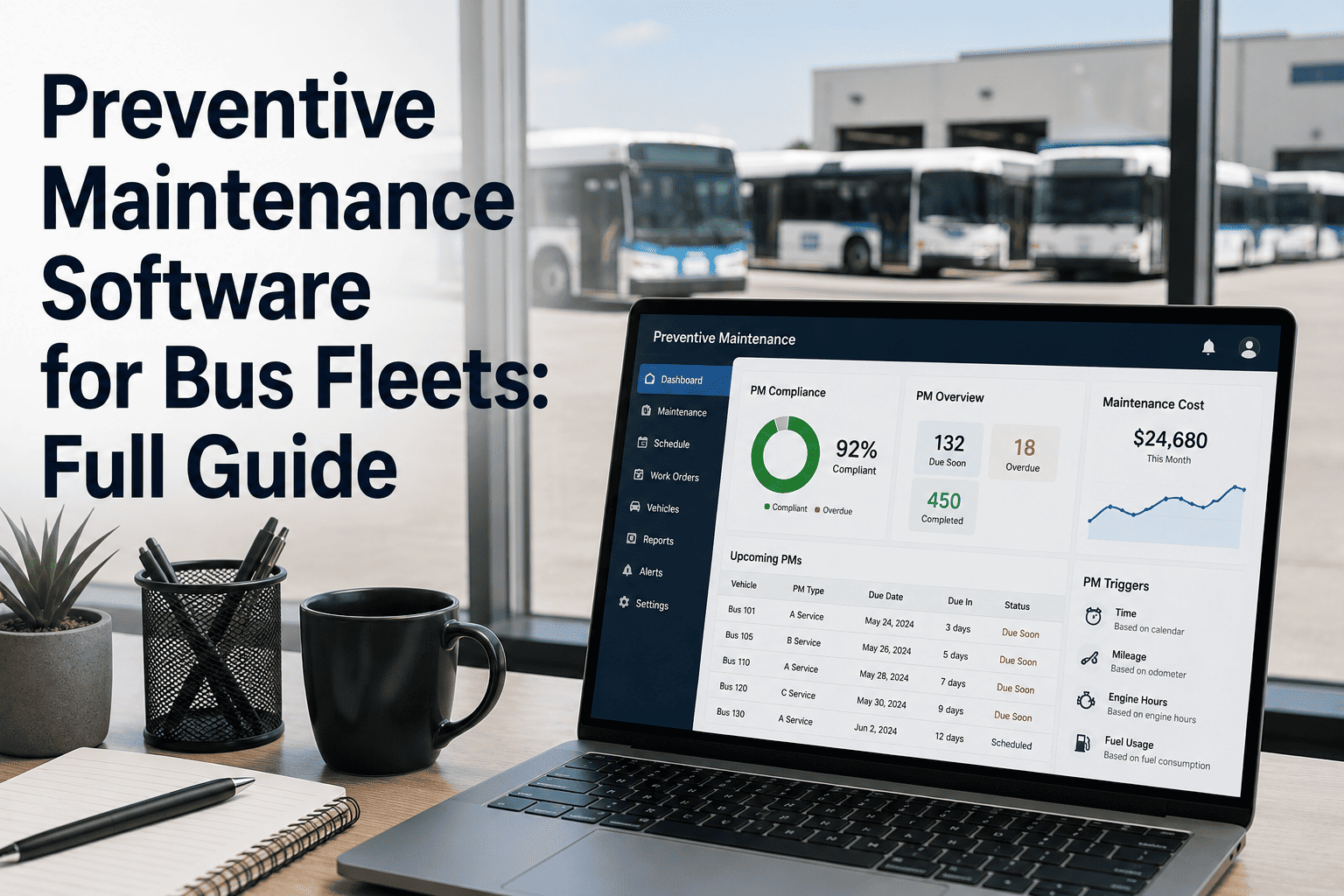
Bus maintenance is triggered by multiple factors: calendar time (every 3 months), vehicle mileage (every 15,000 miles), engine hours (every 500 hours), fuel consumption (every 5,000 gallons), or any combination. A bus that travels 30,000 miles monthly might hit mileage triggers before calendar triggers. A bus that sits in winter reserve might hit calendar triggers before mileage triggers. PM software handles this complexity by evaluating all triggers daily. Bus #47 has 14,200 miles since last oil change (trigger at 15,000). It's been 89 days since last oil change (trigger at 90 days). It has 480 hours since last engine service (trigger at 500). The software recognizes that the mileage trigger will be hit first—probably within the next week—and queues a PM work order. When the trigger is actually hit, the work order is automatically generated and assigned to an available technician. The supervisor sees incoming PM work orders in a queue, prioritized by severity and timing. The technician accepts the work order, performs the service according to the PM template, documents parts used and time spent, and closes the order. The system records completion, updates the mileage/hours/calendar counters, and calculates when the next PM is due. All of this happens without spreadsheets, email chains, or memory. Modern PM software goes further by integrating telematics data when available. GPS and onboard diagnostics automatically capture mileage and engine hours—no need for manual entry. The system knows vehicle status in real time: how many miles until next PM, how many days until calendar trigger, what percentage of PM interval has been consumed. Dashboard alerts warn supervisors when PM is approaching, ensuring work is scheduled before the vehicle hits the trigger. Some systems even optimize PM scheduling: "Bus #47's PM is due next week. Bus #50's is due the week after. The shop has capacity for two simultaneous PMs next week. Should we pull forward Bus #50's PM to consolidate?" This optimization ensures consistent shop capacity and prevents feast-famine cycles of PM work. Additionally, PM software supports conditional triggers. Buses on high-vibration routes or in severe-duty service (frequent starts/stops, poor road conditions) might need PM more frequently than standard intervals. PM software allows fleet managers to define "severe duty" service profiles and automatically adjust PM intervals accordingly. A bus operating in heavy urban traffic might be scheduled for oil changes every 10,000 miles instead of 15,000 because operating conditions are more severe. This data-driven approach prevents component failures specific to harsh operating environments.
Federal Transit Administration regulations require transit agencies to document maintenance compliance. School districts must maintain vehicle maintenance records. Safety audits require evidence that vehicles are maintained according to manufacturer specifications. Without PM software, proving compliance requires assembling records manually: work orders, invoices, technician notes, scattered across multiple systems. With PM software, compliance reports are generated on demand. "Show me all PM work completed on Bus #47 in the past 12 months" generates a comprehensive report with dates, work performed, parts used, technician names, and completion signatures. "Show me my fleet's PM compliance rate" generates a dashboard showing the percentage of scheduled PM completed on or before due date, broken down by vehicle, location, or maintenance type. PM compliance metrics are specific: (1) PM Completion Rate: percentage of scheduled PM work orders closed on time, (2) PM Deferral Rate: percentage of overdue PM work orders still open, (3) PM Timeliness: average days early/late that PM is completed relative to schedule, (4) PM Effectiveness: reduction in unplanned repairs in the period following PM completion. Fleets using PM software typically achieve 85%+ PM completion rates within 3 months of implementation. Without software, 60-70% is more typical because work gets deferred, forgotten, or deprioritized. The 15-25% gap represents significant risk and cost exposure. Additionally, PM software supports predictive maintenance. By analyzing PM records and failure patterns, fleets identify components that consistently fail and recommend condition-based maintenance—testing or replacement intervals tighter than standard. A fleet might discover that brake linings are failing at 60% of the manufacturer-recommended interval in certain vehicles. PM software flags this and recommends reducing the interval to 60% for those vehicles, preventing brake failures while still optimizing downtime. This data-driven refinement of PM schedules continuously improves fleet reliability.
As bus fleets electrify—expected to grow from 7% in 2024 to 36% by mid-2025—PM software must handle radically different maintenance requirements. Electric buses have no oil to change, no transmission fluid, no spark plugs. But they have high-voltage battery systems, thermal management coolant, regenerative braking systems, and charging infrastructure. PM software designed only for diesel buses can't manage EV maintenance, leaving fleets with a dangerous gap: new vehicles without proper maintenance protocols. Future-ready PM software manages mixed fleets: traditional diesel buses and electric buses in the same operation. It includes separate PM templates for EV-specific services: battery health checks and state of charge monitoring, thermal management system inspections, regenerative braking diagnostics, drivetrain fluid analysis, charging infrastructure reliability testing. Some platforms integrate real-time battery data from vehicle telematics, automatically flagging battery health degradation and scheduling battery management services before performance drops. This proactive approach extends battery life and prevents unexpected battery failures that can sideline entire vehicles. Additionally, EV PM software addresses the transition period where fleets operate mixed powertrains. A bus depot might have 60% diesel and 40% electric buses. PM scheduling must account for different service schedules, parts availability, and technician expertise. Diesel technicians need EV training before servicing electric buses; the software can track certification completion and only assign trained technicians to EV work. This orchestration ensures safety, compliance, and service quality across a heterogeneous fleet. Some forward-thinking operators are using PM software to pilot electric buses—intensive monitoring and maintenance tracking to validate that EV technology meets their operating requirements before committing to full electrification. PM software provides the data infrastructure needed to evaluate vehicle performance objectively.
Preventive maintenance software is non-negotiable for modern bus fleet operations. Fleets running 80-85% planned maintenance through automated PM scheduling cut costs 25-35% and reduce breakdowns 40-45%. With electrification accelerating, PM software must handle electric buses natively. The fleets that implement comprehensive PM software early gain operational and cost advantages that persist for years. The gap between leaders and laggards is widening.
Preventive maintenance software automates the planning discipline that separates reliable, cost-effective fleets from reactive, expensive ones. Multi-trigger scheduling ensures no PM is missed. Automated work order generation eliminates scheduling overhead. Real-time dashboards provide visibility that enables proactive management. Comprehensive audit trails prove compliance to regulators. And mixed-fleet PM capabilities prepare operators for electrification and emerging vehicle technologies. The economics are clear: implementing PM software costs money upfront but saves $300,000+ annually in prevented breakdowns, reduced labor costs, and optimized downtime for a typical 100-bus fleet. ROI is achieved within months. By month six, maintenance spending has declined, breakdowns are down, and the fleet is operating more reliably. By year one, the compounding effects of prevented failures, extended component life, and optimized scheduling produce sustained cost advantages. Most importantly, reliable fleets deliver better service to passengers, improve driver safety, and build reputation for dependability.
"Before PM software, we managed oil changes and filter replacements through spreadsheets and hope. PM work was deferred when the shop was busy, leading to overdue maintenance. We had no visibility into which buses were eating up maintenance budgets, and breakdowns were constant. After implementing BusCMMS PM software, work orders are automatically generated when triggers hit. Our supervisors schedule PM proactively rather than reactively. Compliance improved from 62% to 94% within 3 months. Breakdowns dropped 40%. Our maintenance costs are down 28% even after accounting for the PM software. It's transformed how we operate."
— Fleet Manager, School District (420-bus fleet)