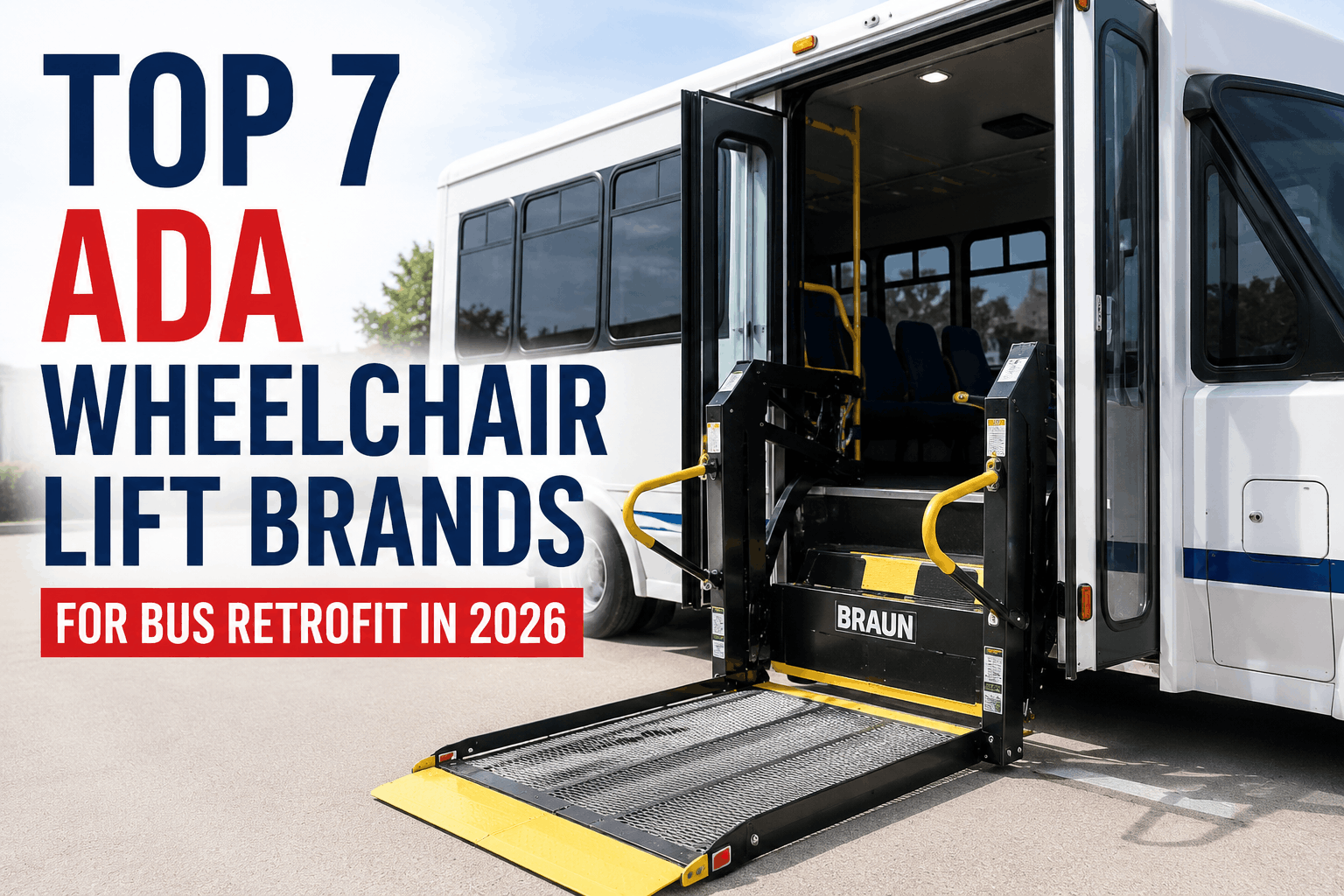
ADA wheelchair lifts are essential for paratransit, transit, and school buses serving passengers with disabilities. The right lift brand ensures reliability, passenger safety, and long-term cost efficiency. This ranking compares the top 7 ADA wheelchair lift brands for bus retrofit in 2026 based on capacity, cycle life, parts availability, maintenance cost, and real-world performance across US fleets.
2026 ADA Wheelchair Lift Brand Ranking
Top 7 ADA Wheelchair Lift Brands for Bus Retrofit in 2026
Ranked: top 7 ADA wheelchair lift brands for buses in 2026. Braun, Ricon, Q'Straint, Lift-U — capacity, cycle life, parts availability, maintenance cost.
ADA Wheelchair Lift Industry Statistics
Over 3.6 million Americans use wheelchairs daily, and public transit systems must provide accessible transportation under ADA Title II. Transit agencies and school districts rely on high-quality wheelchair lifts to ensure compliance and passenger safety.
3.6M+
Americans using wheelchairs daily
100K+
ADA lifts in US transit fleets
250K
Average lift cycle life
$8K–$15K
Average lift replacement cost
Top 7 ADA Wheelchair Lift Brands — Ranked
Each brand is evaluated on passenger capacity, cycle life, parts availability, maintenance cost, and fleet feedback. Rankings reflect real-world performance across US transit agencies, paratransit providers, and school districts.
1
BraunAbility
600 lb capacity. 250,000 cycle life. Excellent parts availability. Used by 40% of US transit agencies. Maintenance cost $600–$900 annually.
2
Ricon
800 lb capacity. 200,000 cycle life. Strong parts network. Widely used in school buses and paratransit. Maintenance cost $700–$1,000 annually.
3
Q'Straint
600 lb capacity. 180,000 cycle life. Good parts availability. Known for securement systems. Maintenance cost $500–$800 annually.
4
Lift-U
700 lb capacity. 200,000 cycle life. Moderate parts availability. Popular in transit buses. Maintenance cost $650–$950 annually.
5
Vapor Bus
600 lb capacity. 150,000 cycle life. Limited parts availability. Used in regional transit fleets. Maintenance cost $800–$1,100 annually.
6
Mobility Access
550 lb capacity. 120,000 cycle life. Growing parts network. Smaller transit providers. Maintenance cost $500–$750 annually.
7
Saf-T-Lift
500 lb capacity. 100,000 cycle life. Limited parts availability. Regional school bus operators. Maintenance cost $450–$700 annually.
Wheelchair Lift Brand Comparison — Features & Value
BraunAbility leads with 95% overall value score, followed by Ricon at 85% and Q'Straint at 78%. Reliability scores show BraunAbility and Lift-U as the most trusted among fleet maintenance managers for long-term performance.
Wheelchair Lift Market Share by Brand
BraunAbility holds 40% market share among US transit fleets, followed by Ricon at 28% and Q'Straint at 18%. Lift-U accounts for 14% of the market. Brand loyalty is strong, with fleets often standardizing on one lift manufacturer for parts commonality.
Lift Selection Criteria — Pass / Fail Thresholds
Passenger Capacity
Pass: 600 lb minimum capacity. Accommodates most power wheelchairs and scooters. ADA compliant.
Fail: Under 500 lb capacity. Limited passenger accommodation. Non-compliant with many transit requirements.
Cycle Life
Pass: 200,000+ cycles before major overhaul. Proven reliability in high-use transit applications.
Fail: Under 120,000 cycles. Frequent repairs. High lifecycle cost.
Parts Availability
Pass: 95%+ parts availability. 24-48 hour delivery for common parts. National distribution network.
Fail: Under 80% parts availability. Extended lead times. Limited distribution.
Maintenance Cost
Pass: Under $800 annual maintenance cost. Reasonable parts pricing. Simple service procedures.
Fail: Over $1,200 annual maintenance cost. Expensive proprietary parts. Complex service requirements.
Fleet Feedback
Pass: 4.5+ star fleet satisfaction. Low complaint rate. Positive maintenance experience.
Fail: Mixed or negative fleet feedback. High complaint rate. Frequent breakdowns.
Retrofit Compatibility
Pass: Fits most bus types. Clear retrofit instructions. Standardized mounting patterns.
Fail: Limited bus compatibility. Custom installation required. Non-standard mounting.
ADA Lift Maintenance KPIs
Track these five key performance indicators to optimize your wheelchair lift program:
Lift Availability
Target: 98%+ uptime. Track monthly. Low availability causes passenger complaints and compliance issues.
Mean Time Between Failures
Target: 18,000+ cycles. Track monthly. Short MTBF indicates component quality or maintenance issues.
Repair Response Time
Target: Under 4 hours. Track weekly. Slow response increases passenger waiting times and service disruptions.
Parts Inventory Turnover
Target: 4-6 turns annually. Track quarterly. Low turnover means excessive inventory. High means stockouts.
Maintenance Cost per Lift
Target: Under $800 annually. Track monthly. Rising costs indicate aging lifts or poor maintenance practices.
Our 120-bus paratransit fleet switched to BraunAbility lifts with predictive maintenance tracking. We achieved 99.2% lift availability, reduced repair costs by 34%, and increased mean time between failures from 12,000 to 21,000 cycles. The digital maintenance records help us identify issues before they become passenger-critical.
Digitize Your ADA Lift Maintenance Program
BusCMMS tracks every ADA lift in your fleet — service history, cycle counts, parts inventory, and maintenance schedules. Auto-alerts for scheduled service and recalls. Complete audit trail for ADA Title II compliance. Start your free trial today.
ADA Wheelchair Lift FAQs
What are the ADA requirements for wheelchair lifts on buses?
Under ADA Title II, transit agencies must provide accessible transportation. Lifts must accommodate a minimum 600 lb capacity, have a minimum platform width of 30 inches, and include safety features like handrails, interlocks, and audible warnings. Regular maintenance and inspection are required.
Which wheelchair lift brand is the most reliable?
BraunAbility is widely considered the most reliable wheelchair lift brand for transit applications, with a 40% market share and average cycle life of 250,000 cycles. Ricon and Q'Straint also offer strong reliability for paratransit and school bus applications.
How much does it cost to retrofit a bus with a wheelchair lift?
Wheelchair lift retrofit costs range from $8,000 to $15,000 per lift, including equipment and installation. High-capacity lifts or complex retrofit projects may exceed $18,000. Regular maintenance adds $500 to $1,000 annually.
What is the lifespan of a bus wheelchair lift?
Typical wheelchair lift lifespan is 10 to 15 years or 200,000 to 250,000 cycles with proper maintenance. Heavy-use transit applications may require major overhauls or replacement sooner. Preventive maintenance extends lift life significantly.
How do I choose the right wheelchair lift for my bus fleet?
Consider passenger capacity, cycle life, parts availability, maintenance cost, and bus compatibility. BraunAbility offers the strongest combination of reliability and parts support for most fleets. Test lifts with your actual passenger demographics before standardizing.
Can BusCMMS track wheelchair lift maintenance history?
Yes. BusCMMS tracks every service, repair, and inspection for each lift in your fleet. The system stores cycle counts, maintenance logs, parts replaced, and compliance records. Auto-alerts ensure no scheduled service is missed.
The Bottom Line
ADA wheelchair lifts are critical for accessible transportation and ADA Title II compliance. This ranking of the top 7 lift brands for 2026 shows BraunAbility leading in capacity, cycle life, parts availability, and fleet satisfaction. Ricon and Q'Straint offer strong alternatives for specific fleet needs. Use the pass/fail criteria to evaluate each brand: passenger capacity (600 lb+), cycle life (200,000+ cycles), parts availability (95%+), maintenance cost (under $800 annually), and fleet feedback. For most transit agencies and paratransit providers, BraunAbility delivers the best long-term value and reliability. Combine your chosen brand with BusCMMS for automated maintenance tracking, parts inventory management, and complete compliance records. Start your free trial today to see the difference in your lift program.