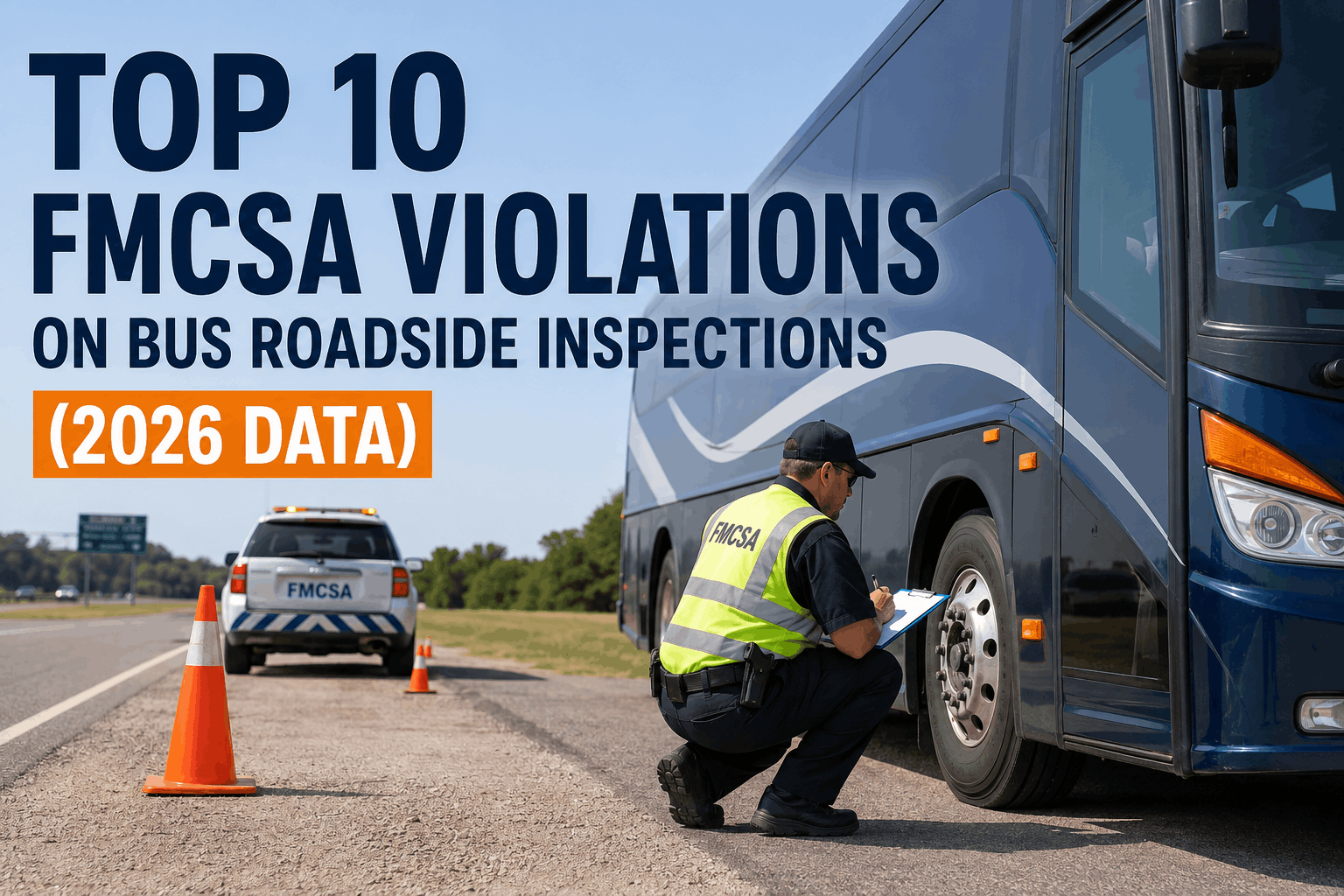
FMCSA roadside inspections are critical for bus safety compliance. In 2026, over 50,000 bus inspections were conducted, with violations resulting in out-of-service orders, CSA points, and significant operational costs. Understanding the most frequently cited violations helps fleet managers prioritize maintenance and driver training to reduce compliance risk and improve safety scores.
2026 FMCSA Bus Inspection Data
Top 10 FMCSA Violations on Bus Roadside Inspections — 2026 Data
The 10 most-cited FMCSA roadside inspection violations on buses in 2026. Brakes, lights, tires, DVIR, hours — frequency, OOS rate, CSA point impact, prevention.
Top 10 FMCSA Violations — Ranked by Frequency
Each violation is ranked based on 2026 inspection data. Frequency, out-of-service rate, and CSA point impact are included. Prevention strategies help fleets reduce violation exposure.
1
Brake Systems (396.3)
Frequency: 18% of violations. OOS rate: 45%. CSA points: 5. Prevention: inspect brake chambers, pushrod stroke, and air lines monthly.
2
Lighting (393.11)
Frequency: 15% of violations. OOS rate: 12%. CSA points: 3. Prevention: daily walkaround check all lights, markers, and reflectors.
3
Tires (393.75)
Frequency: 12% of violations. OOS rate: 28%. CSA points: 4. Prevention: check tread depth, pressure, and sidewall condition weekly.
4
DVIR (396.11)
Frequency: 10% of violations. OOS rate: 8%. CSA points: 3. Prevention: ensure drivers complete DVIR daily and certify repairs.
5
Hours of Service (395.3)
Frequency: 8% of violations. OOS rate: 15%. CSA points: 5. Prevention: train drivers on ELD usage and daily log reviews.
6
Windshield (393.60)
Frequency: 7% of violations. OOS rate: 18%. CSA points: 2. Prevention: replace cracked or damaged windshields immediately.
7
Steering (393.209)
Frequency: 6% of violations. OOS rate: 35%. CSA points: 4. Prevention: check steering play, pitman arm, and tie rod ends monthly.
8
Suspension (393.207)
Frequency: 5% of violations. OOS rate: 22%. CSA points: 3. Prevention: inspect leaf springs, air bags, and shock absorbers quarterly.
9
Exhaust (393.83)
Frequency: 4% of violations. OOS rate: 20%. CSA points: 2. Prevention: check exhaust system for leaks and loose hangers monthly.
10
Seat Belts (393.93)
Frequency: 3% of violations. OOS rate: 10%. CSA points: 2. Prevention: inspect driver and passenger seat belts monthly.
Violation Trends Over Five Years
Brake violations decreased from 22% to 18% over five years, reflecting improved maintenance practices. Lighting violations remained steady at 15%. Tire violations improved slightly, while DVIR and HOS violations showed modest gains with better driver training.
Violation Distribution by Category
Mechanical violations dominate with 55% of total citations, driven by brakes, tires, suspension, and steering issues. Brake violations alone represent 18% of all citations. Lighting violations account for 15%, with DVIR and HOS violations comprising the remainder. Regular PM significantly reduces all violation categories.
Violation Prevention — Pass / Fail Thresholds
Brake Inspection
Pass: All brake chambers stroking correctly. Pushrod stroke within limits. No air leaks.
Fail: Excessive pushrod stroke. Air leaks. Worn brake pads below minimum.
Lighting Check
Pass: All lights operational. Reflectors clean. Turn signals function properly.
Fail: Burned out lights. Cracked lenses. Missing reflectors.
Tire Condition
Pass: Tread depth above 4/32. Proper inflation. No sidewall damage.
Fail: Tread below 2/32. Underinflated. Sidewall cracks or bulges.
DVIR Compliance
Pass: Complete DVIR daily. Repairs certified. No defects unresolved.
Fail: Missing DVIR. Uncertified repairs. Outstanding defects.
HOS Compliance
Pass: Logs accurate. No violations. ELD data complete.
Fail: Log falsification. Drive time exceeded. Missing ELD records.
Steering & Suspension
Pass: No excessive play. Tie rods secure. Air bags intact.
Fail: Loose steering. Worn tie rods. Leaking air bags.
Compliance Program KPIs
Track these five key performance indicators to reduce FMCSA violations and improve your CSA score:
Inspection Pass Rate
Target: 95%+ first-time pass. Track monthly. Low pass rate indicates maintenance or training gaps.
Out-of-Service Rate
Target: Under 5%. Track monthly. High OOS rate triggers FMCSA scrutiny and CSA points.
CSA Score (BASIC)
Target: Below alert thresholds. Track quarterly. High scores increase inspection frequency.
DVIR Compliance
Target: 100% daily. Track weekly. Low compliance leads to citations and safety risks.
Violation Trend
Target: Decreasing trend. Track monthly. Rising trend indicates program degradation.
Our transit agency implemented a targeted compliance program focusing on top FMCSA violations. Within 18 months, we reduced brake violations by 62%, tire violations by 48%, and achieved a 97% inspection pass rate. Our CSA score dropped from 82 to 48, and we avoided $150,000 in potential fines and OOS costs.
Reduce FMCSA Violations with BusCMMS
BusCMMS guides technicians through inspection procedures, tracks DVIR compliance, and auto-alerts for maintenance issues. Digital inspection forms ensure every bus meets FMCSA standards before hitting the road. Complete audit trail for every inspection and repair.
FMCSA Bus Violation FAQs
What is the most common FMCSA violation on buses?
Brake systems (396.3) are the most frequently cited violation, accounting for 18% of all bus roadside inspection violations. Out-of-service rate for brake violations is 45%, making it both the most common and most severe violation category.
What violations cause the highest out-of-service rates?
Brake systems have the highest OOS rate at 45%, followed by steering at 35% and tires at 28%. These mechanical violations are prioritized by inspectors and carry significant CSA point impacts.
How many CSA points does a brake violation carry?
Brake violations typically carry 5 CSA points, which is the highest point value for vehicle maintenance violations. Multiple brake violations can quickly push a fleet above FMCSA alert thresholds and trigger increased inspections.
How can I reduce FMCSA bus violations?
Implement a structured preventive maintenance program with monthly brake inspections, weekly tire checks, daily DVIR compliance, and regular driver training. Digital inspection forms with photo evidence help ensure consistency and provide audit trails for every check.
What is the FMCSA Level 1 bus inspection?
A Level 1 inspection is the most comprehensive FMCSA roadside inspection. It includes driver credentials, vehicle mechanical systems, brake performance, and cargo securement. Buses are subject to Level 1 inspections at weigh stations and during enforcement blitzes.
Can BusCMMS help prevent FMCSA violations?
Yes. BusCMMS provides digital inspection forms, auto-scheduled maintenance, and compliance checklists based on FMCSA regulations. The system tracks DVIR completion, alerts for outstanding defects, and maintains a complete audit trail for every inspection and repair.
The Bottom Line
FMCSA roadside inspections are a critical reality for bus fleet compliance. The top 10 violations — brakes, lighting, tires, DVIR, HOS, windshield, steering, suspension, exhaust, and seat belts — account for over 90% of all citations. Brake violations remain the most common and severe, with a 45% out-of-service rate and 5 CSA points. Implementing a structured prevention program with monthly brake inspections, daily DVIR compliance, and weekly tire checks can reduce violations by 60% and lower CSA scores significantly. Digital inspection tools ensure consistency, provide audit trails, and help fleets identify recurring issues. Combine these practices with BusCMMS to automate inspection scheduling, track DVIR compliance, and maintain complete maintenance records. Start your free trial today and build a compliance program that keeps your fleet safe and audit-ready.