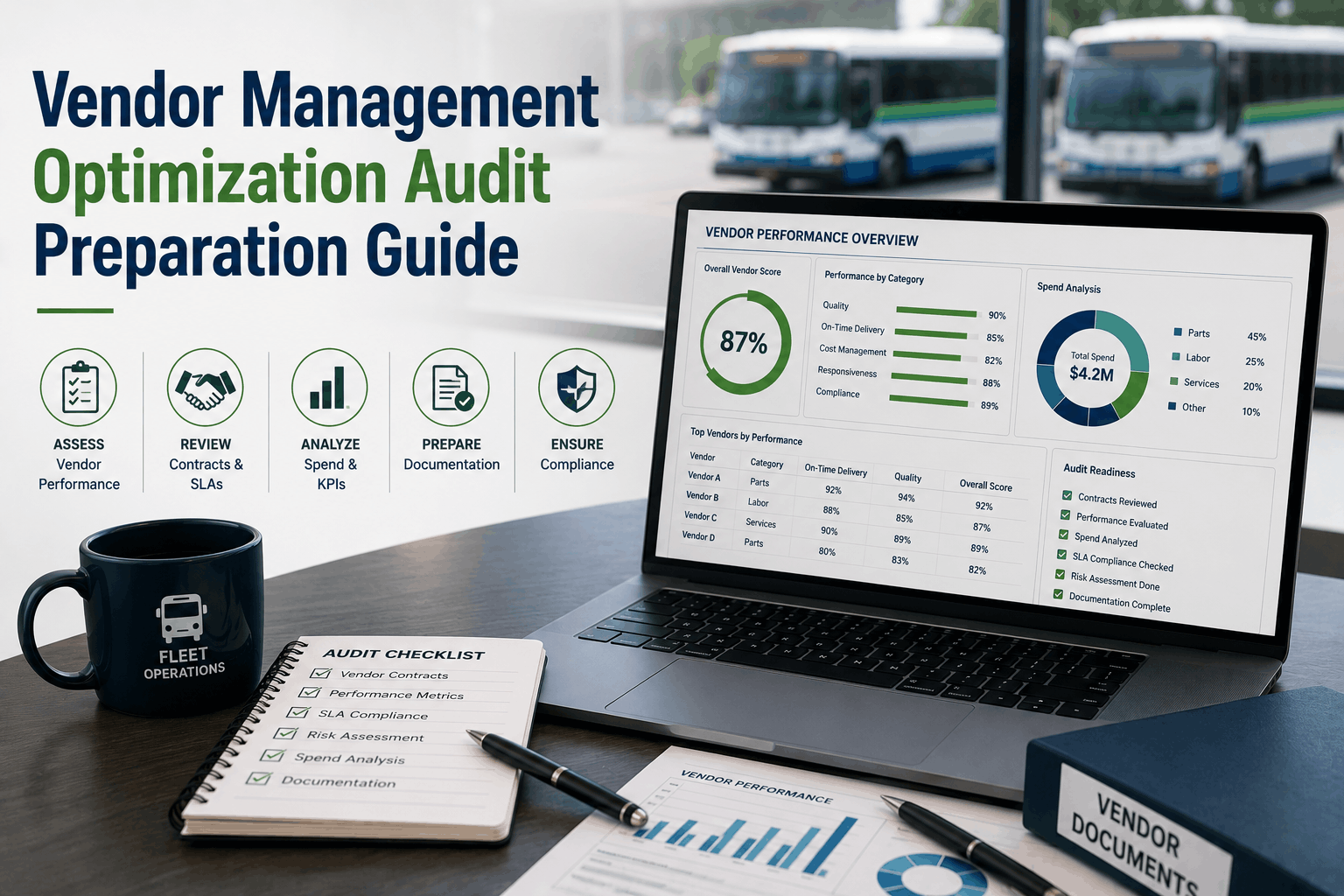
Vendor management is often an afterthought in bus fleet maintenance — until an audit reveals missing warranty claims, unapproved supplier charges, or incomplete procurement records. Transit and school bus fleets rely on dozens of vendors: parts suppliers, tire dealers, body shops, towing services, dealerships, and specialty repair shops. Each vendor relationship creates risk. Poor vendor management leads to overcharged invoices, duplicate payments, warranty claim denials, and audit findings. Yet most fleets manage vendors with spreadsheets and intuition. Modern fleet operations require a structured vendor management framework integrated with your CMMS. This guide explains the technology, processes, and reporting metrics required for effective vendor management optimization across bus operations — and how to prepare for audits of your vendor relationships.
Vendor Management 2026
Vendor Management Optimization Audit Preparation Guide
Understand the technology, processes, and reporting metrics required for effective vendor management optimization across bus operations.
What Is Vendor Management Optimization for Bus Fleets?
Vendor management optimization is the structured process of selecting, onboarding, monitoring, evaluating, and auditing the external suppliers that support your maintenance operation. It answers four critical questions: Are we paying the right price? Are we receiving the right parts on time? Are warranty claims being recovered? Are vendor invoices accurate and audit-ready? An optimized vendor management framework integrates with your CMMS to track vendor performance metrics, automate purchase orders, store warranty documentation, and generate audit trails for every transaction. Without optimization, fleets face overcharges (5-15% of vendor spend), missed warranty claims (15-30% of eligible amounts), duplicate payments, and audit findings for incomplete records.
Vendor Management Scope
Parts suppliers, tire dealers, body shops, towing services, dealerships, warranty administrators, specialty repair shops, fluid suppliers, filter distributors.
Annual Vendor Spend (100-Bus Fleet)
Typical vendor spend: $500,000-1,500,000 annually. Optimization saves 8-15% through better pricing, warranty recovery, and invoice accuracy.
The 6 Essential Vendor Management Metrics
To optimize vendor relationships, you need to track these six core metrics. Without measurement, you cannot manage:
Metric 1: Vendor Fill Rate
Percentage of purchase orders shipped complete. Target 95%+. Low fill rates force emergency orders from secondary vendors, increasing cost and delaying repairs.
Metric 2: On-Time Delivery Percentage
Percentage of orders delivered by promised date. Target 95%+. Late deliveries create downtime and require schedule adjustments.
Metric 3: Warranty Claim Recovery Rate
Percentage of eligible warranty claims successfully recovered. Industry average: 60-70%. Best-in-class: 85-95%. Low rates indicate documentation gaps.
Metric 4: Invoice Accuracy Rate
Percentage of invoices with no pricing or quantity errors. Target 98%+. Each billing error costs time to resolve. Systematic errors indicate vendor process problems.
Metric 5: Vendor Pricing Competitiveness
Compare vendor pricing to market average. Track pricing trends quarterly. Use data to negotiate better terms or switch vendors.
Metric 6: Vendor Lead Time Variance
Difference between quoted lead time and actual delivery. High variance makes inventory planning difficult. Requires safety stock or vendor replacement.
The Vendor Management Audit Preparation Checklist
During an audit, you will need to demonstrate that vendor relationships are properly managed. Use this checklist to prepare:
1
Vendor Onboarding Documentation
Every vendor must have a complete file: W-9 form, insurance certificates, signed contracts or purchase agreements, approved vendor application, and credit application. Review annually.
2
Purchase Order Management
All purchases must have approved POs before order placement. No after-the-fact approvals. POs must include part numbers, quantities, agreed pricing, and delivery terms.
3
Receiving and Invoice Matching
Match every invoice to PO and receiving record. Flag discrepancies for resolution before payment. Maintain three-way match documentation for audit.