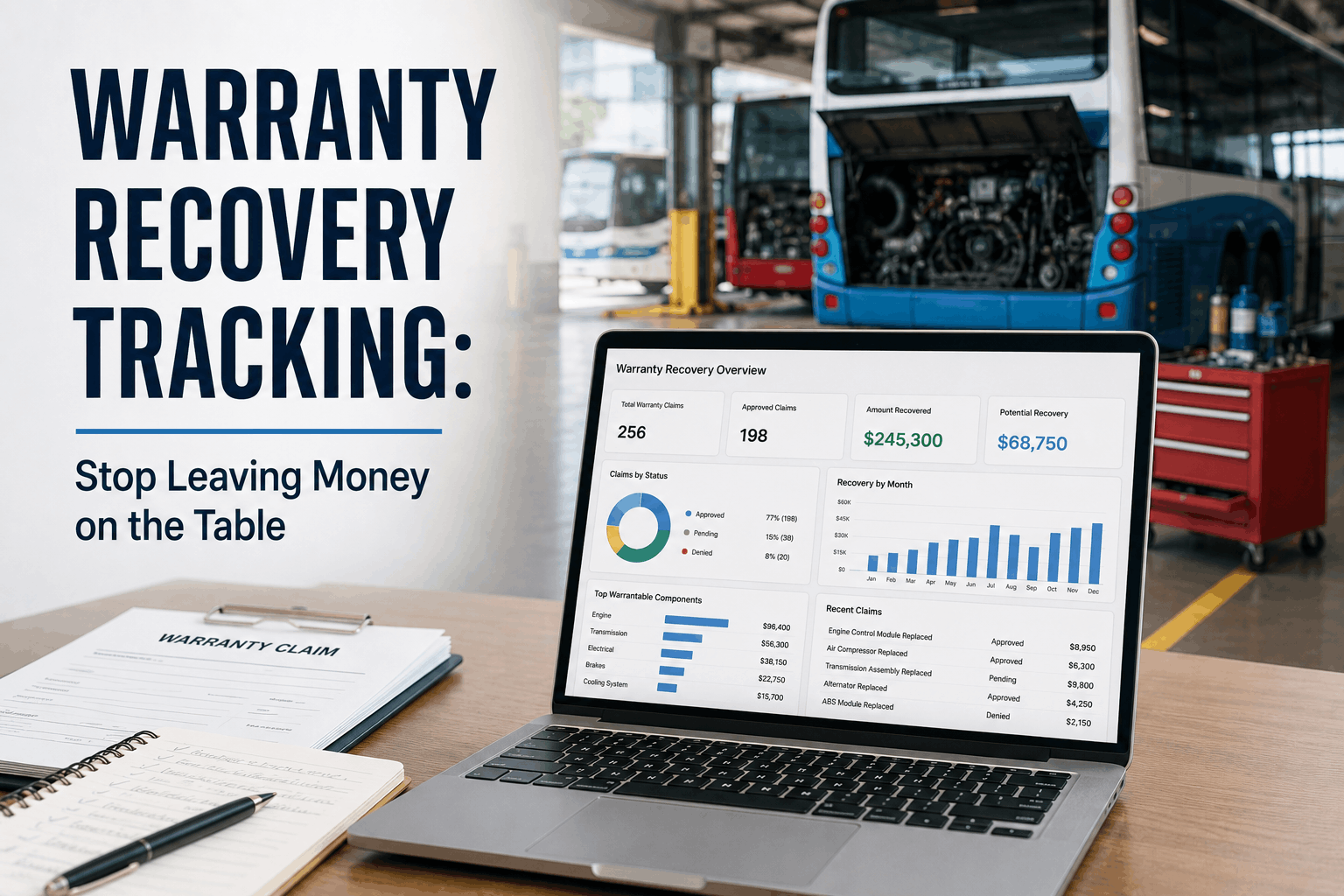
A mid-sized transit operator managing a 60-bus fleet discovered during a routine audit that they had unclaimed warranty claims worth $127,000 over three years. Warranty coverage on parts like transmissions, engines, and hydraulic systems was never tracked. When failures occurred, repairs were paid out-of-pocket instead of being flagged as warrantable. The fleet lost tens of thousands because no one was systematically monitoring which repairs fell under manufacturer or extended warranty coverage. The solution: implement warranty recovery tracking. Track every repair against warranty coverage, flag warrantable repairs before invoicing, and submit claims within manufacturer deadlines. One fleet recovered $42,000 in warranty claims in year one alone. Warranty recovery tracking isn't optional—it's a profit recovery system that most fleets leave untouched. This guide explains how to implement warranty tracking, recover what you're owed, and stop leaving money on the table.
Fleets lose thousands in unclaimed warranties annually. Discover how to track coverage, flag warrantable repairs, and recover what you're owed with systematic warranty management.
Warranty coverage falls into several categories: manufacturer warranties (engine, transmission, drivetrain—typically 5-8 years or 100,000-200,000 miles), extended warranties (purchased at vehicle acquisition, covers major systems beyond manufacturer terms), parts-specific warranties (batteries, lights, upholstery—typically 1-3 years), and vendor warranties (supplier coverage on specific components like door mechanisms, HVAC systems, or seating). Most fleet operators know these exist but don't track them systematically. A transmission failure occurs. The technician orders a replacement. The invoice is processed. No one checks: "Is this covered under warranty?" By the time someone realizes coverage applied, the 30-day claim window has passed. Manufacturer warranty claims have strict deadlines. Miss the window by 31 days and the claim is denied. That's a $15,000 transmission cost that should have been warranty-covered. Warranty recovery tracking solves this by creating a central database of all warranty coverage (manufacturer, extended, parts-specific, vendor) linked to each vehicle, logging every repair against coverage, and flagging warrantable repairs before payment is finalized. One fleet manager reports: "We implemented warranty tracking in January. By March, we had filed eight warranty claims we would have otherwise missed. Total recovery: $28,000. The system pays for itself in the first month."
Warranty recovery tracking starts with a complete inventory of all coverage. Pull your fleet acquisition records. For each vehicle, document: (1) Vehicle VIN and registration number, (2) Manufacturer warranty start date and expiration (mileage and calendar), (3) Extended warranty purchased (yes/no, policy number, coverage scope, expiration), (4) Powertrain coverage specifics (engine, transmission, axles—coverage varies by manufacturer), (5) Vendor warranties (parts suppliers, component coverage, contact information), (6) Claims already filed (date, amount, approval status). Enter this into a spreadsheet or fleet management system. Most fleets never do this audit. They operate with no central warranty database. A repair occurs and no one knows if coverage applies. With a complete inventory, when a technician logs a repair, the system instantly checks: "Is this vehicle still under warranty for this component?" If yes, the repair is flagged as "warrantable pending claim." A warranty coordinator reviews it, collects documentation, and files the claim before the deadline. One fleet operator invested two days building their warranty inventory (about 8 hours of administrative time) and recovered $89,000 in claims over 18 months. The ROI was 11,100%. Don't skip this step.
Warranty claims have strict procedures and timelines. When a warrantable repair is flagged, your warranty coordinator must gather specific documentation: original purchase invoice (proves coverage period), repair work order (describes the failure and repair performed), parts invoice (itemizes components replaced), technician notes (explains the failure mode), customer signature (authorizes claim filing), and proof of payment (invoice shows no coverage was applied). Most manufacturers require claims filed within 30-60 days of repair completion. Some have longer windows (90 days) but filing early is safest. A delay of 31 days on a 60-day claim deadline is cutting it too close. The claim should be submitted with complete documentation via the manufacturer's warranty portal or by mail (certified, with tracking). Processing time varies: some manufacturers respond within 2-3 weeks; others take 45-60 days. Approved claims are reimbursed via check or credit to your account. Denied claims are typically denied for insufficient documentation, missed deadline, or coverage exclusion. To maximize approval rates: file within 30 days, include all requested documentation, ensure vehicle is within warranty period, verify the repair component is actually covered (some items are excluded), and follow manufacturer procedures exactly. A fleet operations director shares: "We were filing claims haphazardly. Claims were denied for missing documentation or missed deadlines. We implemented a standardized process: repair flagged as warrantable automatically, coordinator sends required documents to manufacturer within 7 days, claim tracked from submission to approval. Our approval rate went from 62% to 94%. Last year we recovered $156,000 across the fleet."
Manual warranty tracking (spreadsheets and email) fails at scale. A fleet with 30 vehicles might manage it. A fleet with 100+ vehicles needs systematic software. A proper warranty tracking system should: (1) Maintain a central warranty database (all coverage linked to vehicle VIN, updated automatically), (2) Auto-flag warrantable repairs (when work order logged, system checks coverage and flags if warrantable), (3) Deadline alerts (notification when claim window approaching—30 days from repair), (4) Claim submission templates (standardized forms for each manufacturer), (5) Claim status tracking (submitted, approved, denied, paid—visible in dashboard), (6) Analytics and reporting (total warranty recovery, claim approval rates, recovery by vehicle/system). Integration with your maintenance management system is critical. When a technician logs a repair in the maintenance system, it should automatically cross-reference warranty coverage. If the repair is warrantable, the system flags it for claims processing. This removes manual steps and eliminates the "someone should check if this is covered" moment that delays claim filing. One fleet implemented warranty tracking software and recovered $287,000 in year one alone—from vehicles that had been operating warranty-unclaimed for years. The software cost: $150/month. The ROI: 19,100% in year one. Most fleet operators remain unaware this even exists.
Mistake 1: Not tracking warranty expiration dates. A vehicle's manufacturer warranty expires on a specific date and mileage. Many fleets lose coverage because they don't proactively track these windows. One fleet discovered their entire 2015-2016 fleet had warranty expiration pass unnoticed. They could have filed dozens of claims in the six months before expiration but didn't. Mistake 2: Filing claims after the deadline. A 60-day claim window means day 61 is too late. Many fleets miss the deadline because there's no system flagging the approaching deadline. Implement automatic alerts 10 days before the claim window closes. Mistake 3: Incomplete claim documentation. A claim denied for missing a technician signature or missing original invoice costs you the entire recovery. Create a standardized checklist and verify all documents before submission. Mistake 4: Not checking extended warranty records. Many fleets purchase extended warranties but then forget they have them. The extended warranty paperwork gets filed away and no one references it when a repair occurs. Digitize all warranty documents and link them to each vehicle's record. Mistake 5: Assuming certain repairs aren't covered. Some fleets assume "wear and tear" isn't covered (correct) and then assume nothing else is covered either (incorrect). Review your warranty terms carefully. Many components and repairs are covered that fleets assume aren't. Mistake 6: Not tracking parts warranty. A replacement battery purchased with a 3-year warranty is covered if it fails within that window. Most fleets don't track parts warranties separately. Implement parts-level tracking for high-value components. Mistake 7: Missing vendor-specific warranty claims. A door mechanism or HVAC system often comes with vendor warranty separate from the vehicle manufacturer. These are frequently missed because they're not in the vehicle purchase paperwork. Demand warranty documentation from parts vendors and maintain a separate vendor warranty database.