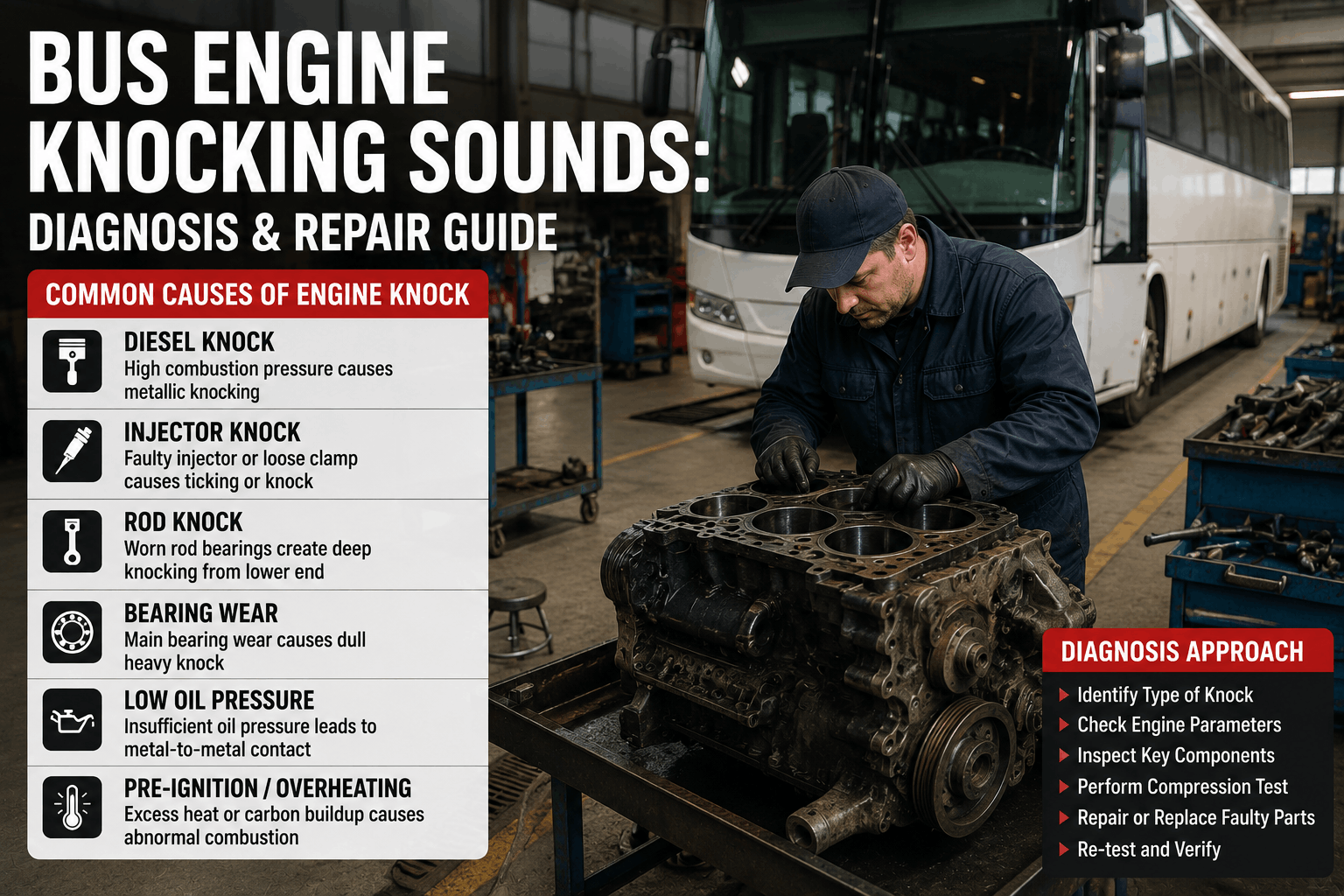
Bus engine knocking sounds are alarming and often indicate serious internal engine problems. A knock can range from a harmless diesel rattle to a catastrophic rod bearing failure that can destroy the engine. This guide covers the top causes of bus engine knocking—diesel knock, injector knock, rod knock, bearing wear, low oil pressure, and pre-ignition—with a diagnostic flowchart and repair approach for each.
Engine Knocking Diagnostic Guide 2026
Bus Engine Knocking Sounds: Diagnosis & Repair Guide
Bus engine knocking? Diagnosis flowchart for diesel knock, injector knock, rod knock, bearing wear, low oil pressure and pre-ignition causes.
Engine Knocking Impact: The Cost of Internal Engine Damage
Engine knocking is a serious warning sign of internal engine problems. Ignoring a knock can lead to catastrophic engine failure costing $15,000-$50,000 in repairs. Early diagnosis is critical to prevent total engine destruction.
$15,000-$50,000
Engine replacement cost
$3,000-$8,000
Major engine repair cost
15-30 min
Average diagnostic time
60%
Knock related to fuel/injectors
Engine Knocking Diagnostic Flowchart
Step 1: Identify Knock Type
Is it a sharp metallic knock (rod/bearing), a dull knock (injector), or a rattle (diesel knock)? Listen with a stethoscope.
Step 2: Check Oil Pressure
Low oil pressure causes bearing knock. Check gauge and pressure switch. If low, stop engine immediately.
Step 3: Test Injectors
Injector knock sounds like a metallic tapping. Perform cylinder cut-out test. Replace faulty injectors.
Step 4: Check Timing
Incorrect timing causes diesel knock. Check injection timing. Adjust if out of specification.
Step 5: Listen for Rod Knock
Rod knock is a deep, heavy knock that increases with load. It indicates bearing failure. Stop engine immediately.
Step 6: Success
Knock identified and repaired! Document diagnosis and repair for future reference.
Top 6 Causes of Bus Engine Knocking
1. Diesel Knock
Frequency: 25% of knock cases. Caused by incorrect injection timing or low cetane fuel. Check timing and fuel quality.
2. Injector Knock
Frequency: 20% of knock cases. Faulty injector causing uneven fuel delivery. Perform cylinder cut-out test. Replace injector.
3. Rod Knock
Frequency: 18% of knock cases. Worn connecting rod bearing. Deep metallic knock. Stop engine immediately. Major repair.
4. Bearing Wear
Frequency: 15% of knock cases. Main or rod bearing wear. Low oil pressure. Requires engine rebuild or replacement.
5. Low Oil Pressure
Frequency: 12% of knock cases. Insufficient oil pressure causing bearing knock. Check oil level and pressure pump.
6. Pre-Ignition
Frequency: 10% of knock cases. Fuel igniting before correct time. Check timing and fuel quality. Adjust timing.
Engine Knock Causes Distribution
Diesel knock is the #1 cause at 25%, followed by injector knock at 20%. Rod knock accounts for 18%. Together, these three causes represent 63% of all engine knock failures. Bearing wear, low oil pressure, and pre-ignition make up the remaining 37%.
Repair Cost by Cause
Timing adjustment averages $150. Fuel quality correction averages $200. Oil pump replacement averages $350. Injector replacement averages $500. Bearing repair averages $1,000. Engine rebuild is the most expensive at $8,000 average.
Engine Knock Incident Trends
Engine PM compliance and knock incident trends show inverse correlation. As PM compliance improves from 60% to 95% over seven years, engine knock incidents decrease from 35% to 6%. Regular injector testing, timing checks, and oil analysis prevent most engine knock issues.
Engine Knock Quick Reference
Diesel Knock
Rattle sound at idle. Caused by timing or fuel quality. Check injection timing and cetane rating. Use high-quality fuel.
Injector Knock
Metallic tapping sound. Perform cylinder cut-out test. Replace faulty injectors. Check injector balance.
Rod Knock
Deep, heavy knock under load. Stop engine immediately. Indicates bearing failure. Requires major engine repair.
Bearing Wear
Low oil pressure and knocking. Check oil pressure gauge. Inspect bearings. Replace if worn.
Low Oil Pressure
Knock with low oil pressure. Check oil level and pump. Stop engine if pressure is dangerously low.
Quick Fix Decision
If knock at idle: check timing and fuel. If knock under load: suspect rod bearings—stop engine immediately.
Engine Knock Diagnostic KPIs
Track these five metrics to measure your engine knock diagnostic program effectiveness:
Knock Incident Rate
Target: Decreasing trend per 100,000 miles. Track monthly. Spike indicates PM gaps.
Diagnostic Time
Target: Under 20 minutes average. Track by cause. Longer times indicate training gaps.
Injector Service Compliance
Target: 100% at recommended intervals. Track by bus. Missed service leads to injector knock.
Engine Rebuild Rate
Target: Decreasing trend. Track monthly. High rate indicates oil or maintenance issues.
Oil Analysis Compliance
Target: 100% at every PM. Track by bus. Oil analysis catches bearing wear early.
Our fleet of 85 buses implemented this engine knock diagnostic workflow. In the first year, engine knock incidents decreased by 55%. Average diagnostic time dropped from 35 to 18 minutes. Injector service compliance improved from 60% to 95%. Engine rebuilds decreased by 40% with early bearing detection.
Digitize Your Engine Knock Diagnostic Program
BusCMMS guides technicians through every engine knock diagnosis—knock type identification, oil pressure verification, injector testing, timing checks, and bearing inspection. Track knock incidents, diagnostic time, and PM compliance. Auto-schedule injector service and oil analysis to prevent engine knock before it destroys your engine.
Bus Engine Knocking FAQs
What does engine knocking sound like on a diesel bus?
Diesel knock sounds like a metallic rattle or tapping noise. It can range from a light rattle at idle to a heavy, deep knock under load. Rod knock is a deep, heavy thumping sound that increases with engine speed and load.
What causes rod knock in a diesel engine?
Rod knock is caused by excessive clearance between the connecting rod bearing and the crankshaft journal. This is typically due to oil starvation, low oil pressure, bearing wear, or detonation. Stop the engine immediately if rod knock is suspected.
How do I test for injector knock?
Perform a cylinder cut-out test by disabling one injector at a time while the engine is running. If the knock decreases or disappears when a specific cylinder is cut out, that injector is faulty and needs replacement.
Can low oil pressure cause engine knock?
Yes. Low oil pressure reduces lubrication to bearings, causing them to wear rapidly and create a knocking sound. Check oil pressure with a mechanical gauge. If pressure is below spec, stop the engine immediately and diagnose the oil system.
How do I know if a knock is serious?
A deep, heavy knock that increases with engine load is always serious—it indicates rod bearing failure. Stop the engine immediately. A light rattle at idle may be diesel knock or injector noise, but any knock should be diagnosed promptly.
Can BusCMMS track engine knock diagnostics?
Yes. BusCMMS tracks all engine knock diagnostics, injector tests, timing adjustments, oil pressure readings, and bearing inspections. The system generates diagnostic checklists, captures test results, and creates complete records for every engine knock event in your fleet.
The Bottom Line
Bus engine knocking is a serious warning sign of internal engine problems that can lead to catastrophic failure if ignored. Understanding the top 6 causes—diesel knock (25%), injector knock (20%), rod knock (18%), bearing wear (15%), low oil pressure (12%), and pre-ignition (10%)—helps technicians diagnose problems fast and make smart repair decisions. The diagnostic flowchart provides a systematic approach: identify the knock type, check oil pressure, test injectors, verify timing, and listen for rod knock. Most diagnoses can be completed in under 20 minutes. Rod knock and bearing wear require immediate engine shutdown to prevent total destruction. Regular engine PM—injector testing, timing verification, oil analysis, and oil pressure monitoring—prevents most knock issues before they become catastrophic. When combined with BusCMMS diagnostic checklists, oil pressure tracking, and repair documentation, your maintenance team becomes proactive—catching engine knock issues before they destroy engines or leave your fleet stranded.