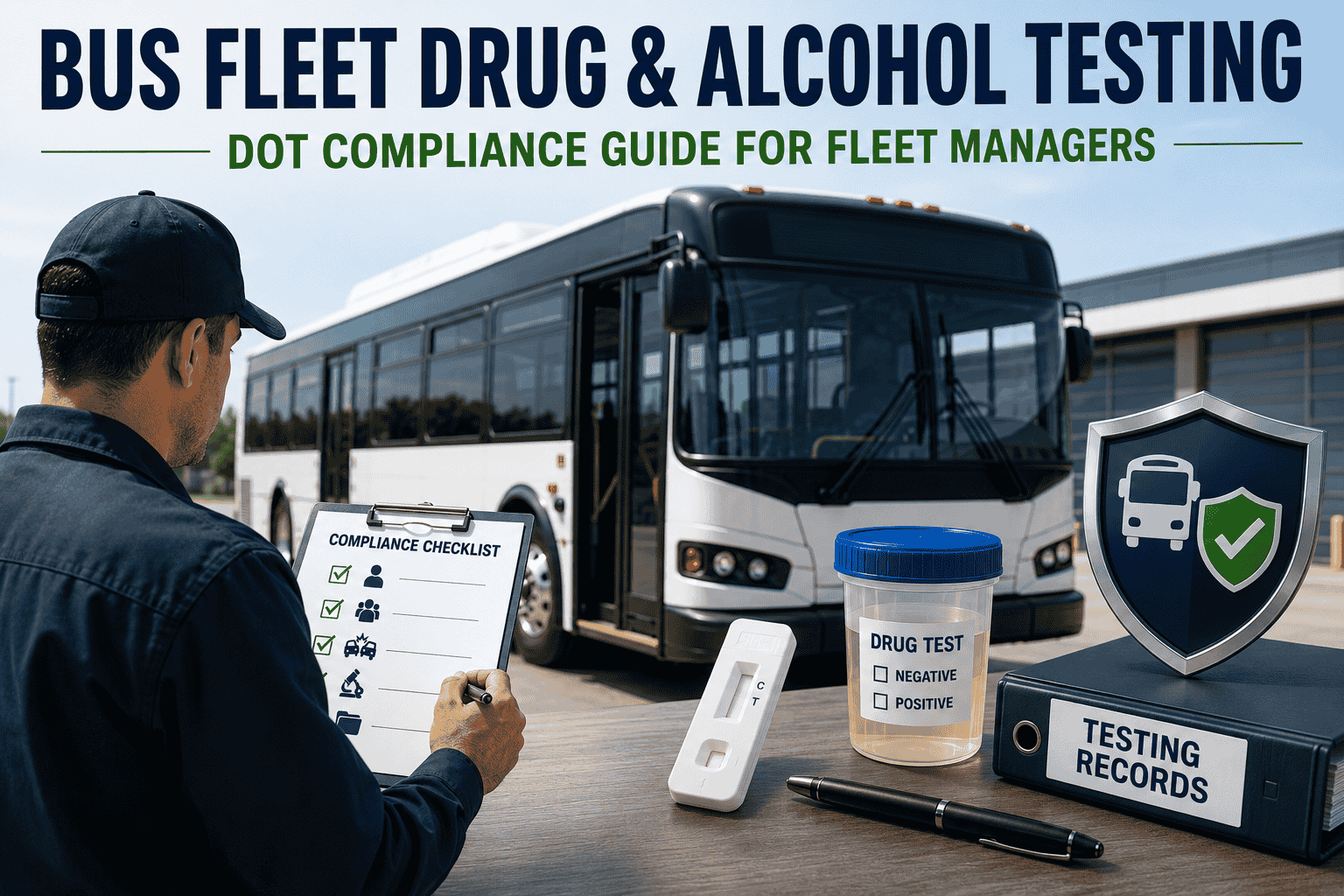
Last month, a 72-bus transit agency in Georgia got audited. FMCSA pulled 12 driver files. Three were missing pre-employment Clearinghouse queries. Two random test records had dates that didn't match quarterly draws. One driver had a "prohibited" Clearinghouse status that nobody checked in 14 months. Total exposure: $63,500+ in fines, three drivers grounded immediately, and a Conditional safety rating that takes 18 months to clear. None of these failures were about drugs or alcohol. They were about documentation. The testing program isn't hard to run correctly — it's hard to run manually, because the deadlines are constant and one missed query on one driver cascades into an audit finding that grounds your fleet.
When Is Each Test Required? The Complete Decision Map
DOT drug and alcohol testing has 6 distinct triggers. Each has different rules, different timelines, and different documentation. Here's the visual decision map — if any trigger applies, testing is mandatory:
Each of these 6 testing types generates documentation that must be retained for specific periods. BusCMMS tracks all 6 per driver — hire clearance, random draws, post-accident decisions, supervisor training, RTD timelines, and follow-up schedules — with automated alerts before every deadline. Book a demo to see all 6 testing types tracked on one dashboard.
The DOT 5-Panel: What Gets Screened
Same 5 substances whether urine or the new oral fluid (saliva) collection method authorized in 2026. Same cutoff levels, same MRO review process:
Log every test result per driver with timestamps — sign up free.
Post-Accident Testing: The 8-Hour and 32-Hour Clocks
Post-accident testing has the tightest deadlines in the program. Miss the window and you must document why — and that documentation itself becomes an audit item:
Track post-accident testing decisions and deadlines — book a demo.
The Clearinghouse: 2026 Has Teeth
The FMCSA Drug & Alcohol Clearinghouse is no longer informational — it's now connected to state DMV systems and actively revoking CDLs. Here's what changed:
- Violations reported but enforcement was weak
- States not connected to CDL systems
- Drivers could keep driving with "prohibited" status
- Annual queries rarely audited
Shift
- State DMVs connected — "prohibited" = CDL suspended automatically
- Positive results must be reported within 24 hours
- FMCSA actively revoking CDLs for unresolved status
- Pre-employment full query + annual limited query mandatory
Record Retention: What to Keep and For How Long
Drug and alcohol records have longer retention than maintenance records. Missing a record during an audit = $1,584/day per document:
Store every test record indefinitely — never fail a retention audit — sign up free.
Expert Review: Building an Audit-Ready Program
The fleets that pass drug and alcohol audits don't have better drivers — they have better systems. Pre-employment testing documented before first day. Random draws spread quarterly. Post-accident decisions timestamped within hours. Supervisor training logged with renewal dates. BusCMMS tracks all of this per driver alongside vehicle maintenance — because FMCSA audits both your driver files and vehicle files in the same review.
Every day without a documented program is another day exposed. A single missing Clearinghouse query costs $1,584/day. A driver operating with "prohibited" status costs $23,048. The dashboard that prevents it costs a fraction of one violation. Stop managing compliance by memory — book a demo today.
Frequently Asked Questions
What are the 2026 DOT random drug testing rates for bus fleets?
FMCSA: 50% of average driver count for drugs, 10% for alcohol annually. FTA: same rates. Selections must be scientifically random and spread across all 4 quarters. All CDL drivers in the pool at all times, including part-time and contracted. Owner-operators must participate through a consortium.
When is post-accident drug testing required for bus drivers?
When an accident involves a CMV and meets "hearse, nurse, or tow": (1) Any fatality — test all surviving drivers regardless of citation, (2) Injury requiring medical transport + driver citation, (3) Vehicle towed + driver citation. Alcohol: within 8 hours. Drug: within 32 hours. Document any delays in writing.
Does state marijuana legalization affect DOT testing for bus drivers?
No. Marijuana remains Schedule I under federal law. CDL drivers are subject to federal DOT testing regardless of state cannabis laws. Any positive THC = violation, even with a medical card or off-duty use. This is the #1 source of Clearinghouse violations in 2025–2026.
How long must drug and alcohol testing records be kept?
5 years: positive results, refusals, SAP evaluations, RTD results. 3 years: Clearinghouse queries. 2 years: calibration, BAT training, random selection records. 1 year: negative/cancelled results, education materials. Missing records = $1,584/day per document during audit.
Can BusCMMS track drug and alcohol testing compliance?
Yes. All 6 testing types per driver: pre-employment clearance dates, random draw schedules, post-accident decisions, supervisor training hours, return-to-duty timelines, and follow-up schedules. All alongside vehicle DVIRs, PMs, and inspections — one dashboard covers both the driver file and vehicle file that FMCSA audits together.