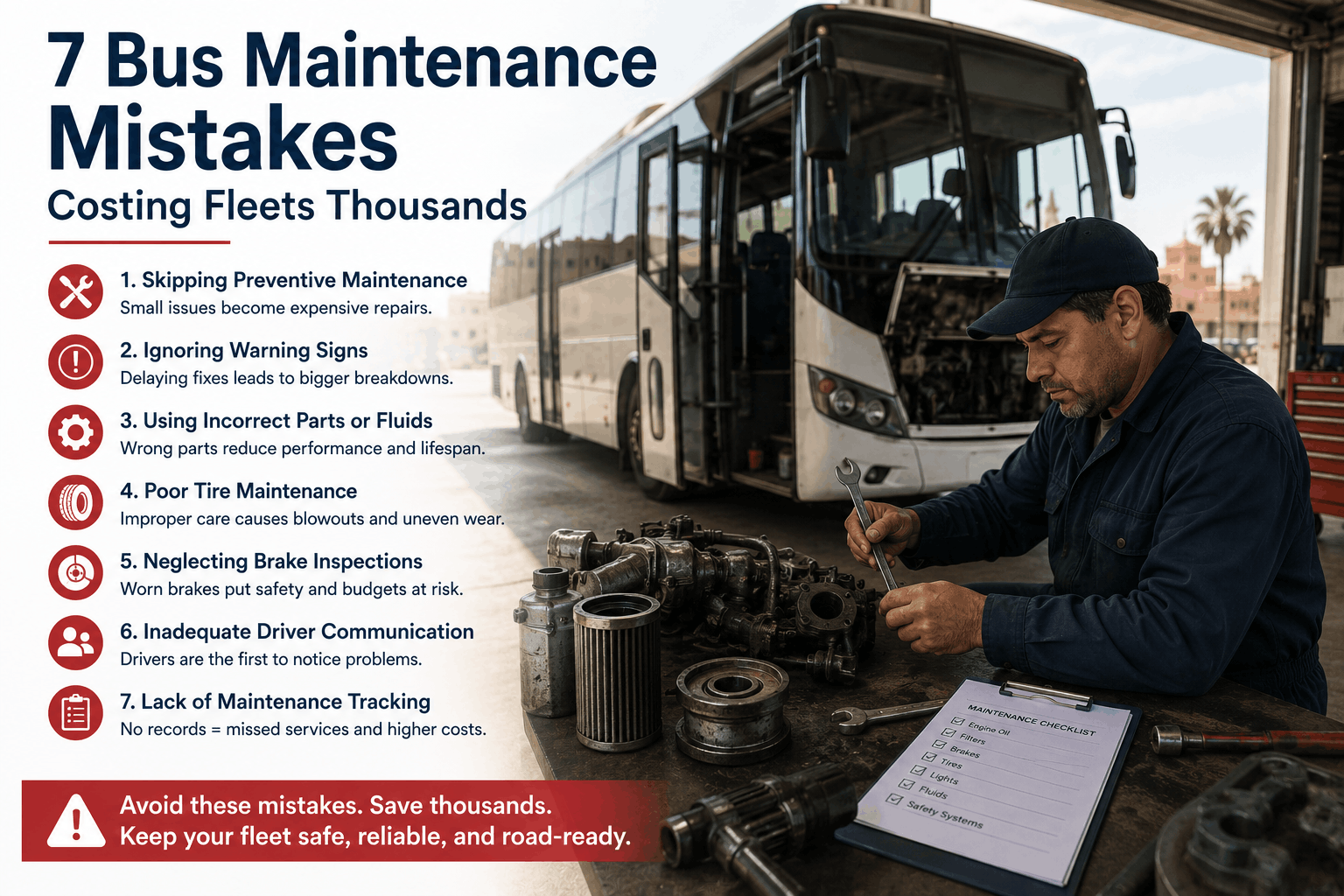
A 50-bus fleet's maintenance budget was $1.2 million annually. The fleet director thought that was good. Then they audited the books. $340,000 was spent on repairs that could have been prevented. One bus had a brake system failure that took it out of service for 6 weeks. Root cause: brake fluid wasn't changed in 7 years. Maintenance cost: $18,500 (parts, labor, lost revenue). Preventable cost: $1,200 (annual fluid change). Another bus required an engine rebuild at 650,000 miles — premature failure. Root cause: oil changes were 8,000 miles overdue. Preventable cost: $35,000 rebuild vs $400 timely oil change. A third bus had chronic transmission problems. Root cause: transmission fluid was topped off but never fully changed. Maintenance cost: $24,000 over 3 years. Preventable cost: $1,600 (two fluid exchanges). These aren't isolated. They're systematic oversights that multiply across a fleet. A 50-bus fleet where half make these mistakes wastes $170,000 per year. These are the seven most expensive mistakes, and how to prevent them.
Small oversights add up fast. These seven mistakes cost a 50-bus fleet $340,000 annually. Here's how to stop them.
Brake fluid hygroscopic — it absorbs moisture from air over time. Fresh fluid has a boiling point of 400°F. Fluid that's 2 years old has a boiling point of 350°F. Fluid that's 5+ years old can boil at 200°F. When brake fluid boils (during hard braking or overheating), it vaporizes and loses pressure. The brake pedal goes to the floor. Catastrophic failure. Most fleets know this. Few actually change brake fluid on schedule. The service interval is 2 years or every 24,000 miles, whichever comes first. A bus that accumulates 40,000 miles per year needs brake fluid changed every 1.2 years. Most fleets do it every 3–4 years, if ever. The cost of skipping one brake fluid change: $18,500 (emergency brake system repair including lines, calipers, possible damage to other systems). The cost of doing the fluid change on schedule: $600. One skipped service = 30 scheduled services in cost. How many buses in your fleet have gone 3+ years without brake fluid replacement? Multiply that by $18,500 and you have hidden liability exposure.
Oil change intervals are typically 10,000–15,000 miles for diesel bus engines. An overdue oil change by 5,000 miles (one interval) adds sludge and varnish that accelerate wear. Two overdue changes compound the problem. Three overdue changes put the engine at risk. Oil that's 5,000 miles overdue starts to degrade filter effectiveness. Dirt that should be captured passes through and enters the engine. Bearing surfaces wear 15–20% faster. An engine that should last 1,000,000 miles now lasts 850,000. The cost of premature engine rebuild: $35,000–$50,000. The cost of three timely oil changes: $1,200. One skipped service = 29 scheduled services in cost. Most fleets don't skip — they just delay. They stretch the interval from 12,000 to 13,500 miles. Across a 50-bus fleet, if each bus has one overdue oil change per year, that's 50 occasions where the engine is running degraded oil. Over 5 years, that's 250 instances of accelerated wear. Result: two or three buses need premature engine work while they should still have 150,000 miles of life left.
Transmission fluid has two functions: lubricate (reduce friction) and cool (dissipate heat). Over time, friction breaks down the molecular structure of the fluid. Worn fluid loses both lubrication and cooling properties. A full transmission fluid change every 60,000–80,000 miles removes the degraded fluid and replaces it with fresh fluid. Topping off (adding 1–2 quarts when level is low) temporarily raises the level but doesn't remove the degraded fluid. If you top off every 20,000 miles, you're adding 3–4 quarts of fresh fluid to 8–10 quarts of old, degraded fluid. The mixture degrades faster than fresh fluid alone. After 150,000 miles of topping off (no full change), the transmission fluid is essentially sludge. Transmission failure follows. Cost: $24,000 (rebuild or replacement). Cost of a full fluid exchange: $800. A fleet that tops off instead of changes loses $23,200 per bus. In a 50-bus fleet, if half operate this way, that's $580,000 in preventable damage. The worst part: the mistake is invisible. The bus operates normally until the transmission fails catastrophically. Most fleets don't track "we topped off" versus "we changed." They just don't track transmission service at all.
Preventive maintenance: fix things on a schedule before they break. An alternator that's working fine but showing 8 years of age gets replaced on preventive basis. Cost: $1,200 installed. Reactive maintenance: wait for it to fail, then fix it. The alternator fails, the bus is stranded, towing is required, substitute bus is operated, and the alternator is replaced at a shop. Cost: $1,200 part + $400 emergency tow + $600 substitute bus rental + 8 hours of downtime. Total: $2,200 (83% more). Multiply this across all components and the difference is staggering. Brake pads: preventive ($600 per set) vs waiting for failure and catastrophic brake system damage ($18,500). Water pump: preventive ($800) vs engine overheating and block crack ($12,000). Battery: preventive ($400) vs failure and stranded bus ($600 + downtime). Reactive maintenance costs 50–300% more than preventive. A fleet that runs 80% reactive and 20% preventive could cut costs by 40% by flipping the ratio. The problem: preventive requires planning. You have to identify what needs maintenance, schedule it, buy parts, and allocate mechanic time. Reactive requires none of that. When something breaks, you fix it. Most fleets default to reactive because it seems cheaper upfront. It's the most expensive strategy long-term.
Mistake #5: Skipping PM Records. You perform preventive maintenance but don't document it. When FMCSA audits, you can't prove it was done. When a bus has an accident, you can't show maintenance records. When a component fails early, you have no history to diagnose the root cause. Proper records prove compliance, enable root cause analysis, and reduce liability. Cost of poor records: loss of compliance evidence ($0) but hidden cost ($500K liability exposure). Mistake #6: Ignoring Telematics Data. Your buses have real-time data on idle time, fuel consumption, harsh braking, and fault codes. Most fleets collect it but don't use it. A bus with 40% idle time should trigger fuel system inspection. A bus with high fault code frequency should be diagnostically checked. Buses with harsh acceleration should have transmission checked. Ignoring telematics data means you're missing maintenance triggers that save 15–25% in fuel costs and 20% in component wear. A 50-bus fleet ignoring telematics data loses $50,000–$100,000 annually in preventable wear. Mistake #7: Poor Parts Inventory. When a bus breaks, you have to source the part. If it's not in stock, there's a 3–7 day lead time. The bus sits idle. Cost: one bus down for 5 days = $5,000–$10,000 in revenue loss. A proper parts inventory ($15,000 investment) keeps critical spares in stock and reduces downtime to same-day repair. The ROI is 3–4 months. Most fleets don't invest in parts because it feels like waste. It's actually insurance against downtime.
The seven mistakes in this guide aren't about knowing better — most fleet managers know brake fluid should be changed, oil changes matter, transmission service is important. The mistakes are about systems. Fleets without CMMS scheduling don't change brake fluid on time because there's no reminder. Fleets without telematics integration don't catch idle time problems because they don't see the data. Fleets without parts inventory accept downtime as normal because they don't have the capital to invest. These aren't knowledge gaps — they're process gaps. A proper maintenance system (CMMS, telematics integration, parts inventory, preventive scheduling) eliminates all seven mistakes automatically. The system tells you when brake fluid is due. The system alerts you when oil is overdue. The system flags buses with high idle time. The system tells you what parts to stock. Build the system first. The mistakes stop automatically.
A 50-bus fleet makes seven common maintenance mistakes that cost $327,000 annually. These mistakes compound: skipped brake fluid changes lead to $18,500 repairs. Overdue oil changes shorten engine life by 250,000 miles. Topping off transmission fluid instead of changing causes $24,000 failures. Running reactive maintenance costs 50–300% more than preventive. Ignoring PM records, telematics data, and parts inventory creates unnecessary downtime. The prevention cost is minimal — a CMMS with automated scheduling ($150/month), telematics integration ($200/month), and parts inventory investment ($15,000 one-time). Total: $18,000 per year to prevent $327,000 in losses. That's an 18x return on investment. The question isn't whether you can afford to prevent these mistakes — it's whether you can afford not to.