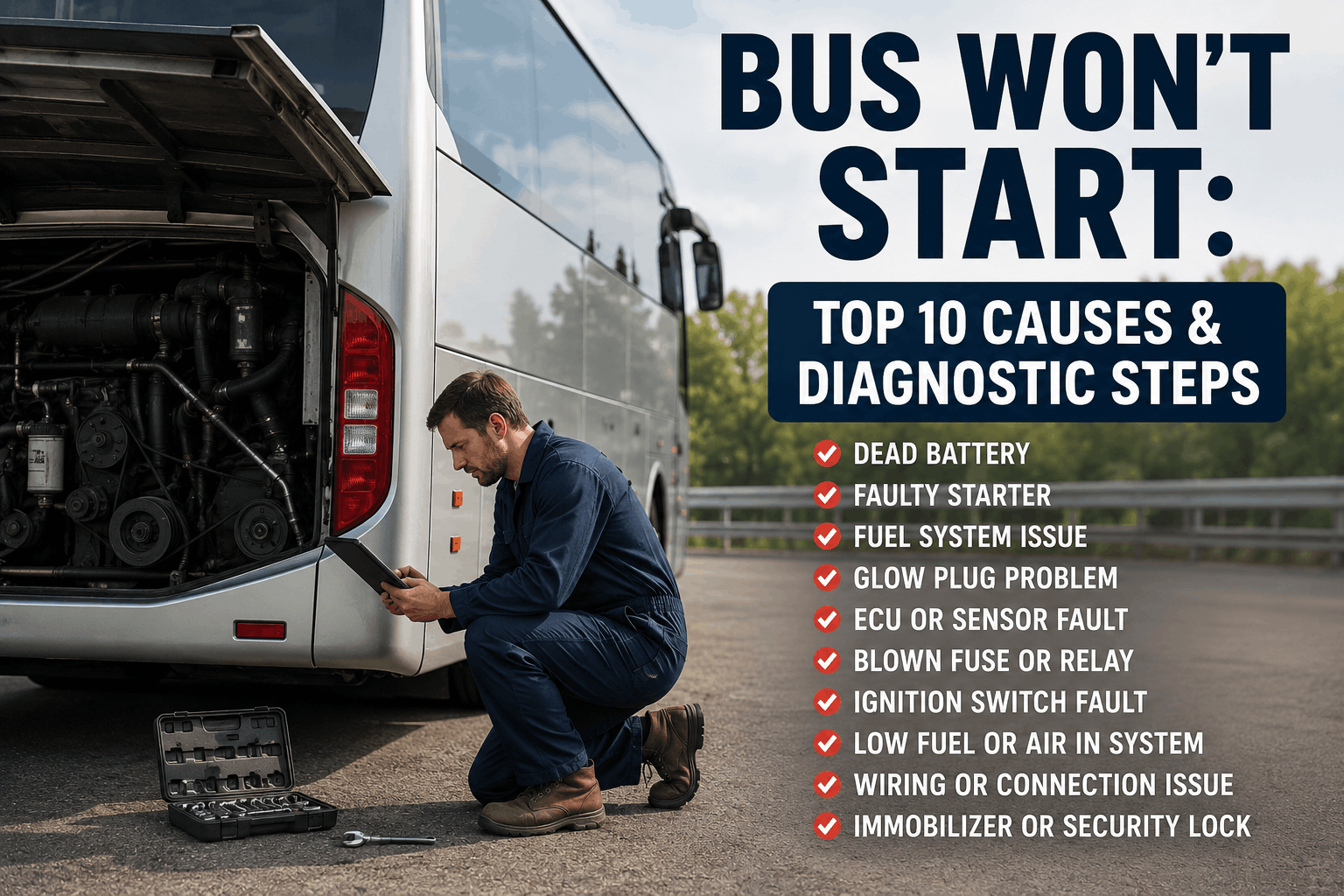
Nothing is more frustrating than a bus that won't start. Whether it's a school bus with students waiting, a transit bus on a schedule, or a motorcoach ready for a charter, starting failures cost time, money, and reputation. This guide covers the top 10 causes of bus starting failures ranked by frequency, plus a step-by-step diagnostic flowchart to get you back on the road quickly.
Bus Starting Troubleshooting Guide 2026
Bus Won't Start: Top 10 Causes & Diagnostic Steps
Bus won't start? Top 10 causes ranked by frequency — dead battery, faulty starter, fuel issue, glow plugs, ECU fault — plus a diagnostic flowchart.
Bus Starting Failure Impact: The Cost of Downtime
A bus that won't start disrupts schedules, frustrates passengers, and costs operators thousands in lost revenue. Understanding the most common causes helps technicians diagnose issues faster and reduce downtime.
5,000+
Starting failures per fleet annually
45-90 min
Average diagnostic time
3-8%
Fleet downtime from starting issues
70%
Failures diagnosed by 3 checks
Bus Starting Failure Diagnostic Flowchart
Step 1: Battery Check
Test voltage. If below 12.4V, jump start. If no start, proceed.
Step 2: Starter Motor
Check for clicking. If no click, test starter solenoid. If bad, replace.
Step 3: Fuel System
Check fuel level and filters. If empty or clogged, refuel or replace filters.
Step 4: Glow Plugs
Test glow plug operation. If faulty, replace. Check wait-to-start light.
Step 5: ECU & Sensors
Scan for fault codes. Check crank and cam sensors. If faulty, replace.
Step 6: Success
Bus starts! Document diagnosis and repair for future reference.
Top 10 Causes of Bus Starting Failures
1. Dead Battery
Frequency: 35% of all starting failures. Caused by age, parasitic drain, or leaving lights on. Test voltage and load.
2. Starter Motor Failure
Frequency: 18% of all starting failures. Clicking sound or no sound from starter. Check solenoid and motor.
3. Fuel System Issues
Frequency: 15% of all starting failures. Empty tank, clogged filters, or bad fuel. Check fuel level and quality.
4. Glow Plug Failure
Frequency: 12% of all starting failures. Cold start issues on diesel buses. Test glow plug resistance.
5. ECU Fault
Frequency: 8% of all starting failures. Fault codes indicate sensor or module issues. Scan and diagnose.
6. Crankshaft Sensor
Frequency: 5% of all starting failures. Crank no-start condition. Test sensor output.
7. Camshaft Sensor
Frequency: 3% of all starting failures. Similar to crank sensor. Check waveform output.
8. Immobilizer System
Frequency: 2% of all starting failures. Security system prevents start. Check key and module.
9. Air Intake Restriction
Frequency: 1% of all starting failures. Clogged air filter. Check filter and inlet.
10. Electrical Ground Issues
Frequency: 1% of all starting failures. Corroded or loose grounds. Check main ground connections.
Starting Failure Frequency Distribution
Battery failures are the #1 cause at 35%, followed by starter motor issues at 18%. Fuel system problems account for 15%. Together, these three causes represent nearly 70% of all starting failures. The remaining 32% includes glow plugs, ECU faults, sensors, and other issues.
Diagnostic Time by Cause
Battery and starter issues are the quickest to diagnose at 10 minutes each. Fuel and glow plug issues average 20-25 minutes. ECU and sensor faults take 35-45 minutes. Immobilizer system issues are the most time-consuming at 55 minutes average.
Diagnostic Steps for Bus Starting Failures
Step 1: Visual Inspection
Check battery cables, grounds, fuel level, and obvious damage. Look for loose connections or corrosion.
Step 2: Battery Test
Test voltage (should be 12.6V+). Load test to verify capacity. Jump start to confirm.
Step 3: Starter Test
Listen for click. Test solenoid voltage. Check starter motor current draw.
Step 4: Fuel System Check
Verify fuel level. Check filters for clogging. Test fuel pressure at rail.
Step 5: Glow Plug Test
Test resistance (should be 0.5-2 ohms). Check wait-to-start light operation.
Step 6: ECU Scan
Connect diagnostic scanner. Read fault codes. Check crank and cam sensors.
Bus Starting Failure KPIs
Track these five metrics to measure your starting failure diagnostic program effectiveness:
Diagnostic Time
Target: Under 30 minutes average. Track by cause. Longer times indicate training gaps.
First-Time Fix Rate
Target: 95%+ first-time repair. Track monthly. Low rate indicates misdiagnosis.
Battery Replacement Rate
Target: Monitor monthly. High rate indicates charging system or usage issues.
Starter Failure Rate
Target: Decreasing trend. Track monthly. Spike indicates quality or usage issues.
Roadside Assistance Calls
Target: Zero preventable calls. Track monthly. Spike indicates maintenance gaps.
Our fleet of 120 buses implemented this diagnostic workflow across all maintenance shops. In the first year, average diagnostic time dropped from 68 to 22 minutes. Battery-related starting failures decreased by 45% with better testing protocols. First-time fix rate improved from 78% to 96%.
Digitize Your Bus Starting Diagnosis Program
BusCMMS guides technicians through every starting failure diagnosis—battery testing, starter checks, fuel system inspection, glow plug testing, ECU scanning, and sensor verification. Track diagnostic time, first-time fix rates, and common failure patterns across your fleet.
Bus Starting Failure FAQs
What should I check first when a bus won't start?
Always start with the battery. Check voltage (should be 12.6V+ for 12V systems). Test battery condition with a load tester. Check for loose or corroded connections at battery terminals and ground points.
What does a clicking sound when starting mean?
A single click usually indicates a bad starter solenoid or low battery voltage. Rapid clicking often means a dead battery or poor connection. Test battery voltage first, then starter circuit.
How do I test if a diesel bus has fuel delivery issues?
Check fuel level first. Then check fuel filter for clogging. Test fuel pressure at the rail. For air in the system, bleed the fuel system using the primer pump.
What is a crank no-start condition?
A crank no-start means the engine turns over but won't fire. This usually indicates fuel delivery issues, glow plug failure (diesel), or sensor problems like crank or camshaft position sensors. Scan for fault codes.
How do I test glow plugs on a diesel bus?
Test glow plug resistance with a multimeter. Good plugs read 0.5-2 ohms. Open circuit or very high resistance indicates a failed plug. Check the wait-to-start light and relay operation.
Can BusCMMS track starting failure diagnostics?
Yes. BusCMMS tracks all starting failure diagnostics, repair actions, and outcomes. The system generates diagnostic workflow checklists, captures fault codes, and creates complete records for every starting failure in your fleet.
The Bottom Line
Bus starting failures are among the most common and frustrating issues in fleet operations. Understanding the top 10 causes—ranked from dead battery (35%) to electrical ground issues (1%)—helps technicians diagnose problems faster and reduce downtime. The diagnostic flowchart provides a systematic approach: start with the battery, then starter, fuel system, glow plugs, ECU, and sensors. Battery and starter failures account for over 50% of all starting issues and are the quickest to diagnose. Regular battery testing, starter maintenance, and fuel system checks can prevent most starting failures before they occur. When combined with BusCMMS diagnostic checklists, fault code tracking, and repair documentation, your maintenance team becomes proactive—catching starting issues before they leave passengers waiting or disrupt schedules.