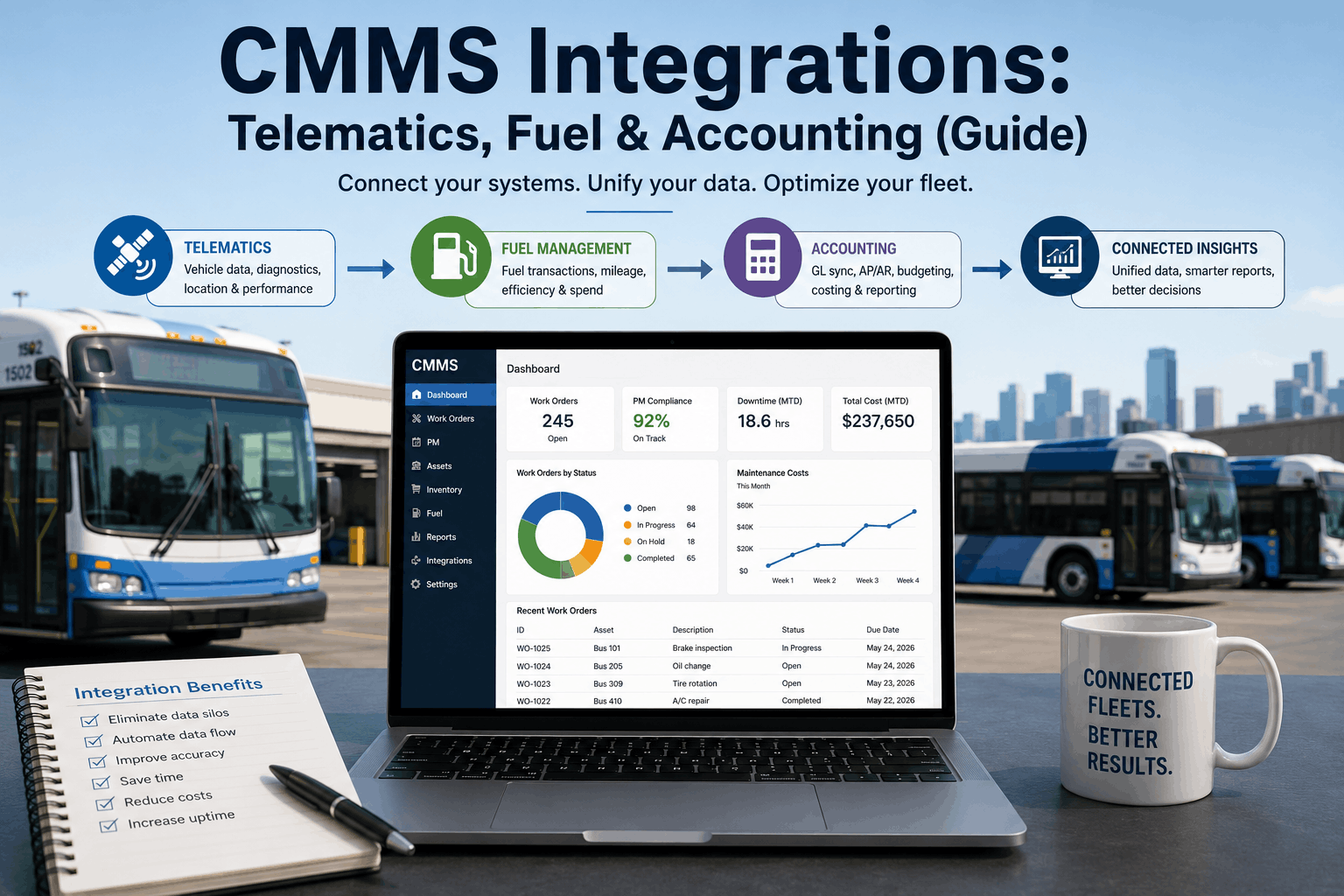
A 75-bus transit fleet tracked maintenance in CMMS, fuel in a separate card management system, telematics data in a GPS vendor's portal, and accounting in QuickBooks. On paper, all the data was there. In reality, no one connected the dots. Dispatch didn't know the fuel cost per mile. Maintenance didn't know which buses were idling 40% of the time. Finance didn't know maintenance spending per vehicle. Every system worked in isolation. Then they integrated: CMMS pulled telematics data automatically, fuel cards synced daily, and work orders flowed to QuickBooks for P&L tracking. The same data, unified. Within 90 days they cut fuel waste by 18%, identified a $45,000 annual maintenance inefficiency, and cut 12 hours per week of manual data entry. Integration isn't a feature. It's the foundation of fleet intelligence.
Manual data sync time (disconnected)12–20 hrs/week
Manual sync time (integrated)1–2 hrs/week
Idle time waste detected (no telematics)Unknown (15–25% typical)
Fuel cost per mile visibilityVia integrated fuel + telematicsNot available (separate tools)
Cost per maintenance event visibilityCMMS + accounting integrationManual P&L calculation
Integration unlocks insights that stay hidden in disconnected systems.
01The Case for Telematics Integration
Telematics data (engine hours, idle time, vehicle location, fault codes, fuel consumption) is the most underutilized input for maintenance. Most fleets collect telematics but leave it siloed in a vendor portal. They look at dashboards that show "avg idle time: 35%" but never connect that to the maintenance pattern: high-idle buses are wearing out engines 40% faster. Without integration, that knowledge stays theoretical. With CMMS integration, telematics triggers actionable maintenance decisions. A bus with extreme idle time becomes a candidate for fuel system inspection (high idle pressure on injectors). A bus with harsh acceleration patterns becomes a candidate for transmission fluid analysis. A bus with frequent fault codes becomes a scheduled diagnostic before the fault becomes a breakdown. Integration also eliminates manual fault code review — telematics pushes new fault codes directly into the CMMS work queue, pre-sorted by severity and frequency.
Telematics Data — Integration Points
Idle timeTriggers fuel system and injector inspection if over 30%
Fault codesAuto-populate work orders sorted by severity and history
Engine hoursDrive PM intervals instead of calendar or odometer alone
Harsh eventsAcceleration/braking patterns flag transmission and brake wear
Telematics alone is passive monitoring. Integrated with CMMS, it becomes predictive maintenance.
Without Telematics Integration
Data silosTelematics in one portal, maintenance in another. Never cross-referenced.
Manual alertsSomeone has to read telematics report and manually create work order
Missed patternsHigh-idle buses degrade unnoticed. Pattern only visible in hindsight.
Reactive maintenanceBreakdowns happen before pattern recognition triggers intervention
Fuel is typically 25–35% of total bus fleet operating cost. Yet fuel data and maintenance data rarely talk to each other. A bus with declining fuel economy should trigger mechanical inspection — injectors, air filter, fuel system pressure. A bus with a high-maintenance history should have fuel consumption tracked closely to detect anomalies. When fuel card data integrates with CMMS and telematics, the connection becomes obvious. A bus showing 15% worse MPG than its fleet peers becomes a diagnostic candidate. A bus with a clogged fuel filter now has a cost impact visible in real time (MPG drop + fuel cost) rather than discovered 500 miles later. Fuel integration also automates cost allocation — maintenance work orders automatically pull the fuel consumption for that vehicle over the work period, showing true maintenance cost (labor + parts + fuel impact).
Fuel Integration — Monthly Data Flow
Day 1–5
Fuel card transactions sync automatically to CMMS
Day 6
MPG calculated per vehicle from telematics + fuel data
Finance teams need cost per bus, cost per mile, and cost per maintenance event. They rarely get it because maintenance work orders and accounting transactions happen in different systems with different taxonomies. A $2,400 brake job might be logged in CMMS as "brake pad replacement" but imported to accounting as "parts + labor" with no link to which bus or which route. Accounting integration closes that gap. CMMS work orders automatically create accounting journal entries with the proper cost code, vehicle ID, and date. Finance can now ask: What's the true maintenance cost for Bus 47? What's the annual cost for all exhaust-related repairs across the fleet? Which buses are costing 30% more per mile than the fleet average? These questions drive budgeting, vehicle replacement decisions, and contract negotiations with manufacturers or lessors.
Without Accounting Integration
Work orders stay in CMMS — never reach accounting
Mechanics bill hours directly to timesheets — no work order link
Parts purchased through vendor invoice — separate from work record
Subcontractor bills arrive separately — no CMMS cross-reference
Finance rebuilds cost per bus monthly from scattered data
Result: Cost data is 30–60 days delayed, incomplete, and error-prone
With Accounting Integration
Work order completion auto-creates GL entry
Labor hours synced from timekeeping system to work order
Parts invoices matched to work orders automatically
Subcontractor expenses categorized by vehicle and component
Real-time cost dashboard shows true cost per bus
Result: Cost data is live, complete, auditable, and actionable
"Before integration, our maintenance cost per bus was a mystery. We'd generate a quarterly report that took 40 hours to compile and was outdated by the time we got it. Now CMMS pushes cost data to QuickBooks in real time. Finance can see cost per bus by day. We discovered Bus 34 was costing 3x the fleet average — a leaking transmission nobody noticed because the data wasn't connected. Found and fixed it. Total cost $4,200. We save $12,000 per year just from that one bus now."
CMMS integration comes in three flavors: API-native (the CMMS has built-in connectors), middleware (third-party tools like Zapier or Make bridge systems), and custom (developer writes integration code). Most fleets assume middleware is the answer. It's usually the worst choice — expensive, fragile, and slow to update when vendor APIs change. API-native integrations are superior. They're maintained by vendors, they update automatically, and they're faster. The right evaluation framework isn't "which CMMS has the most pre-built integrations" — it's "does this CMMS have API-first architecture that allows custom integrations when vendors don't have built-in connectors?"
Integration via Zapier or Make costs $15–50/month per connection but breaks frequently when vendors update APIs. Native API integration costs more upfront but maintains itself.
Integration doesn't happen all at once. The successful approach is phased, starting with the highest-value connections and adding as use cases develop.
Integration Roadmap — 12-Month Timeline
Month 1–2
CMMS implementation + basic fuel card integration
Month 2–3
Telematics integration (fault codes, idle time, engine hours)
Month 3–4
Accounting integration (work orders to GL)
Month 5–6
Reporting optimization — custom dashboards leveraging integrated data
Month 7–12
Continuous optimization — add dispatch routing, BI tools as needed
12-month result
Unified fleet view: maintenance + fuel + costs + telematics in one system
Start with one integration and add as your team learns to use the data. Don't try to integrate everything on day one.
Fleet Expert Review
Integration is where CMMS goes from a maintenance scheduling tool to a strategic fleet intelligence system. Disconnected data creates blind spots. Telematics, fuel, and accounting integration eliminate those blind spots — showing you idle problems, fuel inefficiencies, and cost anomalies before they become expensive problems. The fleets with the best maintenance outcomes don't use better mechanics or newer buses. They use better information. BusCMMS has native API integration with Samsara, Verizon, Geotab, WEX, Fuelman, QuickBooks, and Xero. New integrations are added quarterly.
The Bottom Line
CMMS integration with telematics, fuel, and accounting turns scattered data into fleet intelligence. Idle time patterns become maintenance decisions. Fuel inefficiencies become diagnostic triggers. Cost anomalies become vehicle replacement candidates. Fleets without integration spend 12–20 hours per week reconciling data from separate systems. Integrated fleets spend 1–2 hours and have real-time visibility they never knew was possible. BusCMMS integrates with major telematics providers, fuel card vendors, and accounting systems. Start with one integration — typically fuel or telematics — and add more as your team learns to use the unified data.
What's the difference between native API and middleware integration?
Native API: CMMS vendor maintains the integration directly. Updates automatically. Middleware (Zapier, Make): third-party tool bridges systems, breaks when APIs change, costs $15–50/month per connection. Native is always better if available.
Does CMMS integration require IT setup?
Most modern CMMS integrations are plug-and-play — you authenticate once and data flows automatically. No developer needed. Custom integrations (if you need them) require IT, but standard integrations (telematics, fuel, accounting) are self-service.
How much does telematics integration cost?
If your CMMS has native integration, it's included in your license — zero additional cost. If via middleware, it's typically $15–25/month. Most modern CMMS vendors include telematics integration; verify before choosing.
Can I integrate a CMMS that's already implemented?
Yes. Integration can be added after initial implementation. You don't need to start over. Most CMMS vendors can retro-fit integrations — they just take time to configure and test.
Which integration should I implement first?
Fuel card integration first (quick wins in cost visibility), then telematics (maintenance insights), then accounting (cost allocation). Prioritize by which gives you answers fastest.
Does BusCMMS have all the integrations I need?
BusCMMS integrates with major providers: Samsara, Verizon, Geotab, WEX, Fuelman, QuickBooks, Xero, and more. If you use a vendor not listed, the API is documented for custom integration. Check the integration list during your demo.
Telematics + Fuel + Accounting. All Connected.
Native CMMS integrations eliminate manual data entry and reveal hidden inefficiencies. See the connected fleet in action. Free 14-day trial.