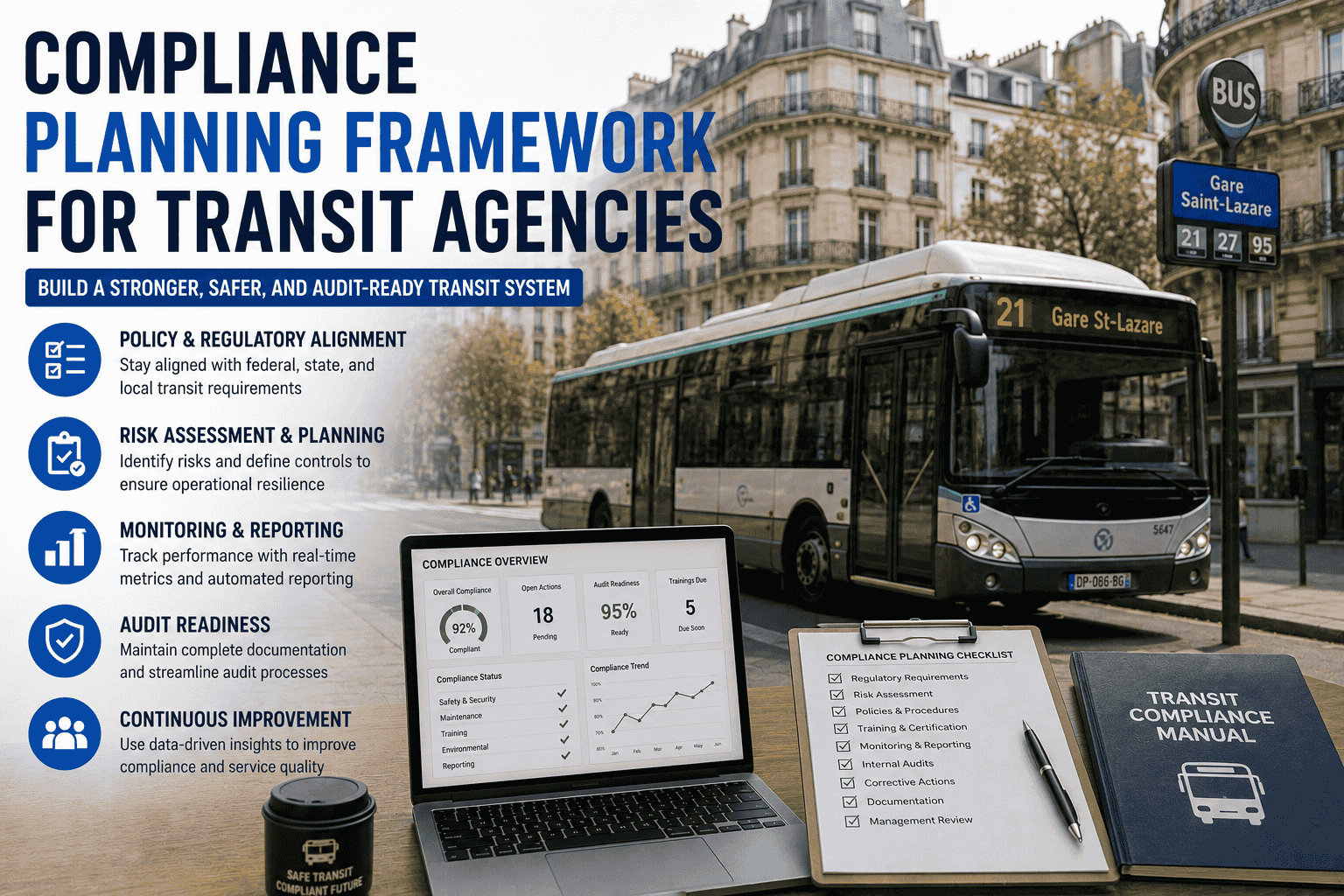
Compliance Planning Framework for Transit Agencies
Compliance planning for transit agencies is no longer a once-a-year audit exercise. Agencies now manage federal requirements, state inspection rules, DVIR documentation, preventive maintenance records, safety defect closure, technician accountability, and board-level reporting at the same time. When these records live in spreadsheets, paper forms, email threads, or disconnected systems, compliance teams lose visibility and audit preparation becomes stressful. A strong compliance planning framework connects inspections, work orders, preventive maintenance, asset records, safety defects, technician actions, and reporting into one repeatable workflow. This guide explains the technology, processes, and reporting metrics transit agencies need to improve fleet compliance, reduce audit risk, and keep buses ready for service.
Compliance Framework
Compliance Planning Framework for Transit Agencies
Build an audit-ready compliance program across DVIRs, inspections, preventive maintenance, safety defects, technician workflows, and reporting metrics.
A complete framework makes compliance visible before auditors ask for records.
01Why Transit Agency Compliance Is Becoming More Complex
Transit agencies are responsible for more than keeping buses on the road. They must prove that inspections were completed, defects were documented, repairs were performed, preventive maintenance happened on schedule, technicians followed procedures, and records can be produced during audits. The challenge is that each compliance area creates a separate data stream. Driver inspections produce DVIR records. Preventive maintenance creates service records. Road calls create repair records. Safety defects create urgent work orders. Parts usage creates inventory evidence. Auditors expect all of this to connect.
The most common compliance failure is not always a missed repair. It is missing proof. A bus may have been serviced correctly, but if the inspection record, work order, technician note, supervisor approval, or closure timestamp cannot be found, the agency still looks non-compliant. A compliance framework solves this by turning every inspection and maintenance event into a documented, searchable, reportable record.
02The 5-Pillar Compliance Planning Framework
A practical compliance plan should be organized around five pillars: asset compliance, inspection compliance, maintenance compliance, safety compliance, and documentation compliance. These pillars help managers assign ownership, track risk, and report progress clearly. The goal is not to create more paperwork. The goal is to make every compliance obligation visible and measurable.
Asset ComplianceAccurate bus profiles, VINs, mileage, equipment, inspection due dates, and lifecycle records.
Documentation ComplianceAudit-ready reports, digital signatures, timestamps, record retention, and searchable history.
Compliance Readiness Breakdown
Preventive maintenance — 35%
Inspections — 25%
Safety programs — 20%
Documentation — 12%
Training — 8%
03Compliance Reporting Metrics Every Agency Should Track
Transit agencies should not wait until audit season to review compliance performance. The most effective teams track compliance metrics weekly and review risk trends monthly. These metrics show whether the agency is operating with control or drifting toward audit exposure.
KPITargetWhy it matters
PM compliance95%+Shows scheduled maintenance is being completed on time.
DVIR closure rate100%Confirms driver-reported defects are reviewed and resolved.
Inspection completion98%+Reduces missed inspection and record retention risk.
Safety defect closure<48 hrsProves critical defects are not left open.
Audit readiness100%Ensures records can be retrieved quickly.
04Compliance Score Trend After Digital Planning
A compliance score makes progress easy to communicate. Instead of reporting dozens of disconnected metrics, agencies can combine PM compliance, inspection completion, defect closure, overdue work orders, and record completeness into one trend. Leadership can quickly see whether compliance risk is improving or worsening.
Compliance Score Trend
Example trend: compliance score improves from 72% to 96% after digital workflows, weekly KPI reviews, and automated audit reporting.
05Compliance Workflow From Driver to Auditor
Compliance becomes manageable when every action follows a clear workflow. Driver inspections should not stop at a form submission. Every defect must move into a work order, every work order must receive an owner and priority, every repair must be documented, and every completed item must update the compliance report automatically.
1Driver inspection
DVIR submitted with defect, photo, and timestamp.
2Work order created
CMMS creates task and assigns priority.
3Repair completed
Technician documents labor, parts, and action taken.
4Supervisor approval
Repair is verified before closure.
5Audit report updated
Records become searchable and report-ready.
06Common Compliance Planning Mistakes
Most audit problems come from preventable workflow gaps. Agencies often know what needs to be done, but lack the system discipline to prove that it happened. These mistakes should be addressed before audit season, not after an auditor asks for evidence.
Spreadsheet trackingSpreadsheets are hard to audit, easy to miss, and usually disconnected from work orders.
Missed PM servicesOverdue PMs create preventable breakdown and compliance exposure.
Paper DVIR formsPaper creates lost records, delayed repairs, and weak proof of defect closure.
Poor documentationRepairs without notes, signatures, or timestamps weaken audit defense.
Delayed safety repairsCritical defects must have fast escalation and documented closure.
No monthly reviewCompliance risk grows when reports are only reviewed quarterly or annually.
A 150-bus transit agency improved PM compliance from 74% to 97% after replacing spreadsheet tracking with a compliance planning workflow. Audit preparation dropped from three weeks to two hours because inspection records, work orders, repair notes, and supervisor approvals were searchable in one system. Open safety defects fell from 118 to 19, and road calls dropped by 32% within the first year.
A compliance framework works only when it connects daily operations to audit evidence. Transit agencies should treat every inspection, defect, work order, PM service, technician note, and approval as part of one compliance record. When the process is connected, audit preparation becomes a reporting task instead of a manual search project.
The Bottom Line
Compliance planning for transit agencies should be built around visibility, ownership, and documentation. The five pillars are asset compliance, inspection compliance, maintenance compliance, safety compliance, and documentation compliance. Agencies that track the right KPIs, automate DVIR-to-work-order workflows, review compliance weekly, and maintain audit-ready records reduce risk and improve operational reliability.
Compliance Planning Starts With Visibility
Track DVIRs, PM compliance, safety defects, work orders, technician actions, and audit reports in one connected workflow.
It is the process of organizing inspections, preventive maintenance, safety defects, work orders, asset records, technician actions, and documentation so the agency can stay compliant and audit-ready.
How often should compliance reports be reviewed?
Operational compliance KPIs should be reviewed weekly. Full compliance planning reviews should happen monthly so overdue PM, open defects, and documentation gaps are corrected early.
What records should be stored digitally?
Store DVIRs, inspections, PM records, work orders, technician notes, parts usage, supervisor approvals, audit reports, asset records, and safety defect closures digitally.
How does CMMS improve compliance?
A CMMS connects inspections, work orders, preventive maintenance, parts, technicians, and reporting. This reduces missed tasks and gives managers audit-ready documentation.
What is a compliance score?
A compliance score combines key metrics such as PM completion, DVIR closure, inspection completion, safety defect closure, overdue tasks, and documentation completeness into one performance indicator.
How can agencies reduce audit risk?
Reduce audit risk by digitizing records, automating inspection-to-work-order workflows, closing safety defects quickly, tracking PM compliance, and generating reports before audit season.
Which KPIs matter most?
The most important KPIs are PM compliance, overdue PM count, DVIR closure rate, inspection completion, open safety defects, defect closure time, repeat defects, and audit readiness.
Can compliance planning improve uptime?
Yes. Strong compliance planning catches defects early, prevents overdue PM, reduces road calls, and helps maintenance teams schedule work before failures disrupt service.