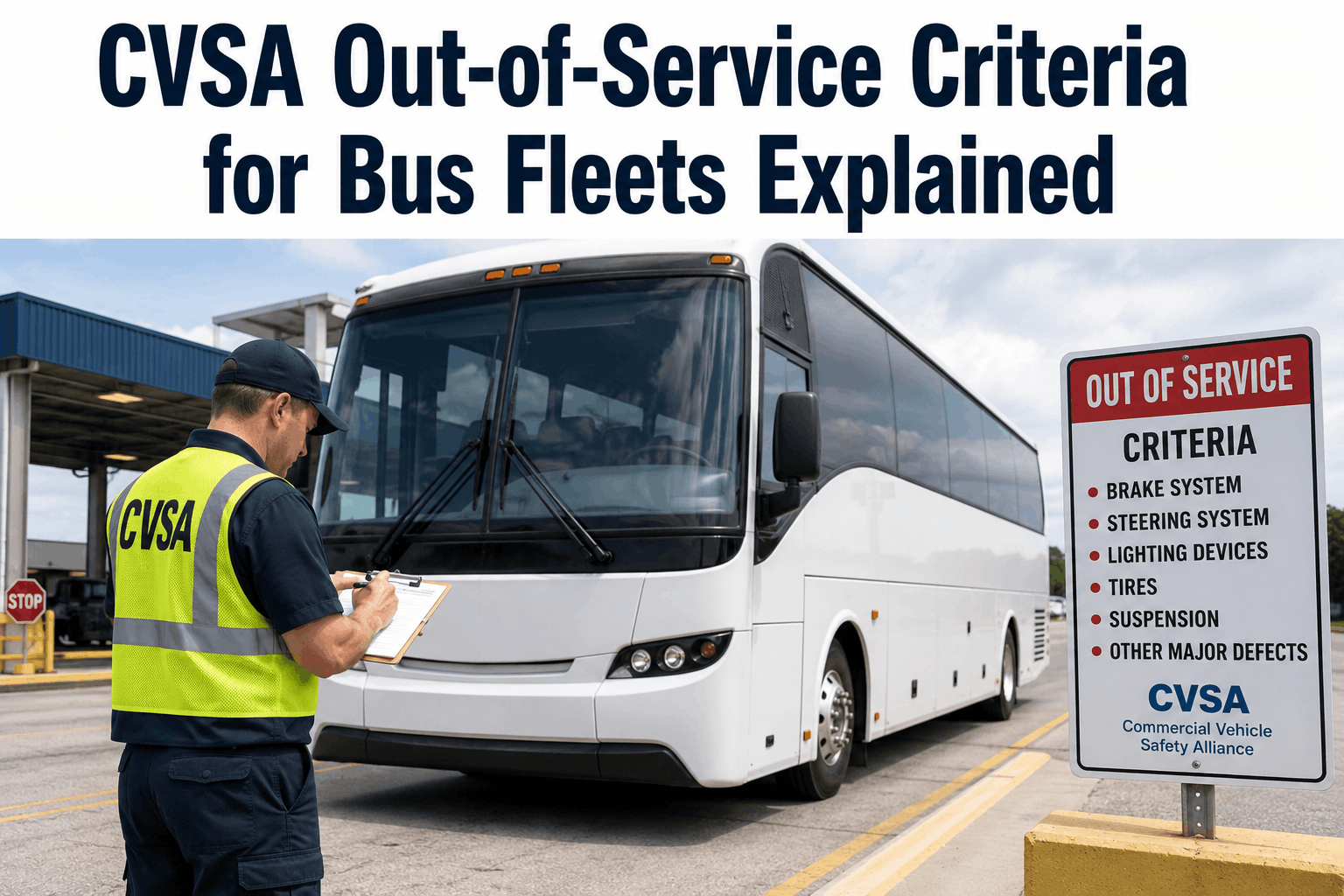
CVSA (Commercial Vehicle Safety Alliance) out-of-service (OOS) criteria are the safety standards that determine whether a bus can legally operate. A single OOS violation sidelines a bus immediately: it cannot be driven until the defect is corrected and documented. A school district with 40 buses facing even 2-3 OOS violations simultaneously loses 5-7% of operational capacity, potentially stranding students if buses are not available for scheduled routes. Understanding CVSA OOS criteria allows fleet maintenance teams to identify and prevent defects before inspection occurs. This guide covers the 20+ critical CVSA OOS defects for buses: brake system failures, steering defects, tire violations, lighting failures, and structural damage. Each defect is explained with inspection points and preventive maintenance measures that keep buses compliant and operational.
What is CVSA Out-of-Service Criteria?
CVSA OOS criteria are federal safety thresholds enforced by DOT inspectors during roadside inspections. If a defect meets OOS criteria, the bus is immediately prohibited from operation ("put out of service") until repaired. OOS defects are serious safety issues that pose risk to passengers and public. Examples: brake failure (bus cannot stop), steering defect (driver cannot control direction), tire blowout (vehicle loss of control), missing safety equipment. Fleet maintenance teams must understand OOS criteria to perform preventive inspections and catch defects before road enforcement.
15 Critical CVSA OOS Defects for Buses
OOS Trigger: Any brake system that does not provide adequate stopping power or control. Inspection: Test brakes under load. Defect: Spongy pedal or no pressure. Preventive: Monthly brake system inspection.
OOS Trigger: Air brake system losing pressure faster than 3 PSI per minute with engine off. Defect: Pressure drops below 85 PSI. Preventive: Monthly air system leak test.
OOS Trigger: Steering wheel movement exceeding 10 degrees (or 2 inches at rim) without movement. Preventive: Quarterly steering linkage inspection.
OOS Trigger: Tire tread depth below 2/32 inch. Inspection: Measure all tires with tread gauge. Preventive: Monthly check, replace at 4/32 inch for safety margin.
OOS Trigger: Visible bulge in tire sidewall or separation of tread from carcass. Preventive: Weekly visual tire inspections; replace immediately.
OOS Trigger: Missing valve stem caps on one or more tires. Preventive: Install caps on all tires, check during daily walkarounds.
OOS Trigger: One or both headlights not functioning. Preventive: Monthly light inspections, check wiring for corrosion.
OOS Trigger: Tail lights or brake lights not functioning. Preventive: Verify all corner lights function, check housing for moisture.
OOS Trigger: Missing red reflectors on rear or amber reflectors on sides/front. Preventive: Monthly visual check.
OOS Trigger: Cracks or damage in driver's critical field of view (58-inch width). Preventive: Replace damaged glass immediately.
OOS Trigger: Windshield wipers that do not clear water or do not function at all. Preventive: Replace blades annually.
OOS Trigger: Missing or non-functional mirror that prevents rear/side visibility. Preventive: Check daily and repair instantly.
OOS Trigger: Entry/exit door that does not open/close properly or sticks. Preventive: Weekly door checks, lubricate hinges.
OOS Trigger: Cracks in frame welds or damage to primary structural members. Preventive: Quarterly professional structural checks.
OOS Trigger: Exhaust system leaks directing fumes into passenger compartment. Preventive: Check for holes and cabin odors monthly.
CVSA OOS Prevention: Proactive Inspection Schedule
Monthly Pre-Trip Inspections (Driver Responsibility)
Quarterly Detailed Inspections (Maintenance Team)
OOS Prevention Checklist for CMMS
CVSA Inspection vs OOS Violation: What's the Difference?
CVSA conducts Level 1 (comprehensive safety) and Level 3 (focused) inspections on buses at roadside checkpoints or truck stops. An inspection documents all defects found. A defect becomes an OOS violation only if it meets OOS criteria. Example: brake pad at 3/32 inch is a safety concern but not OOS (minimum is 2/32). However, brake pressure loss of 5 PSI per minute is OOS (exceeds 3 PSI threshold).
Cost of OOS Violations
Conclusion: Prevention Beats Roadside OOS
CVSA OOS violations are expensive and disruptive. A single brake system failure sidelines a $300,000 bus for weeks while repair is completed. Proactive quarterly inspections using the checklist above catch defects before they become OOS violations. Fleet managers should document all inspections in CMMS and address findings immediately. Technicians trained on OOS criteria become the first line of defense, identifying issues during routine maintenance rather than at roadside inspection.
Set Up Preventive Inspection Workflows Today
Keep your buses compliant, operational, and safe from unexpected roadside shutdowns.