A 100-van last-mile delivery fleet runs vans for 3 years, covering 200,000 miles each. One van gets preventive maintenance on schedule (oil every 5K, fluid checks every 10K, major service every 50K). Another van's maintenance is "whenever something breaks." First van: engine dies at 198,000 miles. Cost to replace: $18,000 (capital loss). Second van: engine dies at 150,000 miles. Cost to replace: $18,000 (capital loss), PLUS 2 weeks downtime (missed 800 deliveries, $9,600 lost revenue). Maintenance schedules don't eliminate failures — but they extend life, reduce severity, and let you plan downtime. Delivery vans are high-mileage machines (40K–60K miles/year). They wear fast. Without a PM schedule, they fail unpredictably and expensively. With a PM schedule, you know when service is due and can plan repairs during off-hours. This guide shows the PM intervals for delivery vans, how to implement them, and how to track compliance.
High-mileage vans need aggressive PM. Oil every 5K miles. Fluid checks every 10K. Major service every 50K. Here's the schedule.
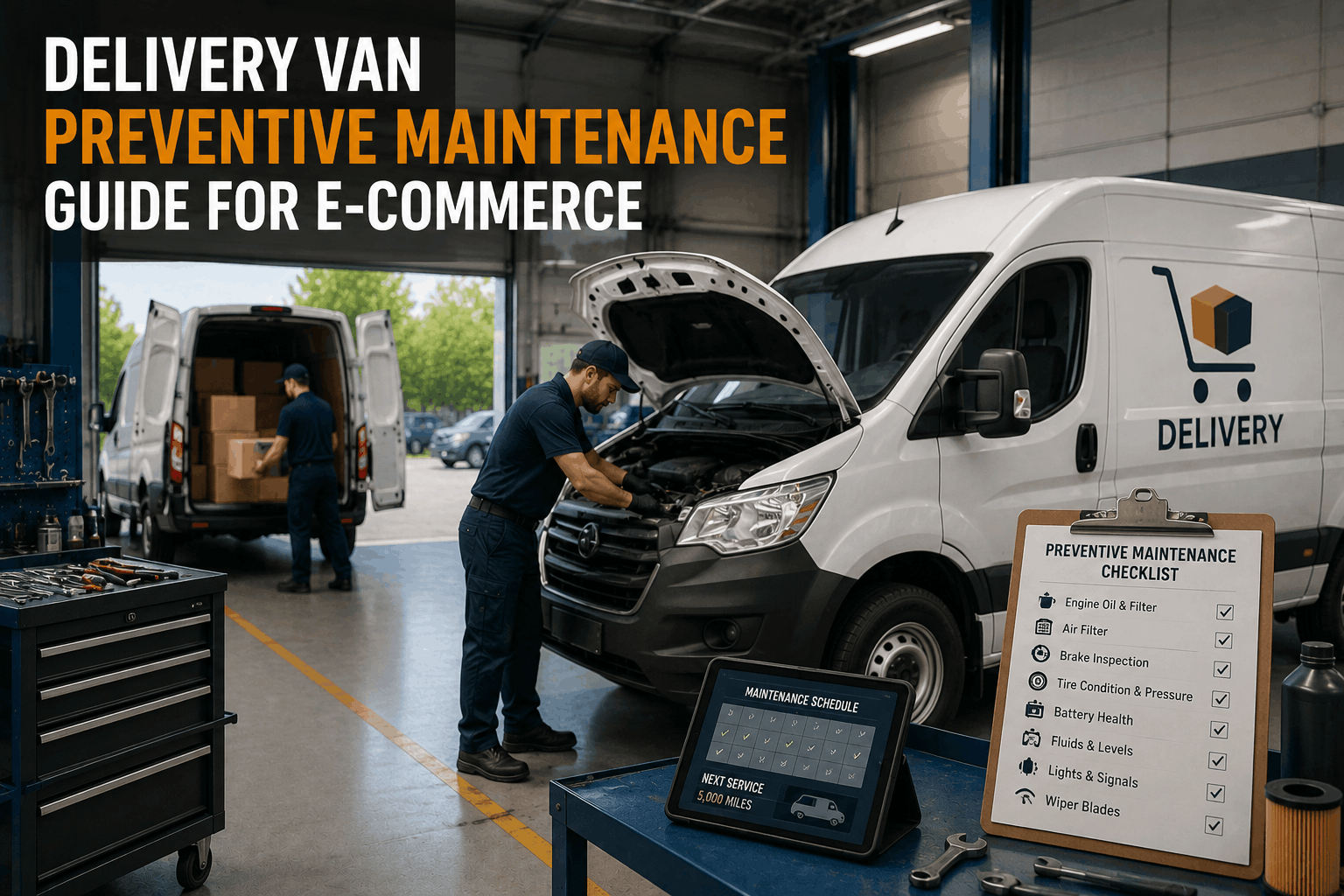
Delivery vans accumulate 40K–60K miles per year. That's 2–3x faster than typical vehicles. Standard car maintenance intervals (15K mile oil change) don't apply. Delivery van intervals must be aggressive: (1) Every 5,000 miles or monthly (whichever first): oil change, oil filter, brake fluid check, tire pressure check, lights check, fluid top-offs. (2) Every 10,000 miles or quarterly: air filter check, cabin filter check, brake pad wear check, suspension inspection. (3) Every 25,000 miles or every 6 months: transmission fluid check, coolant level, hose inspection, battery test. (4) Every 50,000 miles or annually: full fluid change (oil, coolant, transmission), brake service (pads + rotor inspection), suspension work, battery replacement (preventive). (5) Every 100,000 miles: major service (engine flush, transmission service, all hoses/belts, brake system overhaul). These are minimums for commercial delivery. If your manufacturer specifies different intervals, follow theirs. But industry standard for high-mileage commercial vans is tighter than consumer vehicles. Track intervals by mileage, not just time. A delivery van hitting 60K miles in 12 months needs 12 oil changes per year (not 1–2 like a commuter car).
Manual scheduling fails for 100-van fleets. You can't track 100 odometers in a spreadsheet. A CMMS (Computerized Maintenance Management System) integrates with your telematics (odometer data) and automatically triggers work orders when a van hits a PM milestone. Example: Van 47 hits 50,000 miles. CMMS automatically creates a work order: "50K service — oil change, coolant flush, brake service, battery replacement." The work order is assigned to a mechanic, parts are pulled, and service is scheduled for the next available bay (ideally during off-hours). Without CMMS, the van reaches 58,000 miles before anyone notices the 50K service was missed. By then, the transmission is showing signs of wear. CMMS eliminates this. It's the difference between 90% compliance and 5% compliance. For a 100-van fleet, CMMS costs $300–500 per van per year ($30K–50K total). A single prevented transmission failure ($6,000 repair + $2,000 downtime) pays for the system. Most fleets prevent 5–10 premature failures per year. Payback: 2–4 months. CMMS is non-negotiable for high-mileage fleets.
Even with CMMS, compliance can drift. Mechanics miss services. Vans are never brought in for scheduled work. Audit monthly: pull a report of all scheduled vs completed services for the past 30 days. Look for: vans overdue for 5K service by >2 weeks, vans overdue for 10K by >1 month, vans overdue for major service by >2 months. Each overdue service is debt. If 20% of your fleet is overdue for services, you have a capacity problem (you don't have enough mechanic time or bays). You have two choices: (1) Add capacity (hire, expand shop). (2) Reduce fleet size or accept higher downtime. Most fleets choose option 3: accept the problem and hope nothing major fails. That's the road to catastrophic failure. Don't do that. Measure compliance monthly. Flag overdue services immediately. Create priority work orders to catch up. If you're consistently missing deadlines, the problem isn't the vans — it's your capacity.
Some fleets do maintenance in-house. Others outsource to certified shops. There's a third option: hybrid. In-house for routine services (oil changes, filter replacements, fluid checks) that require 1–2 hours and are relatively simple. Outsource major services (transmission service, engine work, suspension overhaul) to specialized shops with the equipment. Hybrid approach: 70% in-house (routine), 30% outsourced (major). Cost: lower than full outsource, more flexible than full in-house. Scheduling: easier than pure in-house (you're not bottlenecked on your mechanics). Quality: better than pure in-house (major work is done by specialists). For a 100-van fleet, hybrid typically costs $3,500–5,000 per van per year (vs $4,000–6,000 for pure in-house, or $6,000–8,000 for pure outsourced). The key decision: do you have the shop space and mechanic time for 70% of maintenance? If yes, hybrid makes sense. If no, pure outsource is cleaner (one contract, one vendor, no capacity issues).
Delivery vans are high-mileage machines. They accumulate 40K–60K miles per year (vs 12K for typical vehicles). Standard PM intervals don't apply. Aggressive intervals are essential: oil every 5K miles (not 10K), fluid checks every 10K (not 20K), major service every 50K (not 100K). With aggressive PM, vans reach 200K+ miles. Without it, they fail at 140K miles. The difference: 60K miles = $8,000 per van in lost residual value. For a 100-van fleet, that's $800K. PM cost: $6K/year per van. ROI: 22x over 7 years. CMMS is non-negotiable for tracking mileage-based intervals. Compliance audits (monthly) catch drift before it becomes catastrophic. Hybrid maintenance (70% in-house, 30% outsourced) offers the best cost and flexibility.
Delivery vans require aggressive preventive maintenance due to high mileage. Oil every 5K miles, fluid checks every 10K, major service every 50K. A CMMS that tracks mileage-based intervals automates compliance and prevents missed services. Monthly audits catch drift. With proper PM, vans reach 200K miles and 6–7 year useful life. Without it, they fail at 140K miles and 4–5 years. The difference in residual value: $8,000 per van. For a 100-van fleet, that's $800K over the lifetime. PM cost is $6K per van per year. ROI: 22x. Most fleets skip PM, accept premature failures, and chalk it up to "the cost of doing business." That's expensive negligence. Build the PM system. Use CMMS. Audit compliance. Your balance sheet will thank you.