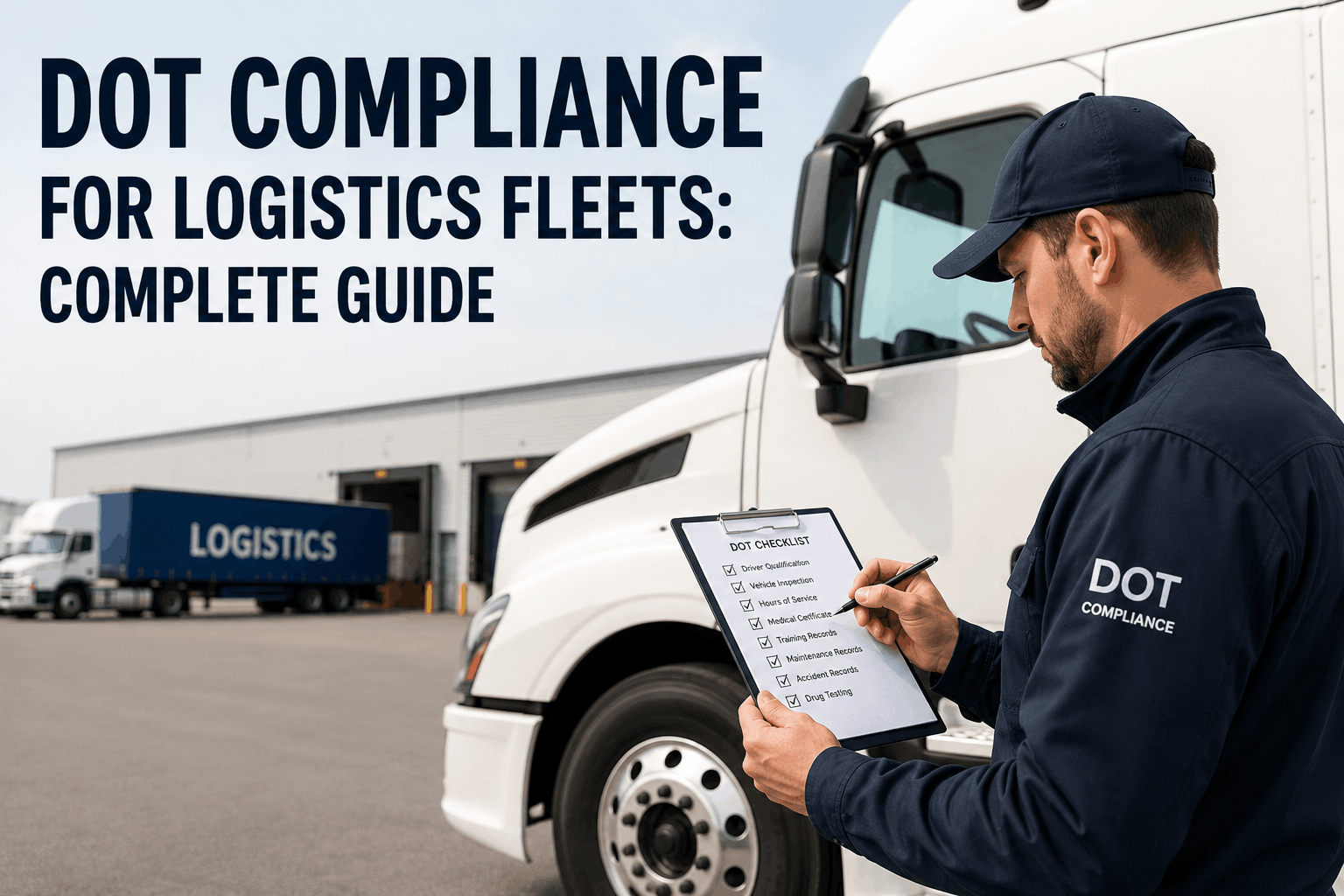
DOT Compliance for Logistics Fleets: Complete Guide


dot-compliance-logistics-fleets-complete-guide

A logistics carrier in Tennessee received a "Conditional" safety rating after a DOT audit in 2024. The violation: incomplete maintenance records for 23 vehicles. Ironically, the maintenance was performed — oil changes happened, inspections were done, repairs were completed. The records just weren't organized for audit review. The carrier spent $150,000 over 18 months fixing compliance systems before being re-audited and upgraded to "Satisfactory." Had they known what DOT actually looks for, that cost and timeline would have been unnecessary. DOT compliance for logistics fleets isn't about perfection. It's about documentation, consistency, and proving you have systems in place. Here's exactly what DOT auditors check, what records they need, and how to stay audit-ready year-round.

DOT Compliance 2026

DOT Compliance for Logistics Fleets: Complete Guide

Inspections, DVIRs, HOS records. Know what DOT auditors check and stay audit-ready year-round.

DOT Audit Reality — Logistics Carriers
Conditional rating (audit failure)35–40% of carriers audited
Cost to remediate Conditional status$80K–$200K+ over 12–24 months
#1 violation found in auditsIncomplete/missing maintenance records
Satisfactory rating maintenance (year 1)Consistent documentation only
Time to prepare for DOT audit2–4 weeks (if prepared)4–8 months (if scrambling)
Compliance is 80% documentation, 20% mechanics. Get records right and audits become routine.
01What DOT Actually Audits: The BASIC Criteria

DOT safety audits evaluate five "BASIC" categories: Unsafe Driving, Hours-of-Service, Vehicle Maintenance, Hazmat, and Cargo Securement. For non-hazmat logistics fleets, the audit focuses heavily on Vehicle Maintenance and Hours-of-Service. The Vehicle Maintenance BASIC specifically checks: Do you have a documented PM schedule? Are maintenance records complete for all vehicles? Are safety-critical items (brakes, lights, tires, coupling devices) maintained? Are roadside defects documented and repaired? The Hours-of-Service BASIC checks: Do drivers maintain accurate records of duty status? Are HOS limits enforced? Are records available for auditor review? Fleets that fail these BASIC categories get Conditional or Unsatisfactory ratings. Fleets that pass with documented systems get Satisfactory. The difference isn't better mechanics — it's organized records.

Vehicle Maintenance BASIC — What Gets Checked
PM schedulesDo you have documented preventive maintenance intervals? Per vehicle? Enforced?
Maintenance recordsFor last 12 months, can you pull records for any vehicle the auditor asks about?
Safety itemsBrakes inspected? Lights tested? Tires checked? Couplings secure? Documented.
DVIR complianceDo drivers submit pre-trip reports? Are defects logged and repaired before next trip?
Missing any of these = violation. Having all four documented = satisfactory rating.
Hours-of-Service BASIC — What Gets Checked
ELD complianceAre all drivers using registered ELDs? Records transferable to auditor?
HOS limitsNo driver exceeded 11-hr drive or 14-hr on-duty limits. Documented.
Rest requirements10-hour rest before returning to service. Records show compliance.
Record accuracyELD records match actual movement. No falsified logs.
HOS violations are objective. Either limits are met or they're not. Documentation makes it obvious.
02The Paper Trail: Records DOT Needs to See

DOT auditors don't care about your brand-new shop or your experienced mechanics. They care about the paper trail. Specifically, they want to see: vehicle maintenance records for all vehicles for the past 12 months, DVIR reports (pre-trip inspections) with defect documentation and repair completion, ELD records for all drivers showing HOS compliance, repair invoices or work orders for all major maintenance items, PM schedules showing what was supposed to happen and what actually happened. If a vehicle shows brake service on March 15, the auditor will ask: "Show me the work order." If you produce a work order, the audit moves on. If you can't produce it, that's a violation — even if the brakes were actually serviced. Documentation is compliance. Lack of documentation is non-compliance, regardless of whether the work was done.

DOT Audit Records Checklist
Maintenance records
Complete for all vehicles, past 12 months, searchable by vehicle
DVIR reports
Daily pre-trip + post-trip, defects documented, repairs completed within 24 hrs
Work orders
For every maintenance action, linked to vehicle and date
ELD records
For all drivers, last 90 days minimum, compliant with 49 CFR Part 395
PM schedule
Documented intervals for each vehicle type, showing planned vs actual
Safety inspections
Annual brake inspection, triennial inspection (if heavy), coupling checks
03DVIR (Pre-Trip Inspection): The Most Audited Document

Driver Vehicle Inspection Reports (DVIRs) are the single most scrutinized document in a DOT audit. The auditor will pull 5–10 random DVIR reports and check: Does the report document date, vehicle ID, and driver name? Are defects recorded specifically (not just "needs work")? When defects are noted, is there a corresponding work order and repair completion? Are safety-critical defects (brake issues, lighting, coupling problems) reported and fixed immediately? A carrier with good DVIR discipline shows the auditor that drivers are looking at their vehicles, problems are being caught early, and defects are being fixed before they become safety issues. A carrier with incomplete or missing DVIRs signals poor control. The fix is straightforward: digitize DVIRs (paper gets lost), make them mandatory, ensure defects trigger automatic work orders, and track repair completion.

If a DVIR reports a brake defect and there's no work order, that's a DOT violation. If there's a work order but the repair completion isn't documented, that's another violation. DVIR + work order + repair proof = compliance.
"We were using paper DVIRs. Drivers would scribble notes, forms would get lost, and we had no way to track defect-to-repair. DOT auditor pulled 8 random DVIRs and found 3 with documented defects but no corresponding work orders. That one finding cost us a Conditional rating. Moving to digital DVIRs with auto-linked work orders fixed it within 60 days."
— Safety Manager, 65-truck carrier, Missouri
04Staying Audit-Ready: Year-Round Compliance

DOT audits are announced (usually 2–4 weeks notice) but the records being audited are from the past 12 months. The only way to be ready is to maintain audit-ready records continuously. The standard for high-performing carriers: monthly compliance review (pull audit reports, check for gaps), quarterly DVIR sampling (spot-check 10 DVIRs, verify work order linkage), and annual pre-audit preparation (full 12-month records review 4 weeks before the scheduled audit). This process takes 20–30 hours per year. Carriers that skip it spend 200–400 hours post-audit trying to fix violations or gather missing records.

Year-Round Audit Readiness Program
Monthly
Run compliance report. Check: Any vehicles missing PM? Any open DVIRs? Any HOS violations?
Quarterly
DVIR audit: pull 10 random reports. Verify work orders + repair completion linked.
Semi-annual
ELD/HOS audit: verify no drivers exceeded limits. Records match actual movement.
Annual (4 weeks pre-audit)
Complete 12-month records review. Pull all maintenance, DVIR, ELD records. Fix any gaps.
Result
Audit preparation is 2–4 weeks, not 4–8 months. Satisfactory rating maintained.
Fleet Expert Review

DOT compliance for logistics fleets is not about having perfect mechanics or brand-new equipment. It's about having documented systems, complete records, and proof that you're following them. A carrier with average maintenance but perfect documentation passes audits. A carrier with excellent maintenance but scattered records fails. The BASIC categories (Vehicle Maintenance, Hours-of-Service) are straightforward to comply with if you have the systems in place. The carriers getting Satisfactory ratings are not doing anything magical — they're just maintaining consistent records and reviewing them regularly. BusCMMS automates the compliance paperwork: PM schedules, DVIR tracking, work order linkage, and HOS verification all in one system, making continuous audit readiness the default rather than a scramble.

The Bottom Line

DOT audits focus on five BASIC categories. For most logistics carriers, Vehicle Maintenance and Hours-of-Service are the critical ones. Pass both and you get a Satisfactory rating. Fail either and you're Conditional or worse. Passing isn't about better mechanics — it's about organized records. Complete maintenance documentation, linked DVIRs with work orders, ELD records showing HOS compliance, and a documented PM schedule. Carriers that review these records monthly stay audit-ready year-round. Carriers that ignore them scramble for 4–8 months post-audit trying to fix violations. BusCMMS provides the documentation infrastructure: automatic PM tracking, digital DVIRs with work order linking, ELD integration, and compliance reports that prepare you for any audit.

Audit-Ready Records. Satisfactory Rating.
Complete maintenance documentation, digital DVIRs, ELD integration, and HOS tracking in one system. Stay audit-ready year-round. Free 14-day trial.
Frequently Asked Questions
How often does DOT audit logistics carriers?
Every carrier is eligible for audit once per year. High-risk carriers (those with Conditional or Unsatisfactory ratings) are audited more frequently. Low-risk carriers with Satisfactory ratings may go 2–3 years between audits, but should maintain audit-ready records continuously.
What's the difference between Satisfactory, Conditional, and Unsatisfactory?
Satisfactory: no safety violations or minor violations that don't indicate a pattern. Conditional: one or more basic violations that indicate a need for corrective action (typically given 90 days to remediate). Unsatisfactory: severe violations or failure to remediate Conditional status (can result in operating authority suspension).
What if we're missing a DVIR for one day?
That's a violation. DVIRs are required daily. Missing reports, incomplete reports, or reports without linked work orders for defects are all violations. The auditor will cite it. You'll have to remediate it as part of your corrective action plan.
How long does it take to fix a Conditional rating?
DOT typically gives 90 days to submit a corrective action plan and evidence of remediation. If violations are fixed and documentation is complete, you can request re-audit within 90 days. Most carriers take 6–12 months to fully remediate and get re-audited to Satisfactory.
Can we use paper DVIRs, or do we need digital?
Paper is permitted, but digital is strongly recommended. Digital DVIRs link automatically to work orders, never get lost, and are easy to audit. Paper DVIRs lead to gaps and missing documentation that become violations.
Does BusCMMS help with DOT compliance?
Yes. BusCMMS tracks PM schedules, digitizes DVIRs with automatic work order creation, integrates ELD data for HOS verification, and generates compliance reports that prepare you for audits. Monthly reports show you exactly what an auditor will see.
Know Your BASIC Categories. Stay Satisfactory.
Vehicle Maintenance + Hours-of-Service. Complete records + monthly review = Satisfactory rating. All automated. Free 14-day trial.


Share This Story, Choose Your Platform!