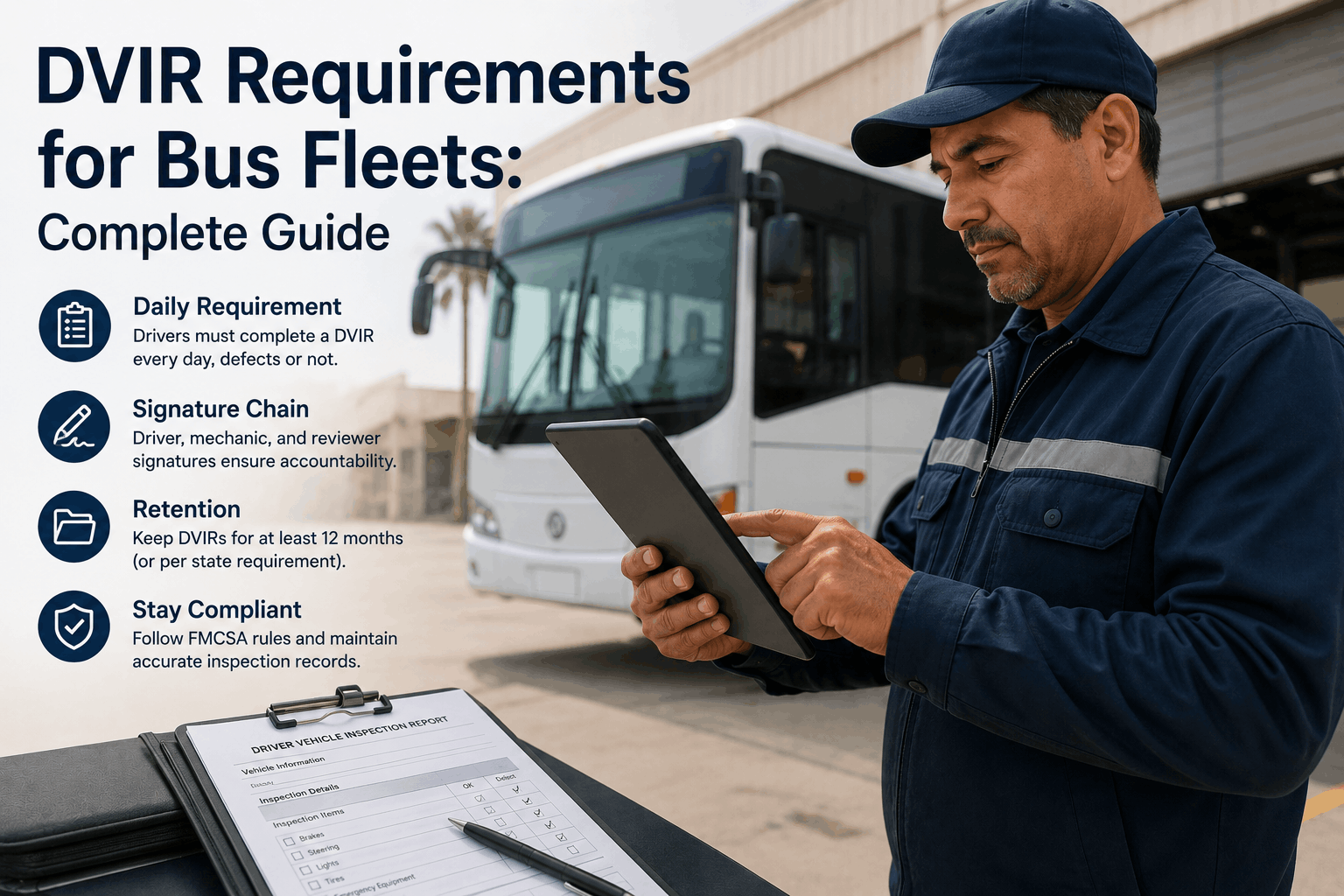
Every bus fleet operating in the United States must file a Driver Vehicle Inspection Report (DVIR) for every vehicle, every day, whether defects exist or not. The FMCSA regulation is explicit: 49 CFR 396.11 requires a written report for each vehicle operated. Most fleets understand the spirit of the requirement — catch maintenance issues early. But the technical compliance is more specific: signature chain, defect classification, correction verification, and 3-year retention. Fleets that skip DVIRs on "good days" or lose records face violations ($500–$5,000 per missing report) during DOT Level 1 inspections. Fleets that maintain compliant DVIR programs have documentation of maintenance discipline, reducing audit risk and demonstrating safety culture. Here's what compliance requires.
Compliance 2026
DVIR Requirements for Bus Fleets: Complete Guide
Buses must file DVIRs daily, defects or not. This 2026 guide explains DVIR rules, the signature chain, retention, and how to stay compliant.
Fleets non-compliant with DVIRs25–35% of audited fleets
Penalty per missing/incomplete DVIR$500–$5,000
DVIR compliance is a low-bar, high-impact requirement. Most violations are avoidable.
01The DVIR Regulation: What the FMCSA Requires
The FMCSA regulation 49 CFR 396.11 is the authoritative source. It states: "Each motor carrier shall require the driver of a commercial motor vehicle to prepare a written vehicle inspection report (DVIR) at the completion of each day's work or before a vehicle is placed in service if a vehicle is not operated every day." The key word is "shall require." It's not optional. It's not situational ("only if defects are found"). Every vehicle, every day. The regulation further specifies: "The report shall include the date, the name of the driver, the vehicle number, and odometer reading. The motor carrier shall ensure that each report is reviewed and signed by a person designated to receive such report." This is the signature chain. The driver fills it out. A mechanic or supervisor reviews and signs it. Both signatures are required for compliance. The report must document defects, or explicitly state "no defects noted." If defects are found, the driver lists them. The motor carrier (the company) must ensure defects are corrected before the vehicle returns to service. This correction must be documented. If a defect is corrected, a mechanic signs off confirming the repair. This closed-loop process — report, review, repair, verification — is what DVIR compliance looks like.
DVIR Compliance Checklist (49 CFR 396.11)
Report completionWritten DVIR filed for each vehicle, each day. No exceptions. "No defects" is a valid report.
Information requiredDate, driver name, vehicle number/ID, odometer reading. These four items are mandatory on every report.
Defect documentationIf defects exist, list them with enough detail for a mechanic to repair. If no defects, explicitly state "no defects noted."
Driver signatureDriver must sign the report, certifying they filled it out and observed the vehicle condition.
Review and sign-offMotor carrier must designate a person (mechanic, supervisor, operations manager) to review and sign each DVIR within 24 hours.
Defect repair documentationIf defects are noted, the motor carrier must repair them before returning vehicle to service. Repair must be documented and signed by mechanic.
These six elements constitute a compliant DVIR. Miss any one, and you have a violation.
Common DVIR Violations
Missing DVIR (no report filed)Vehicle operated without DVIR. Violation: $500–$5,000 per missing report.
Missing signature (driver or reviewer)DVIR exists but missing driver or reviewer signature. Violation: $500–$1,500.
Incomplete information (date, driver, vehicle ID, odometer)One or more of the four required fields missing. Violation: $300–$1,000.
Defect not correctedDriver noted defect, but vehicle returned to service without repair or documented waiver. Violation: $1,000–$5,000 (safety risk).
Most violations are administrative, not safety-driven. Fleets lose records or skip signatures. Digital DVIR systems reduce this risk to near-zero.
DVIR compliance depends on a clear signature chain. The driver initiates. The reviewer confirms. The mechanic closes the loop if defects exist. Each signature represents accountability at that stage. The driver's signature certifies: "I operated this vehicle today and observed these conditions." The reviewer's signature certifies: "I examined this DVIR and agree the documented condition is accurate." The mechanic's signature (if a defect is corrected) certifies: "I have repaired the defect noted in the DVIR and verified the repair." If any signature is missing, the chain is broken, and the DVIR is non-compliant. Inspectors during a DOT Level 1 audit will request DVIRs. They'll check for all three signatures. Missing any one signature across multiple DVIRs will result in violations. A fleet with 50 buses operating 250 days per year has 12,500 DVIRs annually. If 10% of those are missing a reviewer signature, that's 1,250 violations, potentially $625,000 in fines. This is why digital DVIR systems (that enforce signature capture) are worth the investment. They prevent these penalties by design.
DVIR Signature Chain Flow
End of shift
Driver completes DVIR: vehicle condition, any defects noted, driver signature
The regulation requires DVIR retention for a minimum of three years from the date of filing. For a fleet with 50 buses operating 250 days per year, that's 12,500 DVIRs annually. Over three years: 37,500 DVIRs. Storing, organizing, and retrieving paper DVIRs across three years of operation is logistically complex. Most fleets lose records — not intentionally, but through turnover, moves, or lack of organization. When a DOT Level 1 inspector requests a random sample of DVIRs from three years ago, fleets that can't produce them are in violation. The solution is digital DVIR systems that automatically store and index every report. By vehicle, by driver, by date. Searchable. Retention is automatic (system keeps records for the required duration). Compliance is verifiable on demand. For audits, you can generate a compliance report: "Of the 37,500 DVIRs filed over the past 3 years, X% are complete with all required signatures." This transparency demonstrates discipline and reduces audit findings. Paper DVIRs? You're hoping the filing system is organized enough to produce them. Digital DVIRs? You know exactly how compliant you are.
DVIR Retention Requirements
Retention durationMinimum 3 years from filing date. Many fleets keep 5+ years for additional safety margin.
Storage formatCan be paper or digital. Digital is far superior for retrieval and compliance verification.
Accessibility requirementMust be "readily available" to inspectors during audits. "In a box in a warehouse" is not readily available.
SearchabilityInspectors may request DVIRs by vehicle, date range, or driver. System must support quick retrieval.
Digital retention eliminates retrieval risk and proves compliance automatically.
Retention Plan: Paper vs Digital
Paper DVIRs (in filing cabinets)Pros: no software cost. Cons: hard to organize, easy to lose, impossible to search, takes weeks to produce 100 DVIRs for inspector.
Digital DVIRs (in CMMS or DVIR platform)Pros: searchable, automatic 3-year purge, compliance reports in seconds, audit-ready. Cons: small monthly/annual cost.
Hybrid (paper backup of digital)Safe approach: Digital as primary system, quarterly printouts as backup. Best of both worlds.
Cost of non-compliance (missing records)$500–$5,000 per missing DVIR. For 50-bus fleet losing 10% of records: up to $625,000 in fines.
Digital DVIR systems pay for themselves through penalty avoidance on the first audit.
04Defect Classification: Safety-Critical vs Maintenance Items
Not all defects are equal. The FMCSA distinguishes between safety-critical defects (which prevent vehicle operation) and maintenance items (which can be corrected on a schedule). A brake system failure is safety-critical. The vehicle cannot be returned to service. A dirty cabin light is a maintenance item. The vehicle can operate, but the light should be fixed at the next service opportunity. DVIR defect classification affects how quickly the repair must be made. Safety-critical: repair before next operation (same day if possible, or immediately). Maintenance: repair at next scheduled maintenance (within 5–10 days, depending on vehicle utilization). Drivers should understand this distinction. If they note a safety-critical defect, they should inform the supervisor immediately. If they note a maintenance item, they document it in the DVIR and know it will be addressed in the maintenance schedule. The motor carrier must ensure defect classification is clear and that repairs are prioritized accordingly. During audits, inspectors will verify: (1) Safety-critical defects are documented and repaired before vehicle returns to service. (2) Maintenance items are repaired on schedule. (3) All repairs are documented and signed off.
DVIR compliance is straightforward: file daily, document completely, get signatures, repair defects, retain records. Miss any step, and you have a violation. Digital systems enforce compliance automatically.
DVIR Compliance Expert Review
DVIR compliance is a low-complexity, high-value requirement. The regulation is clear: daily report, signatures, defect repair documentation, 3-year retention. Most fleets fail on administrative elements (missing signatures, lost records) rather than safety issues. Digital DVIR systems solve this by enforcing the signature chain, automatically retaining records, and providing searchable compliance reports. A 50-bus fleet with paper DVIRs is vulnerable to audit findings worth $500k+. The same fleet with a digital DVIR system demonstrates compliance automatically and avoids penalties entirely. This is one of the few areas where technology investment provides immediate, measurable ROI on the first audit.
Compliance Is Achievable
DVIR requirements are not ambiguous. File daily. Get signatures. Fix defects. Keep records. Repeat for 3 years. The regulation 49 CFR 396.11 leaves no room for interpretation. Fleets that comply don't worry about audits. Fleets that don't comply face penalties averaging $500–$5,000 per missing or incomplete DVIR. For a 50-bus fleet, that's $625,000+ in potential fines. Digital DVIR systems enforce compliance by design. They capture driver signatures, route reports to reviewers, document defect repairs, and retain records automatically. They're not optional. They're the standard that separates compliant fleets from those at risk.
Digital DVIR system enforces signatures, routes reports, documents repairs, retains records for 3 years. Compliant. Audit-ready. Every time. Free 14-day trial.
Yes. The regulation requires a DVIR for every vehicle every day, regardless of condition. A compliant DVIR with no defects will state "no defects noted" or similar. This is still a filed DVIR and must have driver and reviewer signatures. Failing to file a DVIR (even on a "good day") is a violation.
Who reviews and signs the DVIR?
The motor carrier must designate a person to review and sign each DVIR. This can be a mechanic, maintenance manager, operations supervisor, or anyone authorized by the company. The reviewer must have enough knowledge to assess whether the documented condition is accurate. The reviewer's signature confirms they've examined the DVIR and agree with its content.
How long do I have to fix a defect reported in a DVIR?
Safety-critical defects must be corrected before the vehicle returns to service (same day if possible). Maintenance items can be corrected at the next scheduled maintenance, as long as the repair is documented and happens within a reasonable timeframe (typically 5–10 days). The key is that repairs must be documented and signed off by a mechanic.
What counts as a "readily available" DVIR during an inspection?
Readily available means you can produce the requested DVIR (usually a random sample from the past 3 years) within 30 minutes. Paper files in a disorganized box are not readily available. Digital records that can be searched and printed in seconds are readily available. This is why digital systems are preferred.
Can I use digital DVIRs, or do they have to be paper?
Digital DVIRs are acceptable and encouraged. The regulation doesn't specify format. Digital DVIRs offer advantages: automatic signature capture, searchable records, automatic retention, audit-ready compliance reports. Many modern fleets use digital DVIR systems exclusively.
What happens if I lose DVIR records?
If you cannot produce DVIRs when inspectors request them, that's a violation. The penalty is $500–$5,000 per missing or incomplete DVIR. Losing records from 3 years of operation can result in tens of thousands in fines. Digital retention systems prevent this by design.
Are DVIRs only for buses, or do all vehicles need them?
The FMCSA DVIR requirement applies to commercial motor vehicles used in interstate commerce with a gross vehicle weight rating over 10,001 lbs. This includes buses, trucks, and commercial vans. Passenger cars are exempt. If your operation involves buses, DVIRs are required.
Audit-Ready DVIR Compliance.
Enforce signatures, document defects, schedule repairs, retain records. All in BusCMMS. Compliant every day. Free 14-day trial.