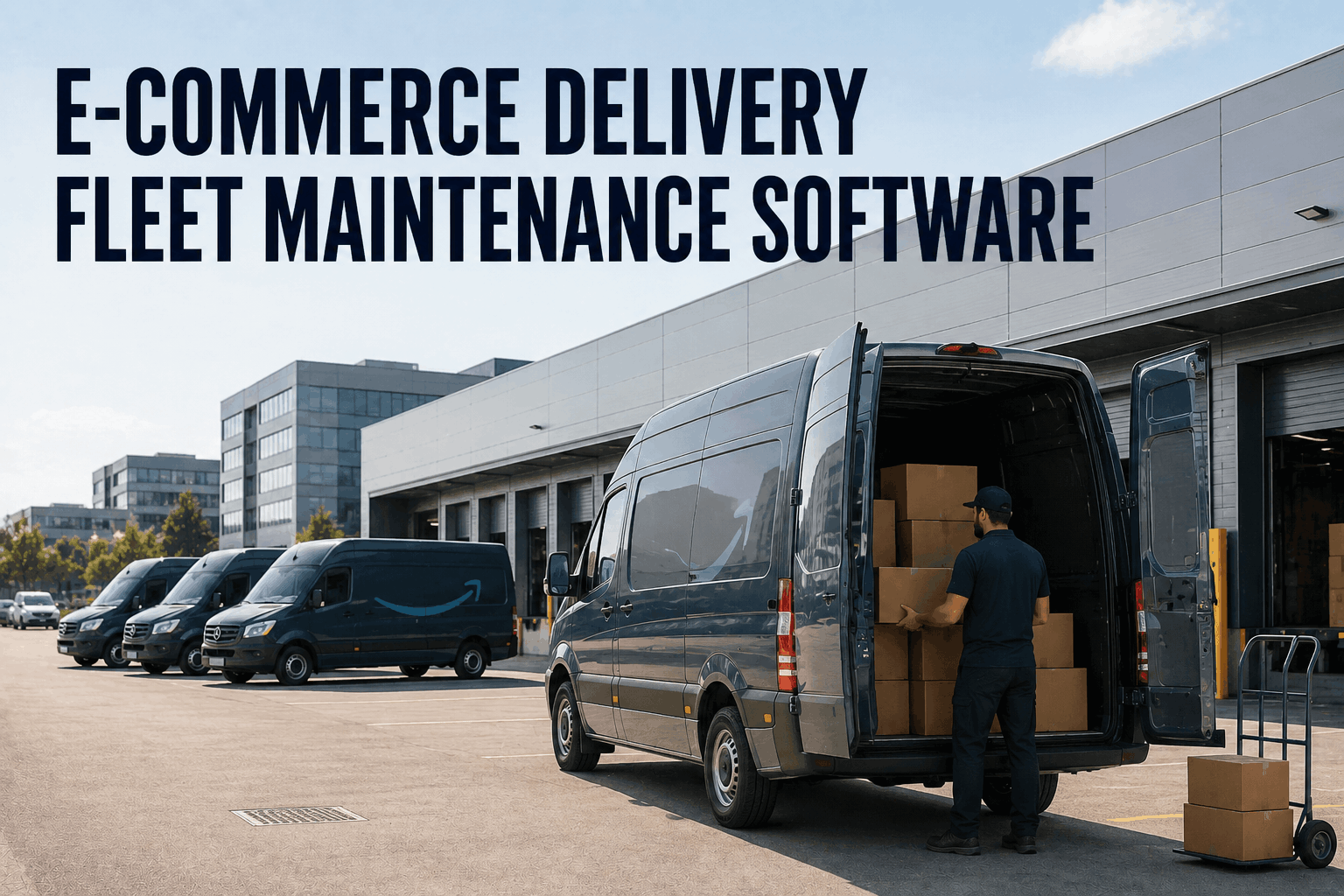
Last-mile delivery fleets face a paradox: they need to keep vans on the road (missed deliveries cost money), but they also need to maintain them (downtime costs more money). Most e-commerce operations use spreadsheets or nothing at all to track maintenance. Result: vans go unmaintained until they break. A delivery van that breaks mid-route misses 50–100 deliveries that day. Lost revenue: $1,500–3,000. The van is down for 2–5 days waiting for parts and repair. Total cost: $5,000–10,000. A preventive maintenance system (CMMS) costs $300–500 per van per year and prevents 60–70% of these breakdowns. But standard fleet CMMS systems aren't built for e-commerce. They're built for transit or school buses (fixed routes, depot-based). E-commerce vans need different workflows: geolocated vehicles, on-demand repairs, fast turnaround, spare parts management. This page shows why e-commerce fleets need specialized CMMS software and what features matter most.
Off-the-shelf fleet software doesn't work for delivery. You need geolocation, on-demand repair, fast parts management, SLA protection. Here's what matters.
Transit fleet software (designed for buses) assumes: (1) Vehicles return to a depot each night. (2) Routes are fixed (same schedule daily). (3) Maintenance is planned weeks in advance. (4) A breakdown causes service delay, not contract failure. E-commerce delivery doesn't work like this. Vans are dispersed across 50–200 locations. Routes vary daily. A breakdown at 3pm needs same-day repair (not next week). A missed delivery is a breach of customer contract. Traditional CMMS solutions add overhead without solving e-commerce problems. A delivery operation using bus-centric software is like using a city bus for long-haul trucking — the tool doesn't fit the job. E-commerce fleets need software built for: (1) Real-time vehicle geolocation (know where each van is if it breaks down). (2) On-demand repair routing (find the nearest mechanic, dispatch repair, track completion). (3) SLA protection (alert when a breakdown threatens delivery deadlines). (4) Parts demand forecasting (anticipate parts needed based on vehicle age and usage). (5) Driver communication (notify driver of maintenance appointments, reroute deliveries if needed).
E-commerce CMMS must have five core features. (1) Real-time geolocation: integrate GPS data from vans. When a breakdown occurs, you know exact location. (2) On-demand repair dispatch: connect to a network of mechanics (in-house or mobile services). Route repairs to the nearest available mechanic. (3) SLA tracking: monitor upcoming delivery deadlines. Alert when a breakdown threatens SLA. Trigger contingency plans (reroute, substitute van). (4) Spare parts forecasting: based on vehicle age, mileage, and failure history, forecast which parts will likely fail soon. Pre-stock those parts. (5) Driver communication: notify driver of maintenance appointments, reroute deliveries if necessary, collect feedback on repairs. A CMMS with these five features cuts downtime by 60–70%. Without them, downtime is unpredictable and costly. Look for software that has all five, or be prepared for problems.
The best e-commerce CMMS integrates with your delivery operations software, not just maintenance. When a van breaks down, the system should: (1) Alert the maintenance team (standard). (2) Immediately notify dispatch and customer service. (3) Show impact on pending deliveries (how many, to which customers). (4) Suggest alternatives (reroute to available van, delay non-urgent deliveries, call customer for reschedule). (5) Track SLA compliance (did we deliver on time despite the breakdown?). (6) Log the incident with all context (customer impact, resolution, lessons learned). A CMMS disconnected from delivery operations misses the point. It tracks maintenance as an isolated function. A integrated system treats maintenance as part of the delivery mission. This is the difference between a tool and a solution. Look for CMMS software that has pre-built integrations with major delivery management platforms (Roadie, Onfleet, Samsara, etc.) or APIs for custom integration.
When evaluating e-commerce CMMS vendors, ask these questions: (1) "Can you show me real-time geolocation working with our telematics (Samsara / Verizon / Geotab)?" If they say "we can integrate," but can't show it live, skip them. (2) "How do you handle on-demand repairs when a van breaks down mid-route?" Look for vendors with network of mechanics (in-house or contractor). (3) "Can the system pull pending delivery orders and alert dispatch if an SLA is threatened?" This requires integration with your delivery software. (4) "What's your parts forecasting capability? Can you show me a sample?" Good vendors use historical failure data + vehicle age to predict failures. (5) "What's the implementation time? Who owns the data migration?" Expect 4–8 weeks for full rollout. (6) "What's your support model? Do you have a 24/7 support desk?" E-commerce downtime happens nights and weekends. Support must be always on. Request references from other delivery companies. Ask them: "Did the vendor deliver what they promised?" and "What took longer than expected?" Get references in writing, not just names.
E-commerce delivery is fundamentally different from transit. Vans are dispersed. Routes are dynamic. Breakdowns have immediate customer impact. Traditional fleet CMMS software (built for buses with fixed routes and depot returns) doesn't solve e-commerce problems. You need software purpose-built for last-mile: geolocation, on-demand repair dispatch, SLA tracking, parts forecasting, driver communication. This isn't a nice-to-have — it's essential. A breakdown without rapid repair costs $2,500–5,000 in lost revenue and missed SLAs. A CMMS that prevents 70% of breakdowns saves $425K annually on a 100-van fleet. The software pays for itself in 5 weeks. Yet many e-commerce operations still use spreadsheets. They're leaving $400K+ annually on the table. Pick a vendor that understands e-commerce, not a vendor that sells the same software to transit authorities. Ask hard questions. Get references. Demand live demos of geolocation and on-demand dispatch.
E-commerce fleets need CMMS software built for e-commerce, not transit. Traditional fleet software is designed for buses that return to depot each night. Your vans are dispersed across 50–200 locations, with dynamic routes and immediate customer impact from breakdowns. You need: real-time geolocation (know where vans are), on-demand repair dispatch (fix them fast), SLA tracking (protect delivery deadlines), parts forecasting (prevent failures), and driver communication (coordinate operations). A purpose-built e-commerce CMMS cuts downtime by 60–70%. For a 100-van fleet, that's $425K in annual savings. The software costs $40K/year. ROI: 961% in year one, 10x over 3 years. Yet most e-commerce operations use spreadsheets or nothing. They're overpaying for downtime by hundreds of thousands annually. Invest in the right software. The payback is immediate.