A charter bus company in Georgia received a $14,500 FMCSA fine in 2024. Not for a crash. Not for a mechanical violation. For paper logs that didn't match GPS records — a discrepancy the company's dispatcher had been manually correcting for months. The ELD mandate isn't new, but enforcement for passenger carriers is intensifying. Hours-of-service violations are the #1 cited infraction in DOT passenger carrier audits. Bus fleets that treat ELD compliance as a checkbox — rather than an integrated operational system — are one roadside inspection away from fines, out-of-service orders, or worse. Here's exactly how the mandate applies to bus fleets and how to stay clean in 2026.
ELD Compliance 2026
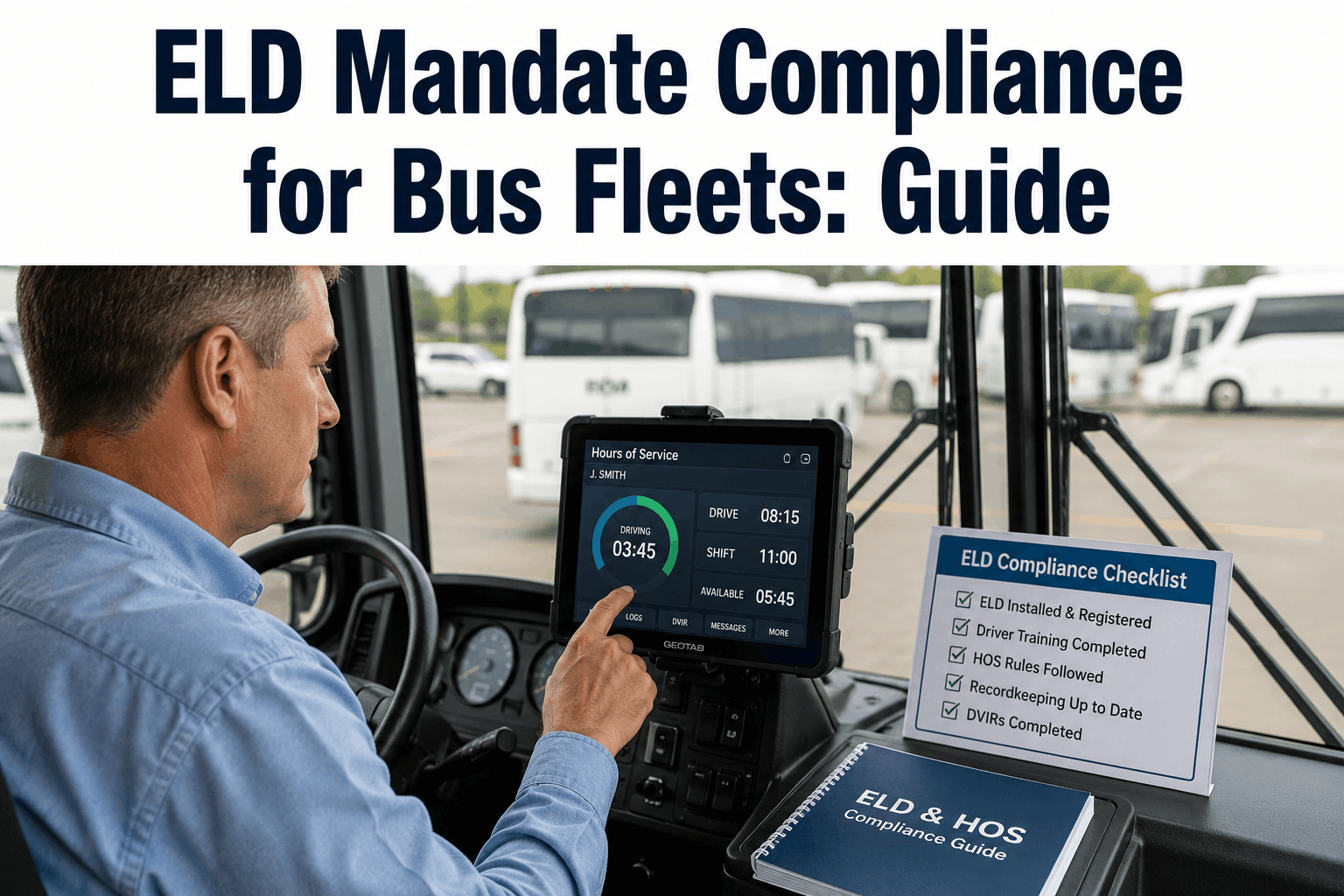
ELD Mandate Compliance for Bus Fleets: Guide
ELDs aren't just for trucks. Passenger carriers face the same HOS rules — and increasingly rigorous enforcement. Stay compliant in 2026.
Paper log discrepancy detectionCaught in 90%+ of audits
ELD-equipped fleets audit pass rate74% higher vs paper
HOS violations in DOT audits#1 cited infraction
ELD compliance isn't optional for most passenger carriers. The fine risk dwarfs the cost of proper systems.
01Does the ELD Mandate Apply to Your Bus Fleet?
The ELD mandate applies to commercial motor vehicle (CMV) drivers required to maintain records of duty status (RODS) under FMCSA regulations. For bus fleets, this means: any vehicle transporting passengers for compensation in interstate commerce, with a gross vehicle weight rating over 10,001 lbs, where the driver operates across state lines. Most charter operators, tour bus companies, motorcoach carriers, and school bus contractors doing interstate runs are covered. Key exemptions: school bus drivers operating solely within a single state may be exempt from federal ELD rules (state rules vary); drivers using the short-haul exemption (100 air-mile radius, same work location, back within 12 hours) are exempt from RODS and therefore ELD requirements. If you're unsure whether your operation is covered, the FMCSA determination isn't optional — non-compliance fines apply regardless of whether you knew the rule applied.
ELD Required — Covered Operations
Interstate charterAny bus crossing state lines for hire — full ELD mandate applies
Tour / motorcoachInterstate routes over 10,001 lbs GVWR — covered without exception
School contractorsInterstate school trips on contract — federal ELD rules apply
02HOS Rules for Passenger Carriers: What Drivers Must Track
Passenger carrier hours-of-service rules differ from property-carrying (trucking) rules. Drivers of passenger-carrying vehicles are governed by 49 CFR Part 395, with specific limits that ELDs must enforce and log. The 10-hour driving limit: drivers may not drive after 10 hours of driving time following 8 consecutive hours off duty. The 15-hour on-duty limit: no driving after being on duty 15 hours following 8 consecutive hours off (regardless of how much of that was actual driving). The 60/70-hour rule: no driving after accumulating 60 hours on duty in 7 consecutive days, or 70 hours in 8 consecutive days. Rest requirements: 8 consecutive hours off duty before returning to driving. These limits are non-negotiable. ELDs enforce them automatically — logging violations in real time and locking out driving beyond limits.
Passenger Carrier HOS Limits — At a Glance
Drive limit
10 hours driving after 8 consecutive hours off duty
On-duty limit
15 hours on duty after 8 consecutive hours off (includes non-driving)
Weekly 7-day
60 hours on duty in any 7 consecutive days
Weekly 8-day
70 hours on duty in any 8 consecutive days
Required rest
8 consecutive hours off duty — must be uninterrupted
Violation risk
Any limit exceeded = immediate out-of-service + $1,000–$16,000 fine
Note: Passenger carrier HOS rules differ from property-carrying (trucking). Using a trucking ELD profile for bus operations creates automatic violations.
03ELD Technical Requirements: What the Device Must Do
Not every GPS or logging device qualifies as an ELD under FMCSA rules. A compliant ELD must meet specific technical standards under 49 CFR Part 395, Subpart B. The device must: synchronize with engine control module (ECM) data — not GPS alone; record date, time, location (within 1 mile), engine hours, vehicle miles, and driver identification; capture all four duty statuses (off duty, sleeper berth, driving, on-duty not driving); support data transfer to enforcement via telematics or local USB/Bluetooth; display a compliant graph grid log; and prevent tampering with auto-recorded engine data. The FMCSA maintains a registered ELD list — devices must appear on it to be compliant. Self-certified doesn't mean technically sound. Roughly 20–25% of devices on the registered list have known technical defects flagged by enforcement agencies.
Non-Compliant "ELD" Red Flags
GPS-only tracking without ECM integration
Not on FMCSA registered ELD list
Cannot transfer data to enforcement officer
Allows manual override of engine-driven records
Using a non-compliant device = same fine as no ELD
Compliant ELD Requirements
ECM-synchronized (engine hours, miles, ignition)
Listed on FMCSA registered ELD database
Supports telematics + local (USB/Bluetooth) transfer
Passenger carrier HOS profile (not trucking rules)
Verify device on FMCSA list before purchase
"We had a vendor sell us 12 'ELD-compliant' tablets that weren't on the FMCSA registered list. Found out during a DOT compliance review — not a roadside stop, thankfully. Switching to a properly registered system cost us $8,400. The fine for operating with non-compliant devices would have been over $60,000 across our fleet."
— Operations Manager, 34-bus charter company, Tennessee
FMCSA inspection data shows consistent patterns in bus fleet ELD violations. Understanding what triggers citations — and building processes to prevent them — is the difference between a clean safety rating and a conditional or unsatisfactory rating that triggers full compliance audits. The most common violations: unassigned driving time (ELD records engine movement with no driver logged in — common when yard staff move buses without logging); form and manner errors (logs missing required fields, location data gaps, or missing required annotation); HOS limit violations (drivers exceeding 10-hour driving or 15-hour on-duty limits); and failure to transfer records (driver cannot transmit log data to enforcement officer at roadside). Each of these has a procedural fix. None requires a hardware change — they require driver training and dispatcher oversight.
Unassigned driving time is the #1 ELD violation for bus fleets. Every bus movement — including yard moves — must be logged to a driver or annotated as unassigned within 24 hours.
Top ELD Violations — Bus Fleets
Unassigned drivingYard moves, lot repositioning without driver login = automatic violation
05Building an ELD Compliance Program: What Top Fleets Do
ELD compliance isn't just installing a device. The fleets that maintain clean safety ratings treat it as a continuous operational program with defined roles, daily processes, and regular audits.
ELD Compliance Program — Daily to Annual
Pre-trip
Driver logs in before first engine movement. Confirms HOS availability on ELD.
Daily dispatch
Dispatcher checks hours available before assigning trips. No exceptions.
24-hour review
All logs reviewed and certified within 24 hours. Annotation errors corrected.
Weekly audit
Fleet manager reviews violation reports. Coaches drivers before patterns form.
Monthly summary
Track violations per driver, per route. Identify systemic scheduling issues.
Annual training
Full HOS rules refresher + ELD operation drill for all drivers.
Before audits
6-month log review. Any unassigned time annotated. All edits documented.
Fleet Expert Review
ELD compliance for bus fleets is tighter in 2026 than it was in 2022. FMCSA has expanded passenger carrier inspection resources, and SMS safety scores now weight HOS violations more heavily than before. The fleets with clean records aren't just running compliant devices — they have daily dispatcher review, driver training, and a platform that surfaces violations before a roadside inspection does. BusCMMS integrates ELD data with driver scheduling, maintenance, and dispatch to give fleet managers complete visibility in one system.
The Bottom Line
The ELD mandate applies to most interstate passenger carrier operations — and enforcement is intensifying. A compliant device on the FMCSA registered list is the baseline, not the finish line. HOS violations, unassigned driving time, and form errors are the three most common citation triggers — and all three are preventable with dispatcher oversight and daily log review. Bus fleets that build disciplined ELD compliance programs avoid fines, pass audits, and maintain the safety ratings that protect their operating authority. BusCMMS integrates ELD data, driver scheduling, and HOS alerts in one platform so dispatchers see problems before enforcement does.
BusCMMS surfaces HOS violations before they become citations. Daily log review alerts, unassigned time flags, and driver hours dashboards — all in one platform. Free 14-day trial.
School bus drivers operating solely within a single state are generally subject to state rules, not the federal ELD mandate. However, school bus contractors doing interstate trips are covered by the federal mandate. State rules vary significantly — verify your specific operation with your state DOT and FMCSA guidance.
What are the HOS limits for passenger-carrying bus drivers?
Passenger carriers follow 49 CFR Part 395: 10 hours driving after 8 consecutive hours off; 15 hours on duty after 8 consecutive off; 60 hours on duty in 7 days or 70 hours in 8 days; 8 consecutive hours off before returning to service. These differ from trucking (property carrier) rules — using the wrong HOS profile creates automatic violations.
How do I know if an ELD is FMCSA-compliant?
Check the FMCSA's registered ELD list at eld.fmcsa.dot.gov. The device must appear on the registered list, integrate with the vehicle's ECM (not GPS only), support four duty status categories, and allow data transfer to enforcement officers via telematics or local connection (USB/Bluetooth).
What is the fine for ELD non-compliance?
FMCSA civil penalties for HOS and ELD violations range from $1,000 to $16,000 per violation. Egregious violations (knowingly operating fatigued) can reach $16,000 per offense. Multiple violations across a fleet during a compliance audit can result in conditional or unsatisfactory safety ratings — which can trigger mandatory operational reviews.
What is the short-haul exemption for bus fleets?
Drivers operating within a 100 air-mile radius of their normal work reporting location, returning to that location each day, and not driving more than 10 hours are exempt from keeping RODS — and therefore from ELD requirements. The exemption has strict conditions; if a driver exceeds the radius even once, they must have kept a paper log for that day.
Can BusCMMS track driver hours and ELD compliance?
BusCMMS integrates with ELD data to track driver hours, flag approaching HOS limits, surface unassigned driving events, and give dispatchers real-time visibility into available hours before trip assignment. Book a demo to see how it works for passenger carrier operations.
ELD + Maintenance + Dispatch. One Platform.
Driver hours, vehicle maintenance, and trip scheduling in one system. No spreadsheets. No missed violations. No surprise audits. Free 14-day trial.