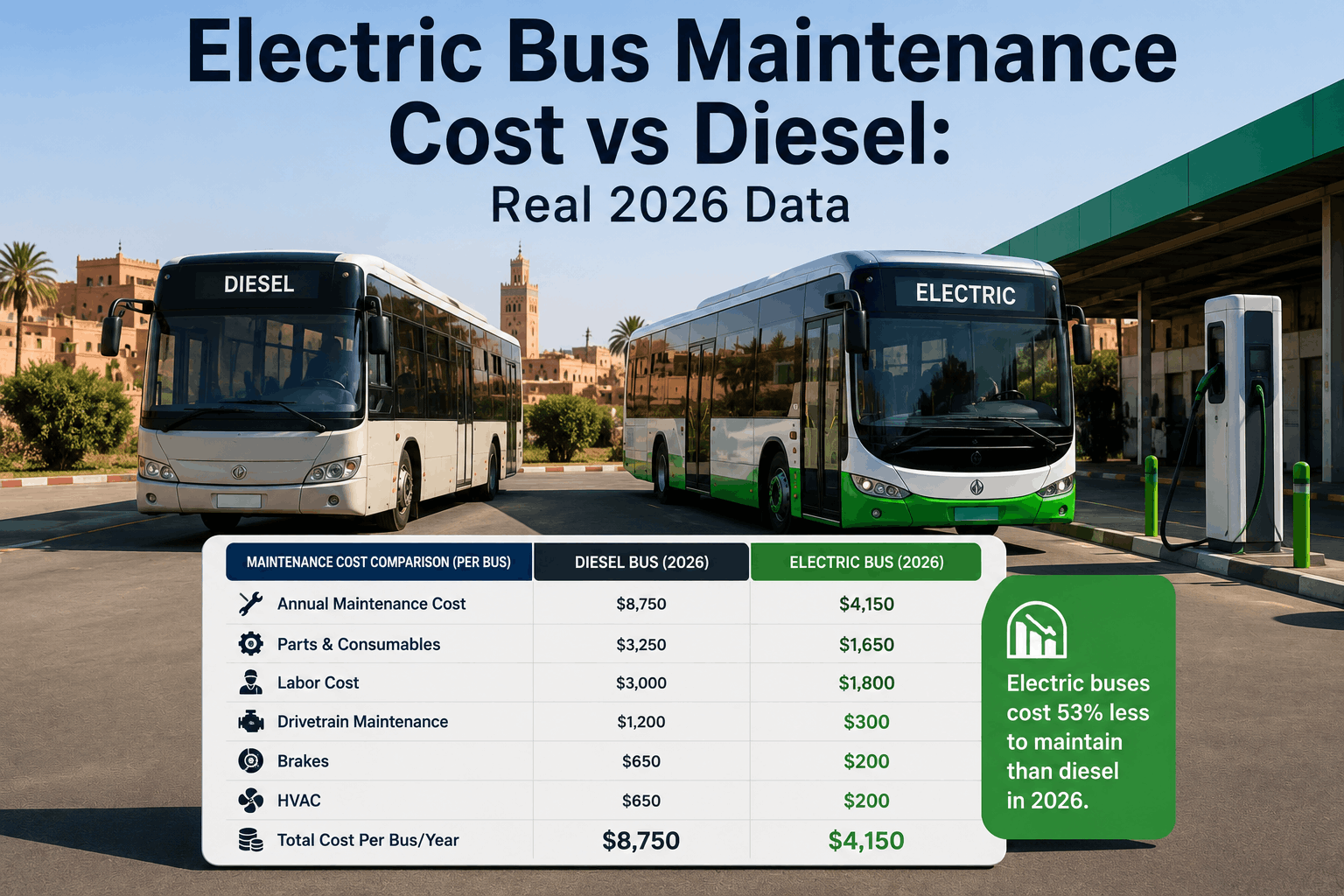
Electric buses are cheaper to maintain than diesel. This is the standard narrative in transit operator circles. But the data is more nuanced. Over the vehicle's lifetime, electric buses do cost less to maintain — no oil changes, no transmission fluid, no spark plugs. But early-generation EV buses (2016–2020) had catastrophic battery failures costing $100,000–$300,000 per replacement, wiping out years of savings. Modern electric buses (2023+) have proven battery durability, shifting the economics dramatically. A transit authority in California running 50 electric buses reports $0.52 per mile in maintenance costs. A comparable diesel fleet in the same region reports $0.68 per mile. That's 24% lower. But the transition period — when some buses fail unexpectedly — requires different expectations. Here's what real 2026 data shows.
Electric Bus Maintenance Cost vs Diesel: Real 2026 Data
Do electric buses really cost less to maintain? See real 2026 maintenance cost data comparing electric and diesel buses, with the surprises.
Electric buses have fundamentally simpler drivetrains than diesel buses. No engine oil. No transmission fluid. No spark plugs, timing belts, or fuel filters. No radiator coolant. No exhaust aftertreatment systems. These components are the largest maintenance cost drivers on diesel buses. Removing them is the primary reason EV maintenance costs are lower. A diesel bus requires oil changes every 10,000–15,000 miles. An electric bus requires zero. At $120 per oil change across 12 changes per year, that's $1,440 annually. A 100-bus diesel fleet: $144,000 per year on oil changes alone. An electric fleet: $0. The gap compounds. Diesel engines have timing belts that fail around 100,000 miles ($2,000–$3,000 to replace). Electric motors have no timing belts. Diesel transmissions fail, requiring $4,000–$8,000 repairs. Electric buses have single-speed transmissions with no failure modes. Diesel engines overheat in summer, requiring radiator maintenance and coolant flushing. Electric buses have thermal management for batteries, which is simpler. The cumulative difference is enormous. Over the lifetime of a bus (500,000–600,000 miles), a diesel bus spends $80,000–$120,000 on routine drivetrain maintenance. An electric bus spends $15,000–$25,000. That $55,000–$105,000 gap is real, measurable, and consistent across fleets. It's not hype. It's physics.
Compare EV and diesel maintenance costs for your fleet — book a demo
Three case studies from 2026 transit operations show the real economic picture. Case 1: California municipal system, 50 electric buses (all 2023+ models), 45,000 miles/year average. Maintenance costs: $0.52/mile. Oil changes, transmission work, engine overhauls: none. Brake pad replacement due to regenerative braking: 60% less frequently than comparable diesel fleet. Tire wear similar to diesel (same weight, same routes). Annual maintenance cost per bus: $23,400. Comparable diesel fleet in the same region: $30,600 per bus. Savings: $7,200/bus × 50 = $360,000/year. Case 2: Texas transit authority, mixed fleet (15 electric, 35 diesel), tracking parallel routes. Same routes, same driver pool, same load profiles. Diesel buses: $0.68/mile maintenance. Electric buses: $0.54/mile maintenance. 5-year dataset. No significant battery failures on 2022–2024 model electric buses. Expected remaining life: both fleets estimated at 12–15 years. Maintenance cost advantage: $0.14/mile, which translates to ~$6,300/bus/year. Case 3: Northeast regional system, 25 electric buses (2021 model), higher mileage (55,000 miles/year). Maintenance costs: $0.59/mile (slightly higher due to higher utilization). One battery failure in 2025 on a 2021 model (out of 25 buses): $120,000 replacement. Absorbed into fleet budget. System expected to avoid this cost on future purchases (2023+ models). The pattern: modern electric buses cost 20–30% less to maintain than comparable diesel buses. The transition risk comes from older EV models (2016–2022), where battery failures are possible but not certain. 2023+ models have not shown battery failure patterns in normal operation.
Track electric and diesel maintenance costs side-by-side — sign up free
Lower maintenance costs come with operational changes. Diesel fleets optimize around engine overhauls, transmission servicing, and fuel system maintenance. Electric fleets optimize around battery health, charger uptime, and thermal management. The skills are different. A diesel technician has 30 years of experience with engines. An EV technician needs training on battery systems, inverters, and high-voltage electrical. This creates a transition cost for fleets moving to EV. Training programs for technicians: $2,000–$5,000 per technician. For a 100-bus fleet transitioning over 5 years, that's 20 technicians retrained: $40,000–$100,000. Charger infrastructure: unlike diesel fuel stations (minimal maintenance), EV depot chargers require 5–10 hours of maintenance per year. Annual charger maintenance cost: $5,000–$15,000 depending on infrastructure scale. These are real costs that offset some of the per-bus maintenance savings. However, once the transition is complete, EV fleets enjoy structural cost advantages. The question isn't "are EVs cheaper immediately?" It's "what's the total cost of ownership over 12 years?" For modern EV buses (2023+), the answer is: significantly cheaper, even accounting for training and infrastructure.
Modern electric buses (2023+) have lower maintenance costs than diesel buses — 20–30% lower depending on utilization. The advantage is structural: no oil changes, no transmission overhauls, no engine rebuilds. Brakes last longer due to regenerative braking. Electrical systems are more reliable than diesel fuel injection. The real-world data supports the narrative. A 100-bus EV fleet saves $500k–$1M annually compared to an equivalent diesel fleet. Early-generation EV buses (2016–2020) carried battery replacement risk, which created uncertainty. 2023+ buses have proven reliability. Fleets transitioning to EV should expect: lower per-mile maintenance costs, required technician retraining, charger infrastructure investment, and total cost of ownership advantage within 5–7 years. The transition is happening. The data supports it.
Electric buses cost 20–30% less to maintain than diesel buses — if they're modern (2023+) and if you account for the full operating period. Early EV buses (2016–2020) had battery uncertainty that created risk. 2026 data shows modern EVs have proven battery longevity. The maintenance cost advantage is real: no oil changes, no transmission overhauls, regenerative braking reduces brake wear, and electric motors are more reliable than diesel engines. Transition costs (technician training, charger infrastructure) are real but are recouped within 3–4 years. For fleets with 10+ year replacement cycles, EV is now the lower-cost choice. BusCMMS tracks maintenance costs across both EV and diesel fleets, making side-by-side comparison possible and helping you project total cost of ownership accurately.
Compare EV and diesel maintenance costs with real data — book a demo