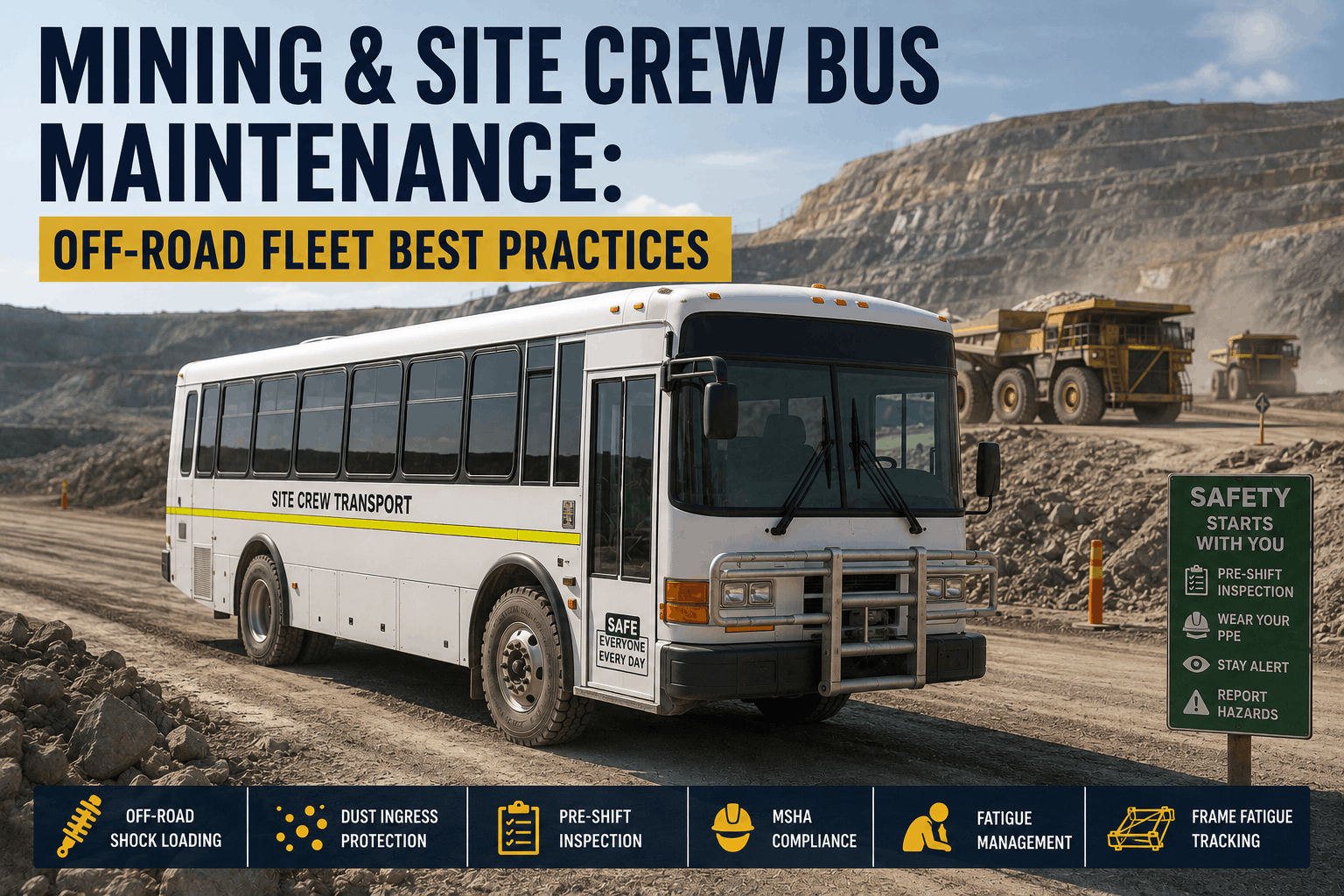
A bus breaks down on Route 47 during morning rush hour. The transmission that showed no warning signs yesterday has failed completely. Passengers wait in the cold for a replacement vehicle. The operations center scrambles to cover the gap. A technician is dispatched for a roadside repair that will take three hours. This scenario—repeated thousands of times daily across transit agencies and school districtsrepresents the world of reactive maintenance that has defined bus fleet operations for decades.
But this world is changing. The convergence of sensor technology, cloud computing, artificial intelligence, and mobile connectivity is fundamentally transforming how fleets approach maintenance. The question is no longer whether buses will break down, but whether we'll know about failures before they happen—and whether our systems will automatically orchestrate the response.
This is the story of maintenance evolution: from handwritten logs and emergency repairs to intelligent systems that predict failures, optimize schedules, and continuously improve from every repair performed. Understanding this evolution isn't just historical curiosity—it's essential context for leaders making technology investments that will define their fleet's capabilities for the next decade.
The Eras of Maintenance: A Historical Perspective
Maintenance has evolved through distinct eras, each defined by the technologies available and the philosophies they enabled. Understanding where we've been illuminates where we're going—and reveals why organizations at different stages of this evolution achieve dramatically different results.
The Reactive Era: Fix It When It Breaks
In the early decades of motorized bus fleets, maintenance was fundamentally reactive. Equipment ran until it failed. Repairs happened after breakdowns. Documentation consisted of handwritten logs in shop notebooks—if documentation existed at all.
Defining Characteristics
- Repairs triggered only by failures or driver complaints
- Paper-based records stored in filing cabinets or desk drawers
- Maintenance knowledge held in technicians' memories
- Parts ordered after failures occurred, often requiring rush procurement
- No systematic approach to preventing failures
Inherent Limitations
Reactive maintenance is inherently expensive. Emergency repairs cost 3-5x more than planned maintenance. Breakdowns occur at the worst possible times—during service, far from the shop, when parts aren't available. Vehicle lifespans shorten as small problems cascade into major failures. And service reliability suffers as breakdowns disrupt schedules unpredictably.
The Preventive Era: Schedule-Based Maintenance
As post-war production demands increased and downtime costs became more visible, manufacturers and fleet operators developed preventive maintenance programs. The philosophy shifted: don't wait for failures—replace components on a schedule before they're likely to fail.
Defining Characteristics
- Maintenance scheduled by time or mileage intervals
- Standard PM checklists ensuring consistent inspections
- Early computerized systems using punch cards and mainframe computers
- Component replacement based on manufacturer recommendations
- Focus on preventing the most common failure modes
Inherent Limitations
Preventive maintenance represented a major advance, but it introduced new inefficiencies. Time-based schedules don't account for actual vehicle condition. Components are replaced before they're worn, wasting remaining useful life. Vehicles in demanding applications receive the same maintenance as those in light service. The schedule drives maintenance, not the vehicle's actual needs.
The Digital Era: Computerized Management
Personal computers, local area networks, and eventually the internet transformed maintenance management. Paper records gave way to databases. Spreadsheets evolved into purpose-built CMMS platforms. For the first time, maintenance data could be analyzed at scale.
Defining Characteristics
- Centralized databases replacing paper files
- Automated scheduling and reminder systems
- Work order tracking from creation through completion
- Parts inventory management integrated with maintenance
- Reporting and analytics enabling performance measurement
- Cloud-based platforms enabling mobile access and multi-location visibility
Inherent Limitations
Digital CMMS platforms dramatically improved efficiency and visibility, but they remained fundamentally passive systems. They tracked what humans told them to track. They reminded when humans set reminders. They couldn't detect problems independently or learn from patterns across thousands of repairs. The data existed, but extracting actionable intelligence required human analysis.
The Predictive Era: Condition-Based Intelligence
The convergence of IoT sensors, telematics, cloud computing, and AI analytics created something new: maintenance systems that can predict failures before they occur. Rather than maintaining on schedules or reacting to breakdowns, operators can now maintain based on actual equipment condition.
Defining Characteristics
- Real-time sensor data from engine, transmission, braking, and HVAC systems
- Machine learning algorithms identifying failure patterns in historical data
- Alerts generated when sensor readings indicate developing problems
- Maintenance scheduled based on predicted component life, not calendar intervals
- Continuous learning from every repair, improving predictions over time
Documented Impact
Fleets implementing predictive maintenance report 25-50% reductions in unplanned downtime, 30-40% reductions in maintenance costs, and significant extensions in vehicle useful life. McKinsey research indicates predictive maintenance can reduce maintenance costs by up to 40% and cut downtime by up to 50%.
The Intelligent Era: Autonomous Operations
The next frontier goes beyond prediction to autonomous action. AI agents that don't just alert managers but take actions—scheduling repairs, ordering parts, adjusting routes to accommodate maintenance, and continuously optimizing the entire operation without human intervention for routine decisions.
Emerging Characteristics
- AI agents that predict failures and automatically schedule repairs
- Parts procurement triggered automatically based on predicted needs
- Digital twins simulating vehicle condition and testing maintenance scenarios
- Prescriptive analytics recommending specific interventions
- Closed-loop systems that measure outcomes and adjust strategies automatically
Early Indicators
Industry projections suggest 65% of maintenance teams plan to use AI by end of 2026. Fortune 500 companies could save $233 billion annually with full adoption of condition monitoring and predictive maintenance. Yet only 27% of fleets currently use predictive maintenance. The gap between early adopters and the rest of the industry is widening.
The Technology Drivers: What Made This Evolution Possible
Each maintenance era was enabled by underlying technology advances. Understanding these enablers helps leaders evaluate which technologies are mature enough for deployment and which remain experimental.
Telematics and IoT Sensors
Modern vehicles contain dozens of sensors monitoring everything from engine temperature to brake pad wear to battery voltage. These sensors, connected through the vehicle's CAN bus and transmitted via cellular networks, provide continuous visibility into vehicle health that was impossible just a decade ago.
Market context: The global telematics market is expected to reach $9.0 billion by 2025, growing at 10.1% CAGR. IoT-enabled fleet management is projected to exceed $26 billion by 2028.
Cloud Computing
Cloud platforms eliminated the need for local server infrastructure, made multi-location visibility standard, and enabled the processing power required for AI and machine learning. Small fleets now access the same analytical capabilities that once required enterprise IT investments.
Impact: Cloud-based platforms offer centralized data storage, advanced analytics, AI integration, real-time dashboards, and predictive modeling—all without on-premise infrastructure.
Artificial Intelligence and Machine Learning
AI transforms raw sensor data into actionable predictions. Machine learning algorithms identify patterns across thousands of vehicles and millions of repairs that human analysts could never detect. These models improve continuously as more data flows through them.
Capability: Leading platforms achieve 90%+ accuracy on component failure prediction. Some specific models reach 98-99% accuracy. Prediction windows of 15-30 days before failure enable proactive intervention.
Mobile Connectivity
Smartphones and tablets transformed maintenance workflows. Technicians access vehicle history, repair procedures, and parts information at the vehicle rather than returning to a desktop. Work orders flow digitally from creation through completion without paper handoffs.
Impact: Mobile access enables 24/7 decision-making from anywhere. Technicians complete inspections at the vehicle with real-time data capture and immediate defect notification.
Digital Twins
Digital twin technology creates virtual models of physical vehicles, updated in real-time with sensor data. These models enable simulation of maintenance scenarios, prediction of remaining useful life, and optimization of maintenance strategies before implementing them in the real world.
Projection: By 2027, over 75% of large enterprises will use digital twins to improve operations and asset management (Gartner). Digital twins are reshaping fleet management by simulating vehicle performance and optimizing logistics.
Integration and APIs
Modern platforms connect with telematics systems, parts suppliers, financial systems, and scheduling tools through standardized APIs. This integration creates unified views of fleet operations and enables automated workflows that span multiple systems.
Impact: Seamless integration enables real-time data flow between vehicles, maintenance platforms, inventory systems, and financial reporting—eliminating manual data transfer and reconciliation.
Assessing Your Position: The Maintenance Maturity Model
Organizations don't transition from reactive to intelligent maintenance overnight. The journey proceeds through identifiable stages. Understanding your current position helps prioritize investments and set realistic expectations for capability development.
Reactive
Maintenance happens when vehicles break down. Records are paper-based or nonexistent. Parts are ordered after failures occur. No systematic PM program exists.
Indicators
- Majority of repairs are unplanned
- Maintenance history is difficult to retrieve
- Road calls and service disruptions are frequent
- Costs are unpredictable and often exceed budget
Scheduled
PM programs exist and are generally followed. CMMS tracks work orders and schedules. But maintenance is calendar-driven rather than condition-driven, and analytics are limited.
Indicators
- PM compliance is tracked but often below 90%
- Work orders are documented digitally
- Some reactive repairs still occur
- Reporting exists but requires manual compilation
Optimized
CMMS is fully implemented with high compliance. Analytics inform decisions. PM intervals are adjusted based on data. Integration connects maintenance with other systems.
Indicators
- PM compliance consistently exceeds 95%
- Cost per mile and availability are tracked and improving
- Telematics data is captured but not fully leveraged
- Dashboards provide real-time visibility
Predictive
Sensor data and analytics predict failures before they occur. Maintenance is scheduled based on condition rather than calendar. Continuous improvement is embedded in operations.
Indicators
- Unplanned repairs reduced by 50% or more
- Telematics and AI drive maintenance decisions
- Parts are pre-positioned based on predicted needs
- Fleet availability consistently exceeds 95%
Intelligent
AI agents autonomously manage routine decisions. Systems learn and improve continuously. Human oversight focuses on exceptions and strategic decisions. The maintenance operation largely runs itself.
Indicators
- AI handles scheduling, parts ordering, and routine decisions
- Digital twins enable scenario testing before implementation
- Closed-loop systems measure outcomes and adjust automatically
- Maintenance costs decrease while availability increases year over year
Most bus fleets today operate at Level 2 or 3. The jump to Level 4 requires technology investment, process change, and organizational commitment. Level 5 remains aspirational for most operations but is achievable with current technology. The leaders who reach Level 4-5 first gain competitive advantages that compound over time.
The Human Side: Challenges in Maintenance Transformation
Technology enables transformation, but people execute it. The most sophisticated predictive maintenance platform delivers no value if technicians don't use it, if data quality is poor, or if the organization resists change.
Technician Adoption
Experienced technicians may view new systems with skepticism, especially if past technology implementations failed to deliver promised benefits. They've built careers on expertise that feels threatened by AI recommendations.
Successful Approaches
Frame technology as augmenting expertise rather than replacing it. Involve technicians in system selection and implementation. Demonstrate how AI handles data analysis so technicians can focus on diagnosis and repair—the work they find most satisfying. Celebrate early wins visibly.
Data Quality
AI predictions are only as good as the data feeding them. Incomplete work orders, inconsistent coding, missing sensor integrations—all compromise analytical value. Organizations with years of poor data practices can't immediately generate accurate predictions.
Successful Approaches
Establish data quality standards before expecting AI benefits. Invest in cleaning historical data where feasible. Accept that prediction accuracy will improve over time as data quality improves. Start with systems that enforce complete data capture going forward.
Process Change
New technology requires new workflows. If predictive alerts arrive but no process exists to act on them, the technology fails. If parts ordering isn't integrated with predictions, pre-positioning inventory is impossible.
Successful Approaches
Map current processes before implementing new technology. Design new workflows that incorporate predictive capabilities. Pilot changes with willing teams before organization-wide rollout. Adjust processes based on real experience rather than theoretical designs.
Legacy System Integration
Few organizations can replace all systems simultaneously. New platforms must coexist with existing telematics, financial systems, and operational tools. Integration complexity can delay or derail implementations.
Successful Approaches
Prioritize platforms with robust APIs and proven integrations. Accept that some manual processes may persist during transition. Plan phased implementations that deliver value at each stage rather than requiring complete integration before any benefit.
The Future: What's Coming Next
Technology evolution continues to accelerate. Understanding emerging capabilities helps leaders make investments that remain relevant as the industry advances.
AI Agents and Autonomous Decision-Making
Current AI systems recommend; future AI agents will act. Rather than alerting a manager that a brake repair should be scheduled, AI agents will schedule the repair, order the parts, coordinate with the driver, and notify the technician—all automatically. Human oversight shifts from approving individual decisions to monitoring outcomes and adjusting parameters.
Industry observers suggest AI agents will shift from "nice to have" to "must have" operational infrastructure by 2026-2027, with early adopters already demonstrating significant advantages.
Vehicle-to-Everything (V2X) Integration
As vehicles become more connected, maintenance systems will integrate with traffic management, charging infrastructure (for EVs), and even other vehicles. A bus reporting transmission trouble could automatically trigger route adjustments across the fleet before the driver even notices a problem.
Prescriptive Maintenance
Beyond predicting what will fail, prescriptive systems will recommend specific interventions and predict their outcomes. "This component will fail in 14 days. Replacing it will cost $800 and take 2 hours. Alternatively, adjusting operating parameters will extend life by 30 days at no cost but with 15% reduced efficiency."
Fleet Electrification Complexity
Electric buses introduce new maintenance requirements: battery health monitoring, high-voltage system safety, charging infrastructure maintenance. Mixed fleets combining diesel, CNG, hybrid, and electric vehicles multiply complexity. Intelligent systems that manage this heterogeneity become essential rather than optional.
Technician Augmentation
AI copilots will guide diagnostics, suggest troubleshooting steps, estimate repair times, and surface tribal knowledge captured from thousands of previous repairs. Junior technicians will perform at senior levels faster. The technician shortage—already acute—will be partially addressed by making each technician more productive.
Leadership Implications: What This Means for Decision-Makers
The evolution from reactive to intelligent maintenance isn't just a technology story—it's a strategic imperative that affects competitive positioning, cost structure, and organizational capability.
Investment Prioritization
Technology investments in maintenance yield measurable returns: reduced downtime, lower costs, extended vehicle life. But sequencing matters. Building on CMMS foundations before investing in AI makes sense; jumping to predictive analytics without data quality foundations wastes investment.
Action: Assess current maturity level honestly. Invest in capabilities that move you to the next level rather than skipping stages.
Talent Strategy
The skills needed for intelligent maintenance differ from traditional mechanic competencies. Data interpretation, system integration, and continuous improvement mindsets become as important as wrench-turning skills. Workforce development must evolve alongside technology.
Action: Evaluate current workforce capabilities against future needs. Invest in training that bridges gaps. Consider hiring strategies that bring new skills into the organization.
Vendor Relationships
The platform you choose for maintenance management will shape your capabilities for years. Vendors that invest in AI, integration, and continuous improvement deliver compounding value. Those that don't become constraints on your evolution.
Action: Evaluate vendors not just on current features but on roadmaps, investment in R&D, and track record of innovation. The platform you choose should grow with your needs.
Competitive Positioning
Organizations that master intelligent maintenance gain advantages that compound over time: lower costs, higher reliability, better service quality. These advantages are difficult for competitors to replicate quickly, creating sustainable differentiation.
Action: View maintenance technology as strategic investment rather than operational expense. The organizations that move fastest gain advantages that persist.
Frequently Asked Questions
How does Bus CMMS support the transition from reactive to intelligent maintenance operations?
Bus CMMS provides a platform designed to meet organizations wherever they are on the maintenance maturity journey while enabling progression toward more advanced capabilities. For organizations moving from reactive to scheduled maintenance, the platform provides PM scheduling, automated reminders, work order management, and compliance tracking that establishes the foundational discipline required for further advancement. For organizations ready to optimize, Bus CMMS delivers integrated analytics, cost tracking, and performance dashboards that enable data-driven decision making. Telematics integration captures vehicle sensor data that feeds condition-based maintenance approaches. Mobile accessibility enables technicians to capture data at point of work, improving data quality that AI systems require. The platform's architecture supports integration with other systems through APIs, enabling the connected ecosystems that intelligent maintenance requires. As predictive and AI capabilities continue developing industry-wide, Bus CMMS evolves to incorporate these advances while maintaining the core functionality that organizations depend on daily.
What ROI can organizations expect from modernizing maintenance operations?
Return on investment from maintenance modernization varies based on starting point, but documented results across the industry demonstrate significant potential. Organizations moving from reactive to scheduled PM programs typically see 25-35% reductions in total maintenance costs as emergency repairs decrease and vehicle life extends. Those implementing predictive maintenance report additional 25-50% reductions in unplanned downtime and 30-40% reductions in maintenance costs beyond schedule-based programs. McKinsey research indicates predictive maintenance can reduce maintenance costs by up to 40% and cut downtime by up to 50%. More tangibly, preventing one roadside breakdown per vehicle per year saves $2,000-$10,000 in direct costs plus avoided lost revenue and passenger impact. Modern platforms that reduce emergency parts procurement by 40-60% generate immediate savings in rush shipping and markup. Fleet availability improvements from low-90s percentage to mid-90s can mean the difference between service reliability and chronic disruption. Most organizations achieve full ROI within 12-18 months of implementation, with benefits compounding as data accumulates and processes mature.
The Transformation Imperative
The evolution from reactive to intelligent maintenance isn't optional—it's inevitable. The organizations that embrace this transformation proactively gain advantages in cost, reliability, and capability that late adopters struggle to match. The organizations that delay find themselves operating with higher costs, lower reliability, and systems that can't compete with more advanced peers.
The technology exists today to move beyond fixing buses after they break. Sensors report vehicle health in real-time. AI algorithms predict failures before they occur. Integrated platforms orchestrate maintenance operations from scheduling through parts procurement through execution. The question is no longer whether intelligent maintenance is possible—it's whether your organization will lead or follow in adopting it.
The bus that breaks down on Route 47 doesn't have to be a surprise. With the right systems, that transmission failure would have been predicted weeks ago, the repair scheduled during an off-peak window, the parts pre-positioned, and the vehicle returned to service before passengers ever noticed anything wrong. That's the promise of intelligent maintenance—and it's achievable today for organizations ready to make the transition.
Explore Intelligent Maintenance
Discover how modern platforms enable the transition from reactive repairs to predictive, intelligent operations.