Your district just received 8 electric school buses from the Clean School Bus Program. Day one: you plug them all in at 3 PM. By 6 PM, the depot's electrical panel trips — you've exceeded your 200-amp service trying to charge 8 buses simultaneously. Day two: you stagger charging but Bus #3 only reaches 72% by morning because it was last in the queue. Its route is 68 miles. Its winter range at 72% charge is 65 miles. The driver calls from mile 61 — battery at 4%, no charging station for 12 miles. Day three: you realize that managing electric buses isn't harder than diesel — it's completely different. Different PM schedules, different failure modes, different infrastructure, different planning. The diesel playbook doesn't work. You need an electric one. Here's the complete guide.
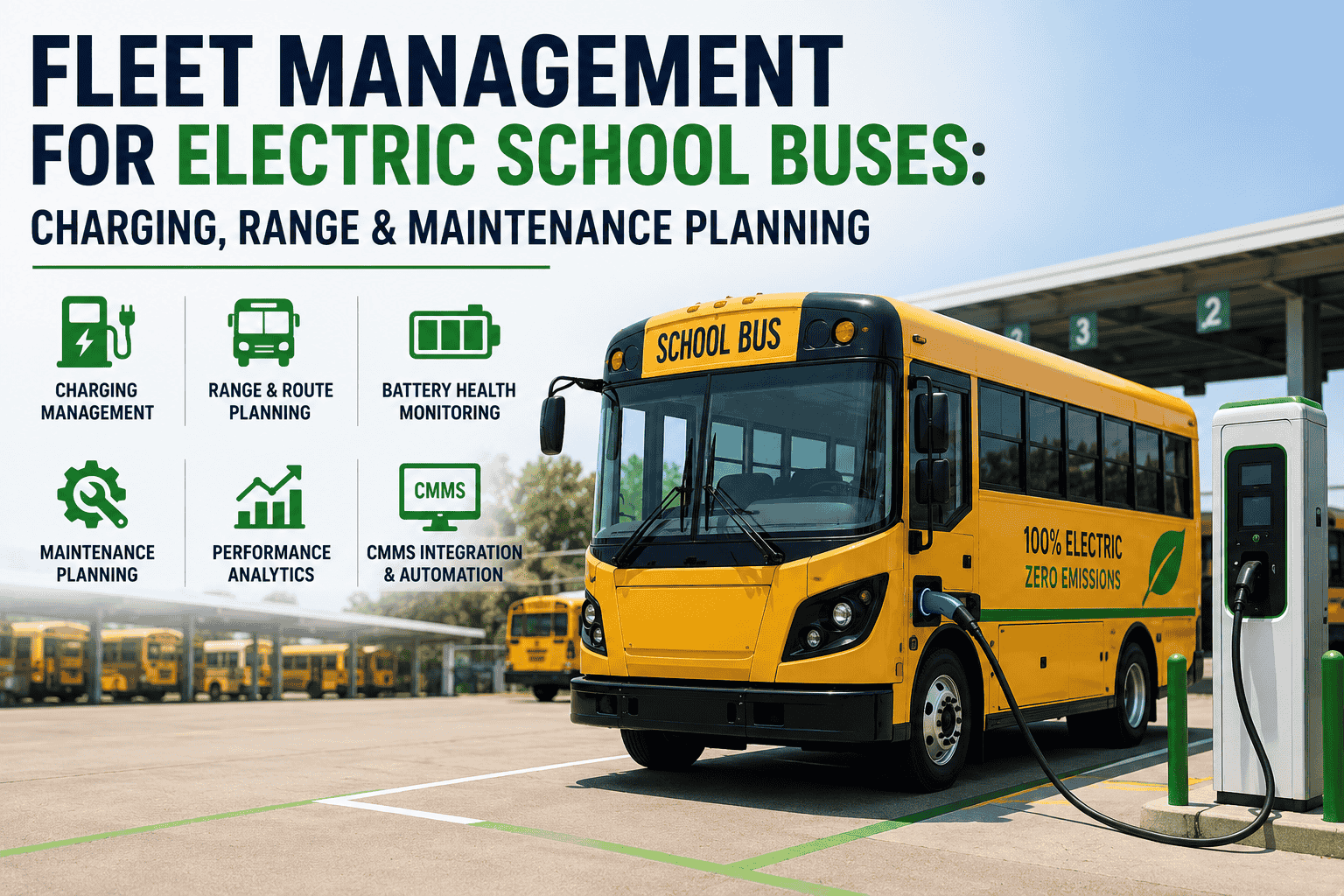
Fleet Management for Electric School Buses: Charging, Range & Maintenance Planning (2026)
Depot charging strategy. Range planning with weather margins. EV-specific PM schedules. Battery health tracking. The complete operational playbook for electric school bus fleets.
Electric vs Diesel School Bus — Quick Numbers
Lower cost. Shorter range. Different management. Same students to protect.
Depot Charging Strategy: The Foundation of EV Fleet Ops
Level 2 AC Charging (19.2 kW)
Standard for most school bus fleets. Plug in at 3 PM, full by 11 PM, ready for morning routes.
DC Fast Charging (60–90 kW)
For long routes or tight turnarounds. Higher install cost, but enables double-shift capability.
The #1 charging mistake: plugging all buses in simultaneously. A 10-bus fleet on Level 2 chargers draws 192 kW — that's a demand spike that triggers peak demand charges and may exceed your panel capacity. Smart charging staggers the start times so buses charge sequentially or in managed groups. BusCMMS tracks charger assignments per bus, logs charge completion times, and integrates with your depot schedule so every bus is fully charged before its morning route — without overloading your electrical infrastructure.
Range Planning: Why Your 138-Mile Bus Only Goes 95 in January
Real-World Range by Season (Type C Electric, 138-mi rated)
Cabin heating is the #1 range killer in winter — not battery chemistry. Pre-conditioning while plugged in saves 15–20% range.
The fix isn't avoiding winter routes — it's planning for them. Pre-condition the cabin while the bus is still plugged in (draws from grid, not battery). Match routes to range with a 20% safety margin. Monitor state-of-charge in real time. BusCMMS tracks per-bus SOC, flags any bus departing below your minimum threshold, and adjusts PM schedules based on actual usage patterns — so your 68-mile route never gets assigned to a bus with 65 miles of winter range.
EV Maintenance: What Changes from Diesel
Eliminated from PM
Oil changes (every 5K–7.5K mi)
Fuel filters, air filters (engine)
Transmission service
DPF / DOC / SCR / DEF system
Exhaust system inspection
Turbocharger / EGR service
Saves ~$4,400/bus/year (Thomas Built est.)
Added to PM
Battery SOH check (every 10K mi) — warranty critical
HV cable inspection
Thermal management coolant
Charger PM (Level 2 + DCFC)
Regen braking calibration
12V auxiliary battery check
Missing one battery SOH check can void $150K warranty
BusCMMS auto-loads EV-specific PM templates when you select "electric" as fuel type. Battery SOH checks at 10,000-mile intervals, HV cable inspections, charger PM schedules, and regen calibration — all auto-scheduled with multi-trigger PM (mileage + calendar + hours). Work orders for electric buses route only to HV-certified technicians. Diesel buses keep their existing PM-A/B/C. Both on one dashboard.
Battery Health: Tracking the $150,000 Asset
Battery Capacity Over Time (Properly Managed)
LFP batteries: 4,000+ cycle life. Properly managed = 12–15 years before replacement. Poorly managed = warranty void at year 3.
The difference between 12-year battery life and a voided warranty at year 3? Documented maintenance. Every manufacturer requires SOH checks at specific intervals — miss one and $150,000–$300,000 in warranty coverage disappears. BusCMMS generates SOH check alerts 30/60/90 days before each milestone, documents every completed check with timestamp and technician certification, and stores the data for warranty claims. When the vendor asks for documentation, you export it in 30 seconds.
"We got 12 electric buses from the EPA program and tried running them on our diesel procedures. Three months in, our battery vendor asked for SOH documentation — we had none. BusCMMS set up the EV template in one afternoon: SOH at 10K miles, HV cable inspection, charger PM, regen calibration, all auto-scheduled. Now when the vendor asks for warranty docs, we export in 30 seconds. We also caught 2 chargers with failing connectors through the PM schedule before they caused overnight charging failures. That's $300,000+ in protected battery warranty plus zero morning no-starts."
Over 5,000 electric school buses are hitting U.S. roads from the Clean School Bus Program. Every one has a battery warranty worth $150K–$300K that requires documented maintenance at specific intervals. Every mile without the correct PM schedule is a mile closer to an unprotected battery.
Don't risk your EV investment — book a demo today
Fleet Expert Review
Electric school buses aren't harder to manage — they're different. Charging replaces fueling. Range planning replaces unlimited diesel range. Battery SOH replaces oil analysis. And the cost of getting it wrong is $150,000 (voided battery warranty) instead of $1,700 (reactive repair). BusCMMS handles both worlds on one dashboard — diesel PM-A/B/C alongside EV battery checks, charger scheduling, and SOC monitoring. The districts succeeding with electric buses aren't the ones with the newest technology — they're the ones with the right management system.
The Bottom Line
Electric school buses save 63% on maintenance and 55–70% on fuel — but only with the right management. Smart depot charging prevents demand spikes. Range planning with winter margins prevents stranded buses. EV-specific PM prevents warranty voids. Battery health tracking protects $150K+ assets. BusCMMS manages all of it — charging, range, maintenance, and battery warranty — alongside your diesel fleet on one dashboard. The diesel playbook got you here. The EV playbook gets you forward.
Your Diesel Playbook Doesn't Work for Electric. Get the Right One.
BusCMMS manages EV + diesel on one dashboard. EV-specific PM templates. Charger scheduling. SOC tracking. Battery warranty documentation. HV-certified tech routing. Works from day one. Free 14-day trial.
Frequently Asked Questions
How far can an electric school bus go on one charge?
How long does it take to charge an electric school bus?
What maintenance does an electric school bus need?
How long do electric school bus batteries last?
Can BusCMMS manage electric and diesel buses together?
Diesel + Electric. One Dashboard. Every Bus Covered.
EV PM templates. Charger scheduling. SOC tracking. Battery warranty docs. Diesel PM-A/B/C. All fuel types. All on one platform. Free 14-day trial. Set up in one afternoon.